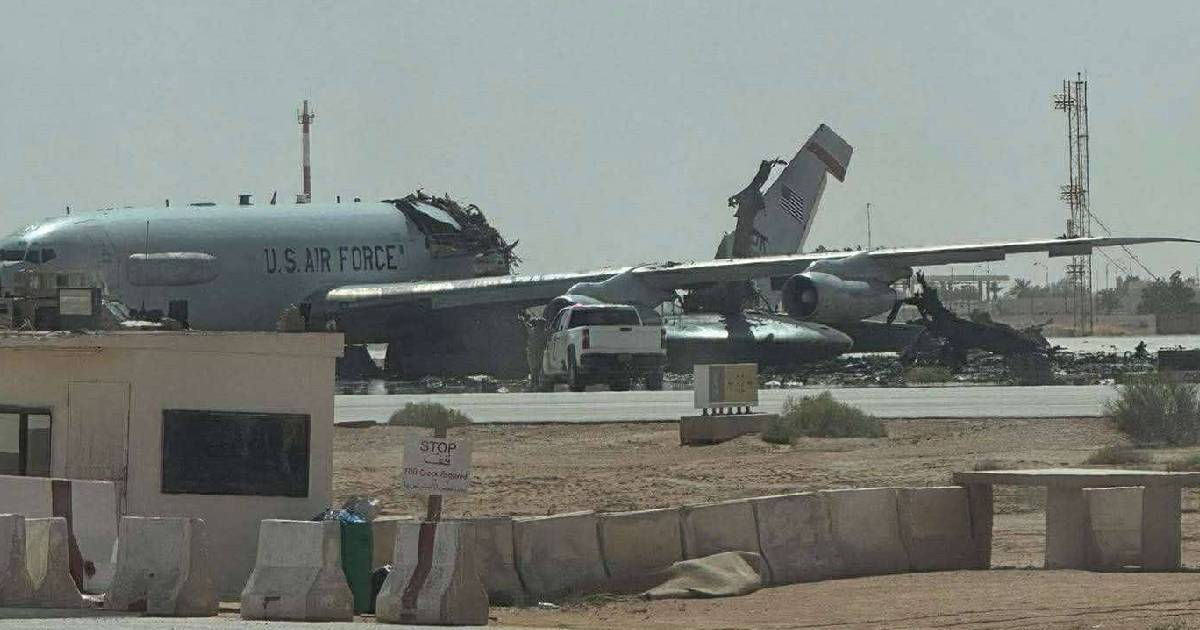
According to U.S. officials cited by international agencies, a missile and drone attack by Iran on Friday has left at least 12 American soldiers injured at the Prince Sultan Air Base in Saudi Arabia.
Reports indicate that the strike damaged U.S. refueling aircraft stationed at this key military site, one of the United States' primary deployment points in the region, as reported by news outlet Infobae.
Among the wounded, two soldiers are reported to be in critical condition.
This base had already faced attacks in recent weeks. On March 1, 26-year-old Army Sergeant Benjamin N. Pennington suffered injuries during an attack and succumbed to those injuries days later, becoming a fatal casualty in the ongoing conflict.
Mounting Tensions and Escalating Warfare
The U.S. Central Command has reported that more than 300 service members have been injured since the conflict began about a month ago. While most have returned to duty, at least 30 remain unable to serve, with 10 suffering severe injuries.
This latest attack is part of a broader military escalation, which has included strikes on strategic infrastructure within Iran. On the same day as the Saudi attack, the Bushehr nuclear power plant was targeted for the third time in under two weeks, in an operation attributed to Israel and the United States.
Rafael Grossi, Director of the International Atomic Energy Agency, expressed concern over military activities near Iranian nuclear sites, warning of the potential for a radiological disaster if the reactor is compromised.
Retaliation and Diplomatic Maneuvers
The conflict's scope continues to widen. In recent days, Iran has launched missiles and drones targeting Israel and other Middle Eastern nations, while attacks linked to the U.S. and Israel have impacted industrial and nuclear facilities within Iran.
Iran's Revolutionary Guard has issued new threats following strikes on two of the nation's steel plants. Majid Musavi, commander of the Aerospace Force, indicated that Iran's response would not be limited to a “tit-for-tat” strategy, hinting at potential retaliatory strikes on U.S. and Israeli infrastructure.
Meanwhile, Washington has proposed a 15-point ceasefire deal to Tehran, with Pakistan acting as a mediator. Iran, however, denies any formal negotiations and continues to exert control over the Strait of Hormuz, a vital maritime corridor for global oil transit.
Global Economic Impact and Political Rhetoric
The conflict is also affecting the global economy, driving up oil prices and creating volatility in financial markets amid uncertainty over the war's duration and impact.
On Saturday, Centcom refuted claims by Iran's Islamic Revolutionary Guard Corps, which alleged an attack on "hideouts" of American troops in Dubai, resulting in over 500 casualties. In an official statement shared on social media, Centcom clarified that “no U.S. personnel have been targeted in Dubai. The Iranian regime is spreading falsehoods on social media to obscure the fact that their military capabilities are undeniably overwhelmed and diminished.”
A day earlier, President Donald Trump openly questioned the mutual defense commitments of the United States with NATO, stating that the alliance “wasn't there for us” during the Iran conflict and suggesting that Washington might reconsider defending its allies in future engagements.
Key Questions on the Iran-U.S. Conflict
What prompted the Iranian attack on the U.S. base in Saudi Arabia?
The attack is part of a larger military escalation involving strategic strikes by Iran in response to actions by the U.S. and its allies in the region.
How have these military actions impacted global oil prices?
The increase in regional tensions has led to a rise in oil prices and has caused fluctuations in financial markets due to the uncertainty surrounding the conflict's progression.
What is the significance of the Strait of Hormuz in this conflict?
The Strait of Hormuz is a crucial maritime passage for global oil transportation, and control over it allows Iran to exert significant influence on international oil markets.