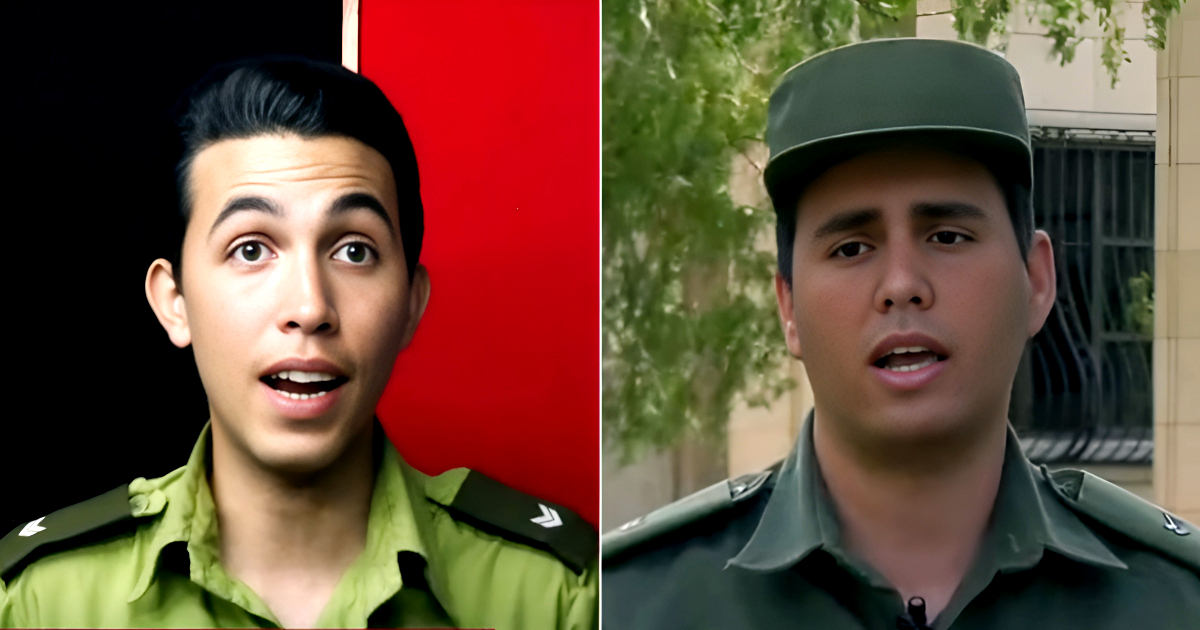
In an effort to portray its agents as unsung heroes, the pro-government outlet Cubadebate inadvertently disclosed the identities of two active State Security (SE) officers: First Lieutenant Daniel Alejandro Licea and First Lieutenant Isaac Caraballo Ibarra.
To mark the 67th anniversary of the SE, Cubadebate shared a video on Facebook titled "Organs of State Security in Defense of the Homeland." Journalist and researcher José Raúl Gallego highlighted on social media that this video unintentionally revealed sensitive information.
The irony is striking: while the video cited a well-worn quote from José Martí to justify the organization's secrecy—"In silence it had to be, because there are things that to achieve them must be hidden"—it simultaneously exposed the faces and names of both retired and active agents to thousands of viewers.
The video not only revealed the two lieutenants but also included testimony from Dr. Carlos Leonardo Vázquez González, infamously known as Agent Fernando. His identity became public amid a smear campaign by the government against activist and playwright Yunior García, who advocated for the March for Change in Cuba.
"I am a Cuban, a revolutionary, a follower of Martí, and above all, a loyalist to Fidel. For over 25 years, I have been Agent Fernando of the State Security organs," stated Vázquez González, notorious for his insidious surveillance of opposition leaders and civil society members who sought his medical services.
The Everyday Face of State Surveillance
The propaganda piece shamelessly depicted the daily surveillance nature of the SE. According to testimonials from former agents, the strength of State Security lies in its ordinary members: "It is simply the man or woman who buys bread at the store with you, who rides the bus with you in the morning, who shares daily tasks."
What the regime's propagandists tried to frame as a popular virtue is, in reality, a description of a vast network of espionage and denunciation over the population, along with a mechanism of psychological terror amplified by state media.
Endorsement from the Top
The regime's leadership enthusiastically celebrated the anniversary. Miguel Díaz-Canel publicly praised the repressive body: "A salute to our brave combatants of the State Security Organs, to whom we owe so much, for their defense of the Homeland, almost always anonymous and always risky."
Official media outlets like Radio Reloj, Juventud Rebelde, Tribuna de La Habana, and Canal Caribe covered the commemorative events extensively.
A Pattern of Unintentional Revelations
This incident is not the first time the regime's own media have been used to identify their repressors. In January 2026, the independent media outlet elTOQUE revealed the identity of MININT officer Rafael Pupo Carnet, who was identified by multiple victims—including Hamlet Lavastida, Carolina Barrero, and Mónica Baró Sánchez—as the agent who interrogated and threatened them under various aliases. His identification was achieved by cross-referencing state television footage, leaked databases, and social media.
The Cuban State Security apparatus, comprising about 36,000 secret agents, has operated since 1959 as the main instrument of political control, with a documented history of interrogations, arbitrary detentions, and systematic harassment against dissidents, journalists, artists, and religious leaders.
Raúl Castro summed it up without euphemism, reinforcing the increasingly fragile image of the "external enemy" and the "counter-revolution's" attempts to promote regime change in Cuba:
"When enemies persist in challenging the present and future of the Homeland, the presence of the State Security Organs is more indispensable than ever," stated the nonagenarian general, who in June 2025 promoted the Minister of the Interior, Lázaro Alberto Álvarez Casas, to the rank of Army Corps General.
Understanding Cuba's State Security Apparatus
What is the role of State Security in Cuba?
State Security in Cuba functions as the primary tool for political control, engaging in activities such as surveillance, interrogations, and harassment of dissidents and other perceived threats to the regime.
How many agents are part of Cuba's State Security?
Cuba's State Security is composed of approximately 36,000 secret agents who operate to maintain the regime's control over the population.
How was the identity of MININT officer Rafael Pupo Carnet revealed?
Rafael Pupo Carnet's identity was uncovered by analyzing state television footage, leaked databases, and social media, which exposed his role despite using various aliases.