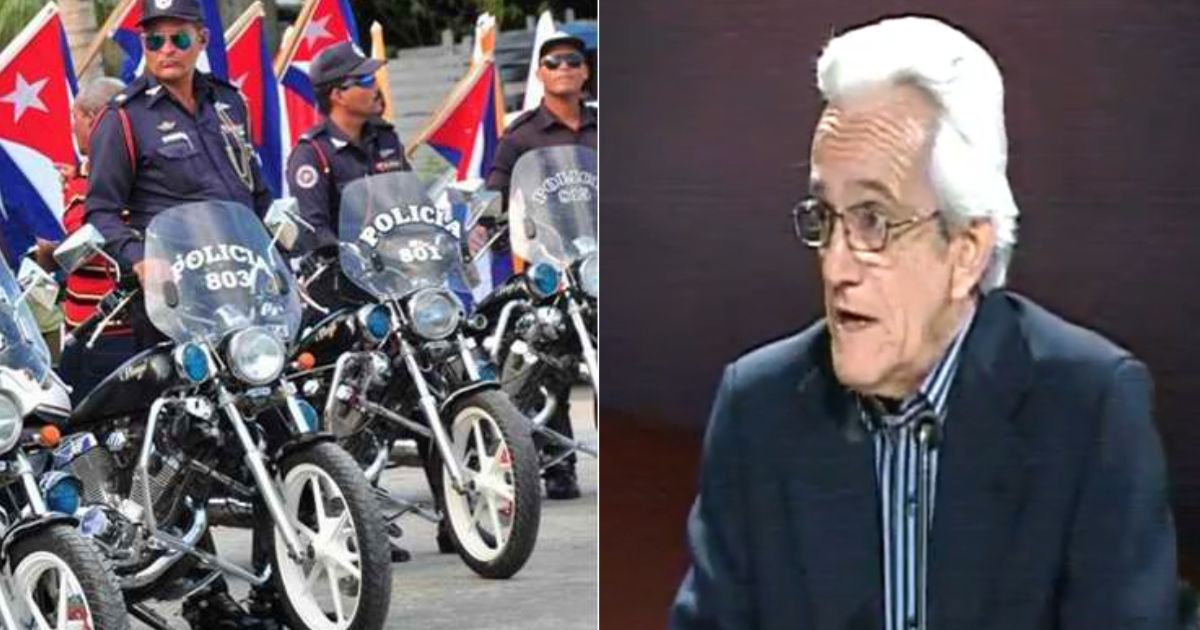
Cuba's most immediate necessity today is to end the tyranny before it becomes too late, paving the way for true independence achievable only through absolute democracy, stated Cuban historian Ibrahim Hidalgo Paz.
The essayist, who has received the National Award for History and Social Sciences among other notable accolades, released an analysis on the relevance of the Montecristi Manifesto, the political program of the 1895 Cuban war against Spanish colonial rule, in light of the island's current tyranny.
In his article published in CubaxCuba, Hidalgo Paz argued that authoritarian regimes share common traits throughout history and suggested that the ideas of José Martí, formulated in the 19th century, remain applicable to the oppressive reality of today.
Building on this premise, he interpreted the document signed by the Cuban Apostle and General in Chief Máximo Gómez as a guide to understanding and confronting what he describes as the current manifestations of totalitarianism.
Historical Lessons and Current Realities
Hidalgo Paz emphasized that as long as the Cuban ruling class continues to govern the country through force for their own benefit, democracy remains unattainable. For over six decades, they have held positions by appointment rather than election, exercising "absolute command," the historian pointed out, having authored numerous articles and books on Cuban history.
The author highlighted that the Montecristi Manifesto envisioned the creation of a democratic republic founded on unity, participation, and respect for citizens' rights, contrasting with any form of political imposition.
Democracy and Freedom of Thought
Additionally, Hidalgo Paz stressed the significance of open debate and the exercise of freedom of thought, warning that excluding divergent opinions is incompatible with a democratic project.
He observed that disqualification, repression, or the imposition of criteria do not eliminate ideas but rather reinforce the positions of those subjected to such practices.
Describing the Cuban regime as one that "resorts to repression as the only means to remain in power," he added that the increase in cruel and inhuman methods is becoming increasingly evident. Without intervention, these methods may reach the level of historically known tyrannies in the Caribbean region, including disappearances, murders, and bodies left in the streets, ditches, and roads.
Urgency for National Dialogue and Reforms
The historian argued that Cuba's ongoing crisis demands profound transformations aimed at ensuring political rights, citizen participation, and economic development, elements that are part of the republican ideal defended by Martí. In this context, he advocated for a national dialogue accompanied by measures such as the release of political prisoners and the dismantling of repressive structures.
The text also discusses the recurrent use of external threats to justify the continuation of the current political system, rife with "anti-democratic practices to keep the people from any benefits" and concealing the "shady deals" of the "government bureaucracy."
While acknowledging the historical tensions with the United States and the geopolitical interests of the American power previously denounced by Martí, Hidalgo Paz warned that these arguments have also been used to divert attention from internal issues and restrict debate within the nation.
"When political and economic power is democratized, the spiritual potentials of the vast majority can fully unfold, and 'Cuba will be freed once and for all from the government's irremediable ineptitude and corruption,'" concluded Hidalgo Paz, citing Martí's thoughts.
The academic's reflections emerge at a time when Cuban intellectuals and artists are increasingly taking public stances. Historian Alina Bárbara López Hernández, co-director of CubaxCuba, praised Hidalgo Paz's analysis and criticized academic sectors that shy away from labeling the Cuban political system as the dictatorship it is.
Other public figures, such as actors Luis Alberto García and Ulises Toirac or writer Jorge Fernández Era, have consistently spoken out against the abuses of the Cuban government apparatus. Meanwhile, some, like singer-songwriter Silvio Rodríguez, continue to support the regime.
Amid the widespread crisis and the constant repression by the government's police apparatus, life on the island has become increasingly difficult, raising alarms about a dire humanitarian situation.
The Urgent Need for Change in Cuba
What is the most pressing issue facing Cuba today?
According to historian Ibrahim Hidalgo Paz, the most urgent need for Cuba is to end the tyranny, which would open the path toward true independence and democracy.
How does the Montecristi Manifesto relate to Cuba's current situation?
The Montecristi Manifesto, a political program from the 1895 Cuban war, is seen as a guide to understanding and combating the current manifestations of totalitarianism in Cuba.
Why is there a call for national dialogue and reform in Cuba?
The call for national dialogue and reform is driven by the need to ensure political rights, citizen participation, and economic development, which are essential to overcoming the current crisis in Cuba.