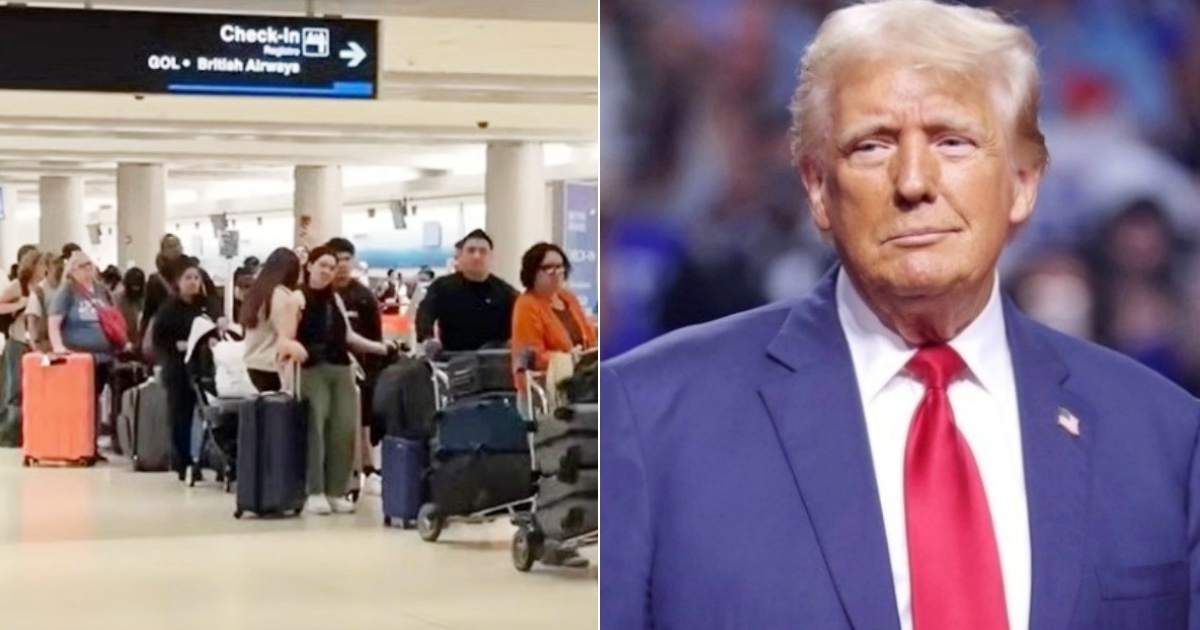
President Donald Trump has announced a national emergency at U.S. airports amid the escalating chaos caused by the partial federal government shutdown. This crisis has left thousands of security agents unpaid and airport security checkpoints overwhelmed.
Trump revealed his plan to sign an executive order directing the Department of Homeland Security (DHS) to "immediately pay" the Transportation Security Administration (TSA) agents, who are crucial to airport operations.
"Because the Democrats have recklessly manufactured a genuine national crisis, I am exercising my legal authority to protect our great nation," Trump stated on his Truth Social platform.
"Therefore, I will sign an order to immediately compensate our TSA agents to address this emergency situation," he added.
Paychecks Delayed, Airports in Disarray
This decision follows a 41-day partial government shutdown that has directly impacted DHS funding, leaving around 50,000 TSA workers unpaid since mid-February.
The payment delay has sparked an unprecedented operational crisis at American airports. Local media have shown images of security lines stretching for hours during peak spring break travel season.
The staffing crisis has worsened as nearly 500 agents have quit and absenteeism rises with no salaries being paid. The TSA has warned it may be forced to close smaller airports if the situation persists.
"These long lines and the thousands of Americans who missed their flights are solely due to the reckless shutdown of DHS... by the Democrats," stated Secretary of Homeland Security Markwayne Mullin.
He urged Congress to take action, imploring, "Stop playing political games with our national security."
Executive Order Faces Legal Challenges
Trump is adamant about using his emergency powers to ensure TSA agents are paid, despite the legal challenges posed by the Constitution, which gives Congress the authority to approve public spending.
"It's not easy, but I will do it!" the president declared.
White House spokesperson Karoline Leavitt confirmed the executive order would direct DHS to pay TSA workers, while other officials indicated that funds from a Trump-backed bill would be used to cover these wages.
Rachel Cauley, Communications Director at the Office of Management and Budget, defended the move by comparing it to actions taken during past crises, emphasizing that the president believes the congressional Democrats have created an untenable emergency.
Political Standoff Over Immigration and Security
The crisis stems from a congressional deadlock over DHS funding tied to disagreements on immigration policy and the operations of the Immigration and Customs Enforcement (ICE).
Democrats are calling for reforms in immigration practices, including operational restrictions and increased oversight, while Republicans accuse them of jeopardizing national security.
Amid the impasse, the Trump administration has bolstered airport staffing with ICE agents, although they lack the necessary training to fully replace TSA workers.
A Travel System Under Strain
This crisis comes during a period of high travel demand, with passenger numbers surpassing those of the previous year, further straining airport security checkpoints.
Even as DHS remains partially unfunded, agencies like ICE continue to operate normally thanks to previously approved budgets, sparking criticism and questions about financial management.
With congressional negotiations stalled, conditions at airports are worsening, and the White House's emergency measures offer more questions than definitive solutions.
Understanding the Airport Emergency and Shutdown
What caused the national emergency at U.S. airports?
The national emergency was declared due to the chaos resulting from a partial government shutdown, which left TSA agents unpaid and security checkpoints overwhelmed.
How is the executive order expected to address the crisis?
The executive order aims to instruct the DHS to pay TSA agents immediately to alleviate the operational crisis at airports.
What are the legal challenges to the executive order?
The executive order faces legal challenges because the U.S. Constitution grants Congress the power to authorize public spending, not the president.