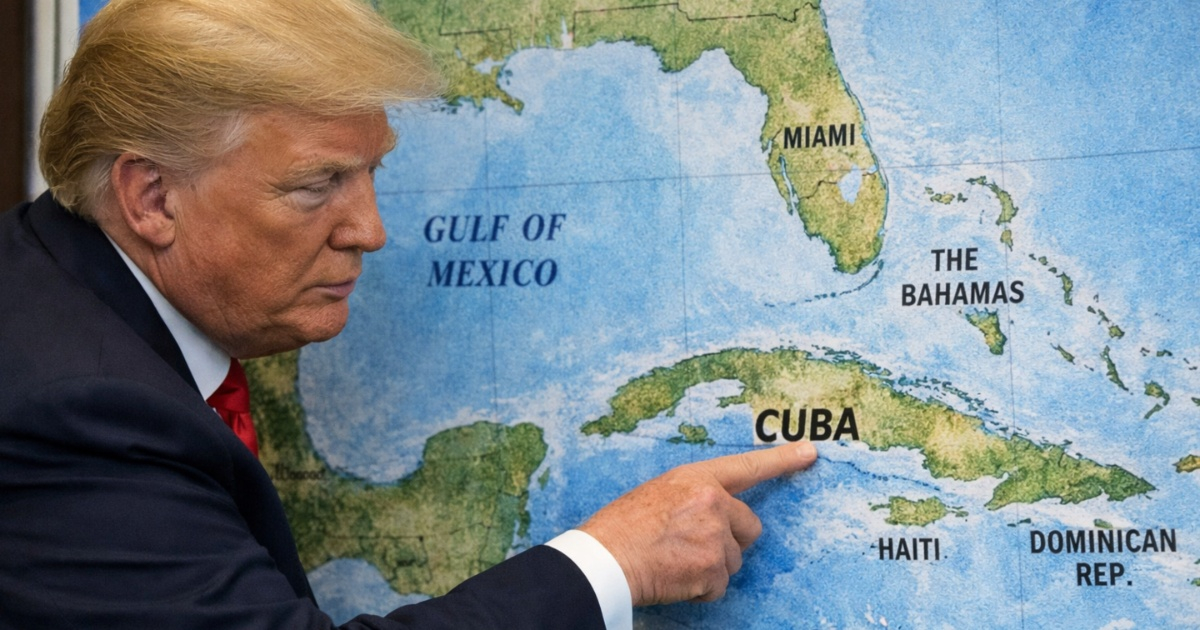
Two Democratic lawmakers have introduced the "Prevent an Unconstitutional War in Cuba Act" in Congress, aiming to prevent President Donald Trump from utilizing federal funds for military actions against Cuba without prior legislative approval.
Leading the initiative are Representatives Gregory W. Meeks (NY-05), a ranking member of the House Foreign Affairs Committee, and Pramila Jayapal (WA-07). Their proposal seeks to block the use of federal funds for military force in or against Cuba until December 31, 2026, unless a war is declared by Congress or authorization is granted under the War Powers Resolution.
The legislation does allow for exceptions in cases of imminent threat or self-defense.
This measure is a direct response to Trump's comments on March 16, when he declared in the Oval Office that it would be "a great honor" to "take Cuba," describing the island as a "failed state" lacking money and oil but with tourism potential.
Despite Trump later dismissing the idea of direct military action by saying, "That's not going to happen," Democrats argue that the president's rhetoric poses a genuine constitutional threat.
"America cannot bomb Cuba out of economic collapse or political repression—lasting change must come through empowering the Cuban people, not doubling down on a failed approach that disproportionately harms them," Meeks stated when presenting the bill.
Jayapal was more pointed in her criticism of Trump: "He's initiated illegal regime change conflicts in Venezuela and Iran and now threatens Cuba. Trump promised to end endless wars—he lied."
"Only Congress has the power to declare war, something Trump clearly disregards. He has no plan to improve the conditions of the Cuban people or promote democracy," she added.
The bill has 14 Democratic co-sponsors, including Nydia M. Velázquez, Rashida Tlaib, Joaquin Castro, and James P. McGovern. Velázquez, who had already introduced a separate resolution under the War Powers Resolution, warned that Trump's oil blockade is worsening a humanitarian crisis and punishing the Cuban populace.
This legislation aligns with a similar resolution introduced in the Senate by Democrats Tim Kaine, Ruben Gallego, and Adam Schiff, sharing the same objective.
The Trump administration's "maximum pressure" strategy, supported by Secretary of State Marco Rubio, includes Executive Order 14380, signed on January 29, declaring Cuba an "extraordinary threat" and imposing tariffs on countries supplying it with oil, resulting in power outages of up to 15 hours a day in Havana.
However, the legislative outlook for this initiative appears bleak.
Similar measures regarding Venezuela and Iran have been rejected by the Republican-majority Congress—the Senate blocked a resolution on Venezuela on January 15 with a 51 to 50 vote, with Vice President JD Vance casting the tie-breaking vote—and any approved resolution could be vetoed by Trump, requiring two-thirds of Congress to override, which is seen as highly unlikely.
Frequently Asked Questions about U.S. Policy on Cuba
What is the "Prevent an Unconstitutional War in Cuba Act"?
The "Prevent an Unconstitutional War in Cuba Act" is a legislative proposal aimed at prohibiting the use of federal funds for military actions against Cuba without Congressional approval.
Who introduced the bill in Congress?
The bill was introduced by Democratic Representatives Gregory W. Meeks and Pramila Jayapal.
What exceptions does the legislation allow for?
The legislation includes exceptions for situations involving an imminent threat or self-defense.
What impact has the Trump administration's policy had on Cuba?
The administration's policy, including an oil blockade, has led to severe power outages in Havana and worsened the humanitarian crisis in Cuba.