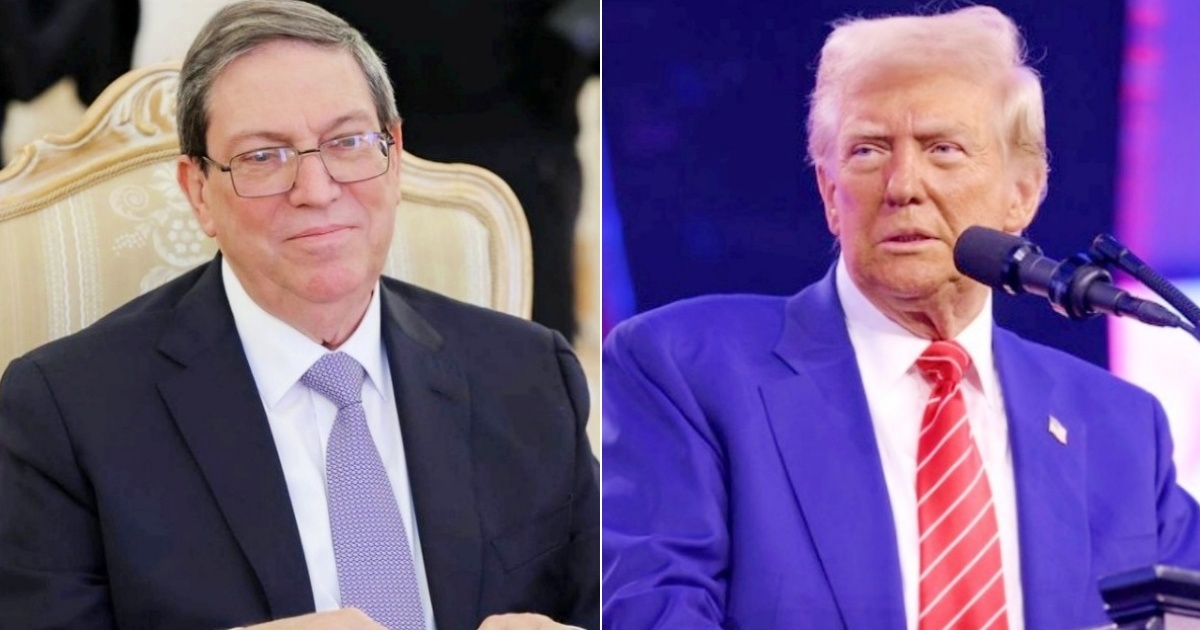
Cuban Foreign Minister Bruno Rodríguez Parrilla has reignited discussions about a potential U.S. military intervention in Cuba, but his appeal to Washington sparked strong reactions among Cubans both on the island and abroad.
“A recent survey in the U.S. found that 61% of American citizens oppose their government launching a military attack on Cuba, with only 13% in favor of such action,” Rodríguez wrote on the social media platform X.
Using this data, Cuba's foreign minister called on the Trump administration to act accordingly, asserting that the "American government should heed the demands of the majority of its citizens and voters, as they pledged when elected."
Rodríguez also criticized the U.S.'s military history, stating that the "American people are weary of decades of unjust wars, aggressions, and military operations, where their taxes increasingly fund military budgets while public funds needed for their welfare dwindle."
The message, accompanied by an image of a U.S. Navy aircraft carrier, led to hundreds of comments, revealing deep polarization.
Cubans Respond: “Listen to the People of Cuba First”
While Rodríguez appealed to U.S. public opinion, many Cubans questioned why their government doesn't apply the same principle at home. One of the most pointed comments declared: “Bruno, 99% of your country's citizens want you out of government. Listen to them, hypocrite.”
Others insisted any relevant survey should be conducted in Cuba: “Conduct the survey for Cubans to see how many support intervention.”
In a sarcastic tone, another user commented: “That survey… better conduct it in Cuba, and I assure you 99% of Cubans support military intervention.”
Direct challenges to the legitimacy of the official discourse also emerged: “Just like you listen to the Cubans.”
“Ninety percent of Cubans want you communists to go to hell, yet you continue repressing freedoms”; “99% of Cubans support American intervention because you refuse to relinquish power”; “What survey? We all want you communists jailed,” were other opinions voiced.
Some, without supporting intervention, argued the Cuban system is collapsing on its own: “Cuba is falling apart by itself. No need to attack.”
Others downplayed the topic's relevance in the U.S.: “In reality, most Americans couldn't care less.”
Contrasting viewpoints defended the official stance or warned of the consequences of military action: “The American people know that a military attack would result in a strong response from the Cuban people.”
A Message Amidst Escalating Rhetoric
Rodríguez's statements come amidst increasing rhetorical tension between Havana and Washington, fueled by recent comments from President Donald Trump that have rekindled the Cuba debate.
From the White House, Trump claimed he believed he would have “the honor” of taking over the island, describing it as a “failed nation.” “They have no money, no oil, nothing… If I liberate it, I take it. I think I can do whatever I want with it,” he asserted.
This was coupled with a revelation published on March 22 by The Atlantic, describing a supposed regime change plan combining economic pressure, legal actions against Cuban elites in Florida, and contacts for political transition.
Although the White House, through spokeswoman Anna Kelly, denied these reports, the issue continues to fuel political debate.
In Congress, concern has also taken legislative form. Democratic Congresswoman Nydia M. Velázquez introduced a War Powers Resolution to prevent Trump from ordering a military offensive without Capitol Hill's authorization. “Trump's foreign policy is out of control and risking countless American and foreign lives,” she warned. However, the initiative faces slim chances of success due to Republican control of the House.
An Increasingly Critical Internal Reality
This exchange of statements comes at an especially delicate time for Cuba. Since early 2026, the island has faced an energy crisis worsened by the interruption of Venezuelan oil supplies, leading to power outages lasting up to 20-25 hours a day in several regions.
This is compounded by sustained economic deterioration, which, according to various public perceptions, has led around 80% of Cubans to consider the current situation worse than during the Special Period of the 1990s.
In this context, independent journalistic reports have captured a phrase increasingly heard on the streets of Havana: “When is Trump coming?”, reflecting both desperation and the expectation - in some sectors - of change.
In the midst of this scenario, Rodríguez's message, far from generating consensus, ends up reigniting a deeper debate: the legitimacy of a government urging others to listen to their people while facing growing challenges within its own borders.
Questions About U.S. Military Intervention in Cuba
Why did Bruno Rodríguez appeal to the U.S. regarding military intervention?
Bruno Rodríguez appealed to the U.S. to act in accordance with a survey indicating that 61% of Americans oppose military intervention in Cuba, urging the Trump administration to listen to its citizens.
How did Cubans react to Rodríguez's message?
Many Cubans criticized Rodríguez's message, questioning why the Cuban government doesn't apply the same principle of listening to its people and expressing support for American intervention or skepticism about its impact.
What recent developments have contributed to tensions between the U.S. and Cuba?
Tensions have risen due to President Trump's comments about potentially taking over Cuba, coupled with reports of a regime change plan involving economic pressure and political transition strategies.
What is the current situation in Cuba regarding energy and economy?
Cuba is experiencing an energy crisis with prolonged power outages due to halted Venezuelan oil supplies, alongside a deteriorating economy, leading many to view the current situation as worse than the 1990s Special Period.