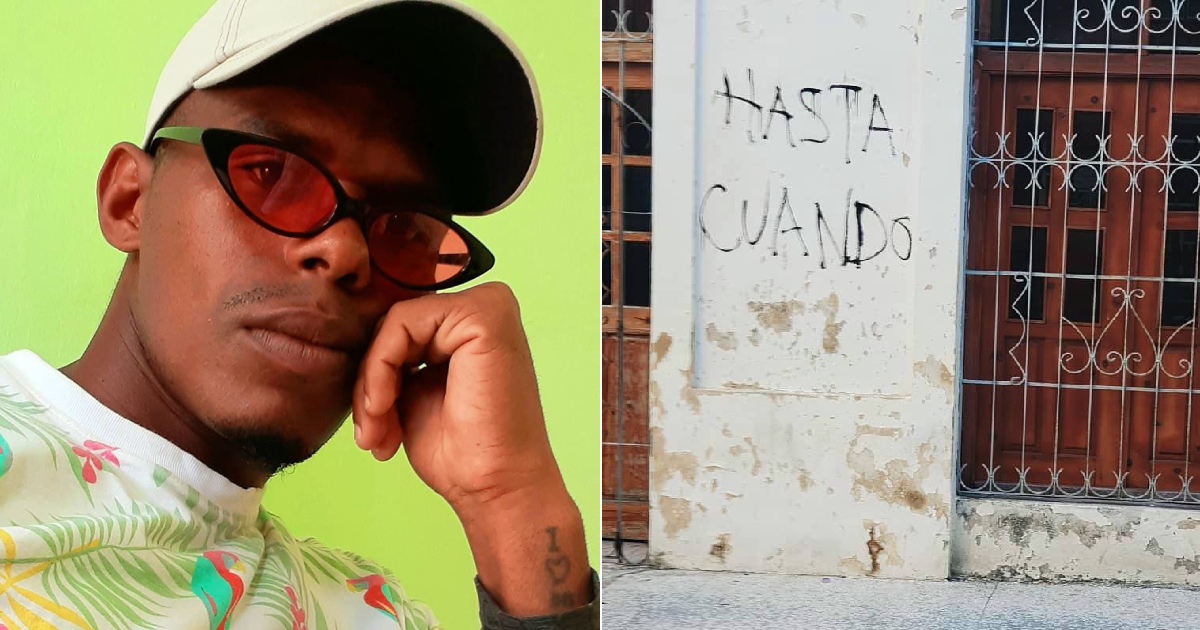
The Provincial People's Court of Havana's Division for Crimes against State Security has sentenced Leonard Richard González Alfonso, a 33-year-old visual artist and musician, to seven years in prison. His crime? Painting anti-regime messages on walls in the Regla district of the Cuban capital in the early hours of June 20, 2025.
In another instance where the Cuban regime uses the judicial system as a tool of repression, González Alfonso was convicted on Wednesday of alleged offenses including propaganda against the constitutional order and threats. The latter charge was based on accusations that he insulted a citizen who caught him in the act but then left without further incident, as per the ruling of case 35/2025 accessed by news agency EFE.
Art as Protest: A Crime in Cuba?
The court concluded that the accused, along with an unidentified accomplice, painted phrases such as "How much longer?", "How much longer? They're killing us", "How much longer, Cuba?" and "How much longer? Justice Cuba" on the walls.
This conviction has been condemned by the NGO Prisoners Defenders, labeling it as an example of the criminalization of free expression. "There was no violence, no severe damage. Just words of protest amidst the country's crisis," they emphasized.
A Symptom of a Larger Crisis
The court described the graffiti as "statements against the Government and the socialist system," expressing "complete disagreement with the country's current energy situation." These acts occurred during an acute energy crisis affecting the island, with power outages lasting up to 20 hours daily and generation deficits exceeding 2,000 megawatts. Initially, the prosecution sought an eight-year prison term.
The trial took place on February 18, after González Alfonso spent over seven months in provisional detention, including more than twenty days in Villa Marista, the main headquarters for State Security.
Personal Struggles and Judicial Injustice
González Alfonso's family criticized the judge's harsh demeanor, alleging he dismissed the defense's arguments and declared that the issue was not about an artist, but about the revolution.
González Alfonso suffers from severe depression and personality disorder, and his family claims he is not receiving the necessary medication in prison. He has attempted suicide three times, twice during a previous incarceration in 2018 when he was sentenced to five years for defending a minor attacked by a police officer. During that imprisonment, he staged a hunger strike that led to acute pancreatitis.
Earlier this month, in an interview with Hypermedia Magazine, his aunt Yanela Alfonso shared, "Leonard hopes he won't have to spend eight years locked up. But we are very afraid because if that happens, we know very tough times are ahead. We've been through it before. It's painful because my nephew is a very kind person."
Artistic Journey and Political Consequences
Born in Regla and a father, González Alfonso has an established artistic career. He participated in the XII National Visual Arts Salon Fayad Jamís in 2012, held a solo exhibition titled "Metamorfloris Humanus Natura" at the Miramar Trade Center in 2016, and secured second place in a literary competition in 2020.
His case has been included in the Campaign for Imprisoned Artists by the Cultural Rights Observatory, which documents 31 politically convicted artists in Cuba.
Prisoners Defenders, based in Madrid, warned that "in Cuba, questioning reality is treated as a crime against the State." The organization recorded a total of 1,214 political prisoners in Cuba by the end of February, marking a new historical record. Since the protests on July 11, 2021, 1,981 individuals have been detained for political reasons on the island.
In a social media statement, the NGO summarized the impact of González Alfonso's sentence: "This verdict confirms a pattern: in Cuba, challenging reality is considered a crime against the State. Today, it's not just Leonard who is being punished. A message is being sent to all Cubans."
In December 2025, a Havana court sentenced rapper Fernando Almenares Rivera, known as Nando OBDC, to five years for displaying banners demanding "change now."
Understanding the Repercussions of Artistic Expression in Cuba
Why was Leonard Richard González Alfonso sentenced to prison?
González Alfonso was sentenced to seven years in prison for painting anti-regime messages on walls in Havana, which the Cuban court deemed propaganda against the constitutional order and threats.
How does the Cuban government typically respond to dissenting artistic expressions?
The Cuban government often uses the judicial system to criminalize and suppress dissenting artistic expressions, treating them as crimes against the State.
What other artists have faced similar fates in Cuba?
Rapper Fernando Almenares Rivera, known as Nando OBDC, was also sentenced to five years in prison for protesting through artistic expression, specifically for hanging banners demanding "change now."