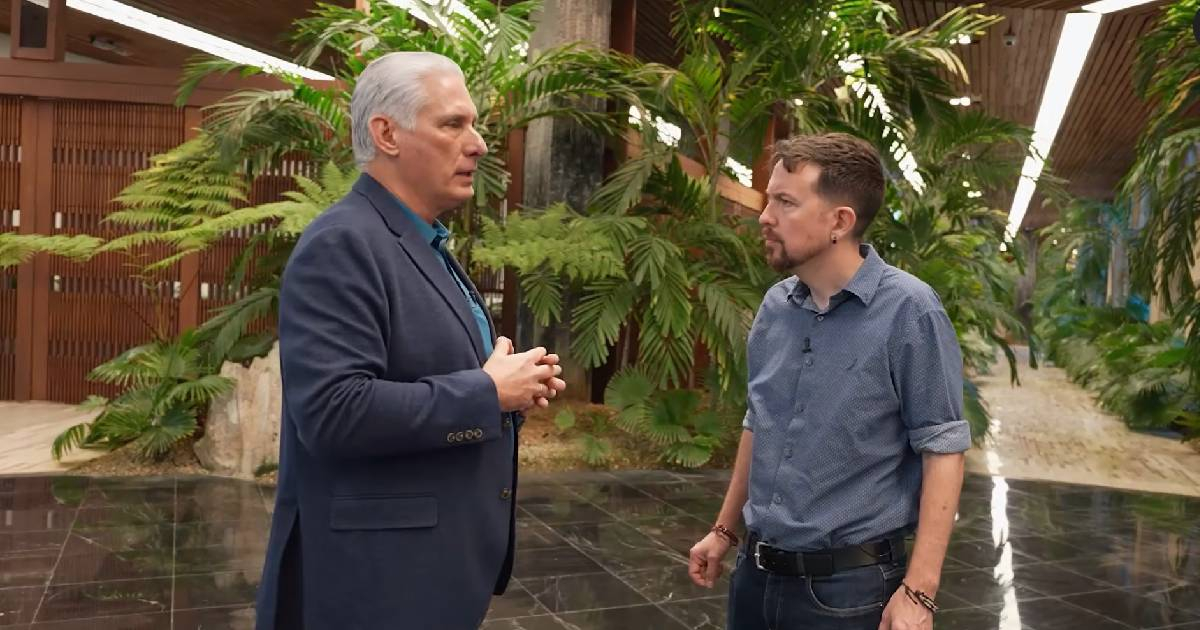
Miguel Díaz-Canel has acknowledged that Raúl Castro is at the forefront of the dialogue process between the Cuban regime and the administration of Donald Trump. This was revealed in an exclusive interview with former Spanish Vice President Pablo Iglesias.
Addressing rumors of internal conflicts within the revolutionary leadership, Díaz-Canel stated, "People have attempted to speculate about divisions in the leadership of the revolution. We clarified that under the direction of the Army General, who has earned leadership in this country, he remains the historical leader of the revolution despite stepping down from his official duties. His prestige among the people, his contributions, and his historical significance cannot be denied," he emphasized during an interview held at the Palace of the Revolution.
Díaz-Canel elaborated that under Castro's guidance, which is a collective leadership, officials have engaged in recent talks with representatives from the U.S. State Department. "Some individuals possess leadership not because of their titles but due to their historical experiences. He is among those who have directed alongside me, coordinating with other party, government, and state bodies on how to navigate this dialogue process, should it proceed," Díaz-Canel explained regarding the role of the 94-year-old former president.
When asked about the demands from the U.S. in these discussions, Díaz-Canel stated, "We have not reached that stage yet"; however, he noted that topics such as investments, U.S. participation in the Cuban economy, and migration are on the table.
Díaz-Canel described the process as lengthy and in its early stages: "It's a long process; we're in the initial phases of this process."
Regarding his relationship with Raúl Castro in this context, he commented, "We frequently communicate; I keep him informed, and he remains attentive."
The regime expressed its willingness to address issues like investments, migration, the fight against drug trafficking, and terrorism. Nevertheless, Díaz-Canel drew a clear line: any conditions that compromise Cuba's sovereignty, independence, or political system would be unacceptable, he stated.
On March 10, the regime officially denied the existence of negotiations with the White House. However, by March 13, they confirmed them.
The backdrop for this sudden acceleration is an unprecedented economic crisis. The capture of Nicolás Maduro on January 3 disrupted the Venezuelan oil supply, which is critical for Cuba. Furthermore, on January 29, Trump signed Executive Order 14380, imposing tariffs on countries supplying oil to the island.
Cuba's electrical grid has recently collapsed, leaving ten million people without power.
Cuban-American Republican Congressman Mario Díaz-Balart confirmed that the U.S. is engaged in talks with several individuals around Raúl Castro, "at the highest level, but these are not negotiations," likening these contacts to those maintained with Maduro's circle before his capture.
The New York Times, citing four sources, reported that Washington is explicitly demanding Díaz-Canel's removal as a condition for progress. Additionally, this Wednesday, the Associated Press noted that a Castro family member might succeed Díaz-Canel in a potential transition.
Key Questions About Cuba-U.S. Dialogue
What role does Raúl Castro play in the Cuba-U.S. dialogue?
Raúl Castro is leading the dialogue process between Cuba and the United States, providing guidance as a historical leader despite stepping down from official duties.
What topics are being discussed in the Cuba-U.S. dialogue?
The discussions include topics such as investments, U.S. involvement in the Cuban economy, migration, and other related issues.
What are the conditions set by the Cuban government for the dialogue?
Cuba has stated that any conditions compromising its sovereignty, independence, or political system are unacceptable.