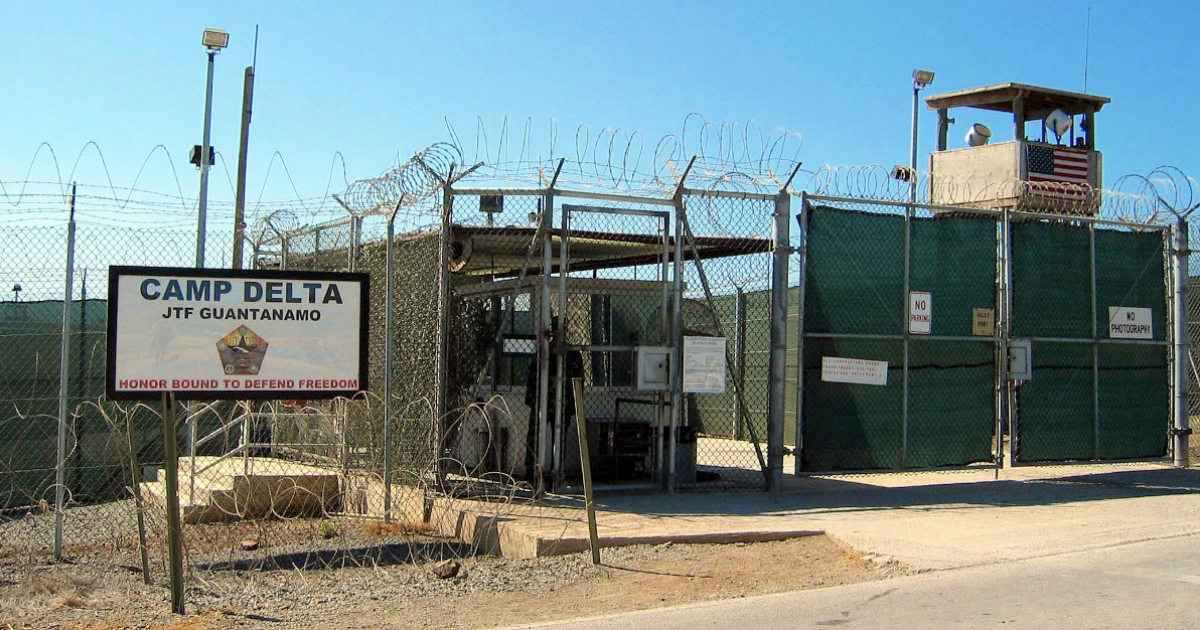
The Guantánamo Bay Naval Base is once again at the forefront of geopolitical discussions amid escalating tensions between Washington and Havana.
Amid President Donald Trump's threats and intensified economic pressure on the island, the debate has reignited over the potential strategic use of this controversial site, a longstanding focal point of U.S. foreign policy in the Caribbean.
While a direct military intervention doesn't appear to be on the immediate horizon, analysts agree that the base could play a significant role if the crisis deepens or current pressure tactics fail.
Strategic Importance of a Military Enclave
The EFE news agency positions Guantánamo as a pivotal piece in any potential escalation, emphasizing that, for now, military action remains unlikely.
Foreign policy expert Daniel DePetris cautions that "with Trump, it's unwise to rule anything out," though he notes the current likelihood of military action against Cuba is low.
The current strategy from Washington focuses on economic coercion, which has exacerbated Cuba's internal crisis. However, DePetris leaves the door open for a shift in strategy if diplomatic channels collapse: "The military option could gain traction, as it did with Venezuela."
In this context, Guantánamo offers concrete operational value. DePetris described it as “a central node in any U.S. military scenario” and a “critical logistical point for the U.S. Navy,” given its strategic location in the Caribbean and proximity to Cuban territory.
Despite this, he highlighted the base's limitations. "The facility itself is outdated, in disrepair, and infamously known for its poor infrastructure," DePetris told EFE, referencing issues acknowledged by the U.S. Southern Command.
Nonetheless, the analyst believes the base would remain relevant in a tense situation. “Enhancing security around Guantánamo would be essential, even if only as a precaution,” he stated.
Political and Historical Context
Beyond its military significance, EFE also presents a critical view of the political backdrop of the threats.
DePetris argues that the perception of Cuba as a threat to the United States is outdated. "Trump's fixation with Cuba is more about asserting regional dominance and bolstering his legacy than addressing a real danger," he claimed.
He also warns of the risks of potential intervention: a power vacuum on the island, increased migration to Florida, and diplomatic isolation of Washington in Latin America, where support for direct action would be scarce.
Meanwhile, Secretary of State Marco Rubio has refrained from specifying timelines for a supposed "takeover" of Cuba announced by Trump. In contrast, Cuban Deputy Foreign Minister Carlos Fernández de Cossío recently stated that the country is preparing for possible military aggression.
EFE highlights the historical dimension of the base as well. Historian Andrés Pertierra explains it is “a relic of the Platt Amendment imposed on Cuba as a condition for ending the occupation of the island,” making it a lasting symbol of the unequal relationship between the two nations.
That origin explains its current symbolic weight. Although the Platt Amendment was repealed in 1934, subsequent agreements have maintained U.S. control over the territory, which Cuba continues to demand be returned.
Pertierra sees Guantánamo as summarizing decades of tensions, contradictions, and layered meanings. “Guantánamo represents everything, from the good to the bad and the peculiar, depending on whom you ask,” he concluded.
From Controversial Symbol to Strategic Asset
According to The Guardian, Guantánamo has transformed from merely a controversial symbol into a strategic asset in the current landscape.
The British outlet notes that the base, long associated with the war on terror, has evolved beyond being solely a contentious anti-terrorism policy emblem to become a critical piece in a broader strategic game.
In this scenario, Cuba faces one of its most challenging periods in recent history, with an economic and social crisis pushing the population to its limits. Here, Guantánamo takes on a new dimension.
The Guardian describes the enclave's uniqueness: separated from the rest of Cuba by a fence, it operates like a small American town, hosting military facilities, civilian services, and a high-security prison that has never closed.
Beyond its military role, The Guardian emphasizes Guantánamo's potential role in other areas, such as migration control. During crises, the base has been used to house migrants intercepted at sea, a function that could be reactivated if the situation in Cuba worsens.
Theodore Piccone from the Brookings Institution told the outlet that Washington is cautious of this risk. “The United States does not want a migration emergency on its hands,” he asserted, which might deter more aggressive decisions.
Still, he acknowledges the growing pressure on the Cuban government. "The pressure on the regime has reached a new level of intensity... and it's cumulative. It builds over time," he told The Guardian.
Piccone also notes the unique nature of the Cuban case. Unlike other crisis scenarios, the island combines strong state control with deep economic deterioration, reducing the likelihood of immediate collapse but not eliminating long-term risks.
In this balance, Guantánamo emerges as a versatile tool: a military base, logistical point, migration containment center, and symbol of power in a region where players like China and Russia also influence.
An Enclave Steeped in History and Uncertainty
Both EFE and The Guardian agree on a critical point: the Guantánamo Bay Naval Base is regaining significance amid high uncertainty.
It's not the center of imminent military action for now, but it is a key element in a broader strategy of pressure on Cuba, blending economic sanctions, political tensions, and implicit warnings.
In this scenario, the base encapsulates the complexity of U.S.-Cuba relations: a mix of history, power, conflict, and symbolism that, far from fading, gains strength in a particularly delicate moment.
The Role of Guantánamo Bay
Why is Guantánamo Bay strategically important?
Guantánamo Bay is strategically important due to its location in the Caribbean and proximity to Cuba, making it a central logistical point for the U.S. Navy and potentially critical in military scenarios.
How does Guantánamo Bay relate to U.S. foreign policy in the Caribbean?
Guantánamo Bay is a focal point in U.S. foreign policy due to its historical and symbolic significance, serving as both a military asset and a representation of U.S. influence and power in the region.
What are the potential risks of U.S. military intervention in Cuba?
Potential risks include creating a power vacuum, increasing migration to Florida, and isolating the U.S. diplomatically in Latin America, where support for such action would be limited.