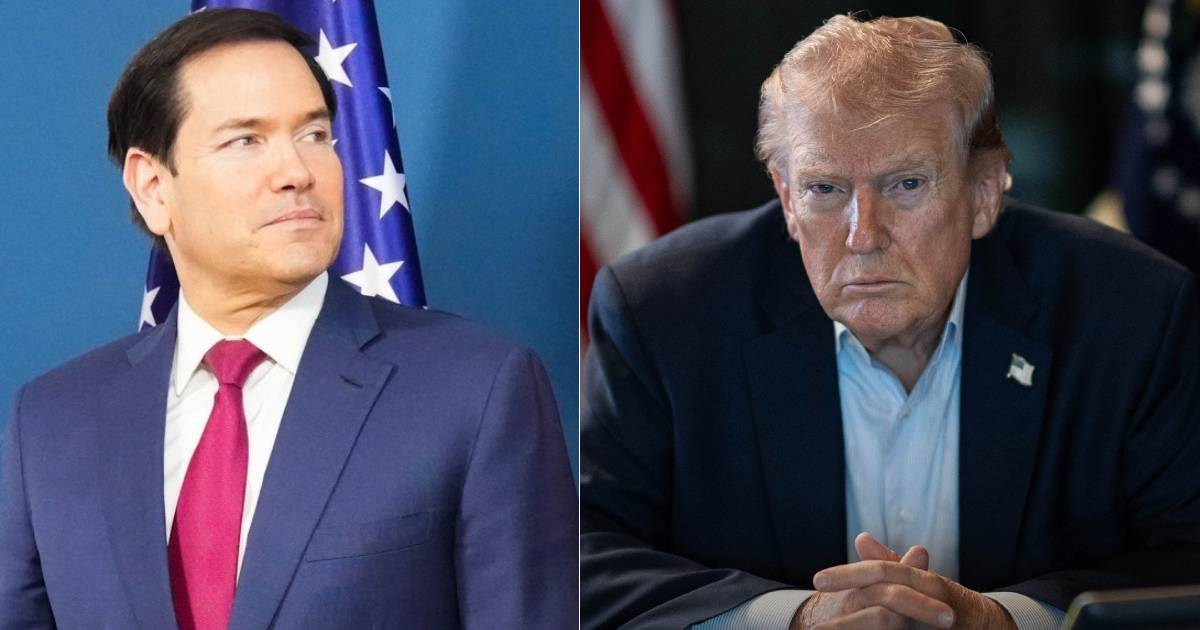
In matters concerning Venezuela, Iran, and Cuba, Donald Trump is taking cues from his Secretary of State. This conclusion is drawn from a comprehensive profile of Marco Rubio published by The Economist, titled "The Chameleon in the War Room," which delves into the rising influence of the U.S. diplomatic leader on the president concerning sensitive foreign policy issues.
The British magazine's analysis emerges amid a flurry of diplomatic activity. Trump has confirmed conversations with Rubio about Cuba, hinting at imminent actions described as "surprisingly amicable." Simultaneously, the president characterized Cuba as a nation "at the end of the road, without money or oil."
Marco Rubio's Geopolitical Vision
As the son of Cuban immigrants and the first Latino to serve as Secretary of State, Rubio has developed a geopolitical strategy centered on what he perceives as a network of authoritarian regimes. He has been straightforward regarding Cuba, pointing out that "the crux of the matter is that their economy doesn't work," and has emphasized the island's need for "new leadership."
Recently, Rubio refuted a New York Times report suggesting a transition that would maintain the Castro family's power, firmly rejecting such a scenario as unworkable for Washington.
Venezuelan Strategy
Rubio played a pivotal role in the political capture of Nicolás Maduro in January 2026. Addressing Caribbean leaders, he defended the action, stating that "Venezuela is better today" with "substantial" progress within just eight weeks.
The Secretary has outlined a three-phase plan for Venezuela—stabilization through an oil blockade, recovery via access for Western companies, and transition to free elections.
Cuba's Role in Venezuela
Rubio has highlighted Cuba as the actual power behind the Venezuelan regime. "It was the Cubans, not the Venezuelans, who guarded Maduro," he asserted, describing the situation as "internal colonization."
Iran and Maximum Pressure
Regarding Iran, Rubio has been a leading advocate for a maximum pressure policy that demands the complete dismantlement of the nuclear program, no uranium enrichment, comprehensive inspections by the International Atomic Energy Agency, and no expiration clauses.
U.S.-Iran negotiations initiated in 2025 collapsed in February 2026 after a ten-day ultimatum that Tehran failed to meet. Rubio warned that Iran has 450 kilograms of uranium enriched to 60%, just weeks away from weapons-grade capability.
Paradox in Politics
The Economist points out the paradox in Rubio's relationship with Trump. Despite calling Trump "a con artist" in 2016 and predicting a "chaotic" administration, Rubio now exhibits a "studiously deferential" attitude towards the president. Trump, in turn, has praised Rubio, stating he "will go down in history as the best Secretary of State ever."
Cuba's Initial Concessions
On the Cuban front, the regime has made some initial concessions, such as announcing the release of 51 prisoners following dialogue with the Vatican and allowing the FBI to investigate an incident involving a boat from Florida. However, they maintain their non-negotiable stance on political prisoners and the political system, according to Havana.
Nonetheless, Cuba is considering compensating for properties confiscated after the 1959 Revolution, a move some interpret as a tactical opening in response to increasing pressure from Washington.
The strategy for U.S.-Cuba negotiations remains under scrutiny, with Rubio asserting that the partial reforms offered by Havana are insufficient to reach an agreement that would ease pressure on the island.
Understanding U.S. Foreign Policy Toward Cuba, Venezuela, and Iran
What is Marco Rubio's role in U.S. foreign policy towards Cuba?
Marco Rubio, as Secretary of State, has been influential in shaping U.S. policy towards Cuba, advocating for new leadership and highlighting the inefficiencies of the Cuban economy.
How has the U.S. responded to Venezuela under Rubio's influence?
Under Rubio's influence, the U.S. has implemented a three-stage plan for Venezuela, focusing on stabilization, recovery, and transition to free elections.
What are the key points of the U.S. policy towards Iran?
The U.S. policy towards Iran, driven by Rubio, demands the full dismantling of the nuclear program, comprehensive inspections, and no uranium enrichment.