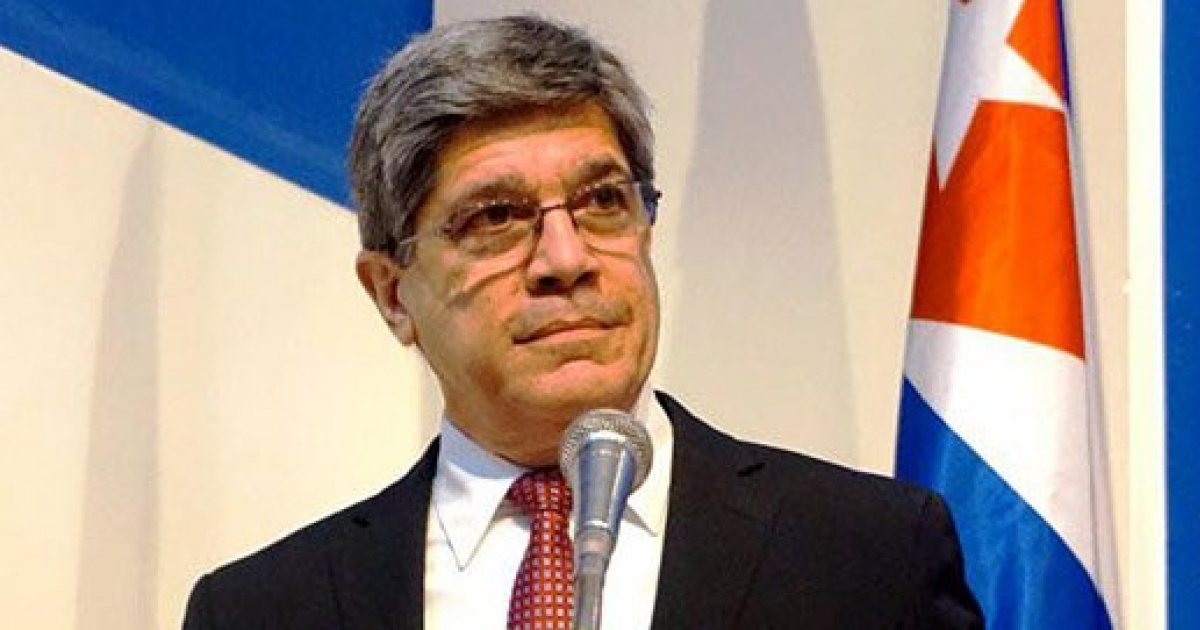
On Friday, Cuban Deputy Foreign Minister Carlos Fernández de Cossío declared that the nation's political system is off the table for negotiation, along with any government positions.
During a press briefing, De Cossío highlighted the sensitivity of talks with the United States, which are being conducted with "secrecy." He refused to provide specific details about these discussions.
"I can absolutely confirm that the Cuban political system is not up for negotiation, nor are the president or any government positions, either with the United States or any other nation," he stated, as reported by the EFE agency.
The official condemned any attempts to undermine the Caribbean nation's independence as "completely unacceptable for Cuba."
Dialogue Over Hostility
De Cossío emphasized that Cuba remains open to dialogue with the United States on mutually beneficial topics, such as cooperation in combating drug trafficking and organized crime.
He assured that the Cuban government's "consistent stance" is its "willingness" to engage in dialogue, which will not change "despite the increased hostility" from Washington. "We see no other path" to resolve our differences, he pointed out.
Criticism of U.S. Policies
The deputy minister criticized what he described as Washington's "ruthlessly aggressive policy" towards the island, citing the "effective energy blockade" since January and recent "illegal and illegitimate threats."
Nonetheless, he emphasized that Cuba believes that despite these "bilateral differences," both countries can maintain a "respectful relationship."
"Cuba does not pose a threat to the United States," he asserted.
Reaction to U.S. Rhetoric
Fernández de Cossío's statements align with a message from Miguel Díaz-Canel last Wednesday, accusing Washington of threatening to overthrow Cuba's constitutional order by force.
"The U.S. publicly threatens Cuba almost daily with forcibly toppling the constitutional order. And they use a disgraceful excuse: the harsh restrictions of the weakened economy they have been attacking and attempting to isolate for over six decades," Díaz-Canel wrote on X.
The Cuban leader accused the U.S. government of seeking to "take over the country, its resources, properties, and even the economy itself," describing the embargo as a "fierce economic war" meant as "collective punishment against the entire population."
High-Level Discussions
This confrontation followed statements from former President Donald Trump and Secretary of State Marco Rubio earlier in the week. Trump claimed that Cuba is a "failed nation" and expressed his intent to take it over: "If I free it, I take it. I think I can do whatever I want with it."
Rubio demanded radical changes, stating that Cuba's economy "does not work" and insisting on new leadership: "They need to put new people in charge. They must change drastically."
This exchange occurred days after Díaz-Canel confirmed that Cuban officials are engaging in discussions with representatives of the U.S. administration, aiming to "find solutions through dialogue to bilateral differences."
The leader added that these exchanges have been conducted at the highest level: "Led by the Army General as the historical leader of our revolution (explicitly referring to Raúl Castro) and myself, and coordinated with the top structure of the party, the state, and the government."
This announcement marked a 180-degree turn from the official stance maintained for weeks.
On January 12, Díaz-Canel himself had denied the existence of such talks, limiting them to "technical contacts in the migratory field."
In February, Deputy Minister Fernández de Cossío stated that "this dialogue has not begun." On March 10, the regime again denied negotiations.
Díaz-Canel outlined four objectives for the conversations: identifying the most severe bilateral issues, finding solutions, assessing both parties' willingness, and exploring areas of cooperation for regional security.
He also noted that the Cuban side insists that the process be developed "on the basis of equality and respect for the political systems of both states."
Key Questions on Cuba-U.S. Relations
What is Cuba's stance on negotiating its political system?
Cuba's government, as stated by Deputy Foreign Minister Carlos Fernández de Cossío, firmly maintains that its political system and government positions are non-negotiable in any discussions with the United States or other nations.
How is Cuba handling talks with the United States?
Cuba is approaching talks with the U.S. with secrecy, focusing on mutually beneficial topics such as security cooperation against narcotics trafficking and organized crime, despite tensions and hostilities from Washington.
Why does Cuba criticize U.S. policies?
Cuba criticizes the U.S. for its aggressive policies, energy blockade, and threats, which it sees as attempts to undermine Cuba's sovereignty and destabilize its economy as a form of collective punishment.