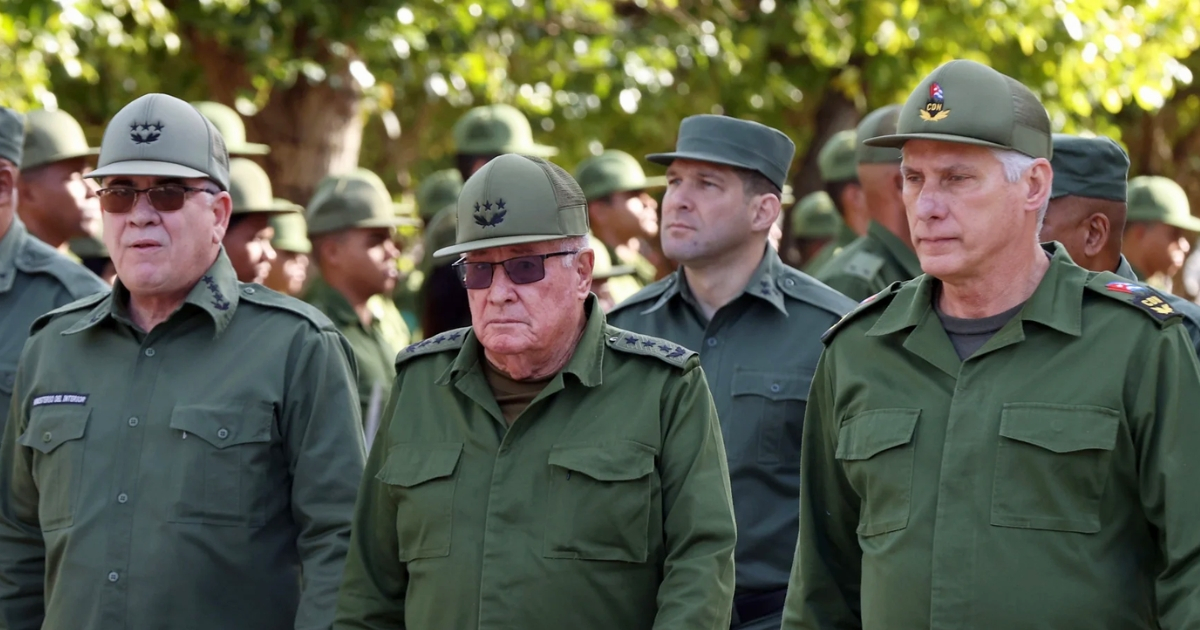
In recent days, Cubans have witnessed a telling image that leaves no room for doubt. During official meetings led by Miguel Díaz-Canel, the person announcing "measures" is not only the appointed leader, but also an individual with no clear public responsibility to the nation: Raúl Guillermo Rodríguez Castro, known as "The Crab."
His frequent appearances on state television seem far from coincidental. They underscore the notion that the real power in Cuba does not reside within the institutions the regime displays, but within a family nucleus that has long dictated control over the Cuban Armed Forces (FAR), GAESA, and consequently, what remains of the country.
This power has a name and surname. And it does not answer to the Cuban people.
The question that officers, colonels, and generals of the FAR must confront is as straightforward as it is uncomfortable: Will they risk the lives of their men and plunge the nation into armed conflict, not to defend Cuba, but to protect a single family?
Not to safeguard the Cuban people.
Not to uphold national sovereignty.
But to defend a power structure that has treated the country as inherited property.
This is the crux of the matter. Because in any scenario of military escalation, the FAR would not be engaging in a battle among equals. They would be drawn into a confrontation against the world's most powerful military, vastly superior in numbers, technology, logistics, budget, and operational capacity. It would not be a realistic defense of the homeland. It would be a futile sacrifice to shield an elite.
And even worse: to protect an elite whose most visible face at this moment is a descendant of power, elevated by surname and bloodline, not by any known military achievement that justifies such influence. While thousands of officers have dedicated their entire lives to the military career, enduring the deterioration of their salaries, living conditions, and the future of their families, that privileged circle has lived in luxury, excess, and secrecy.
There is no moral or patriotic justification to ask a Cuban officer to sacrifice his men for this.
The true loyalty of the FAR should not be to a family. It must be to the nation.
Thus, the solution does not have to be an absurd war or blind obedience. It can be an act of historical responsibility: a coordinated, peaceful national disobedience to any order that pits the FAR against the Cuban people or exclusively serves the survival of the Castro family.
Such a step could pave the way, without firing a shot, toward an orderly transition, an urgent humanitarian intervention, and a national renewal.
Cuba is in need of change. And that change begins not with an order, but with a decision.
The decision to refrain from using weapons against the people and not to sacrifice the country for a family.
Understanding the Cuban Armed Forces' Dilemma
What is the current role of Raúl Guillermo Rodríguez Castro in Cuba's power structure?
Raúl Guillermo Rodríguez Castro, despite having no clear public role, is frequently seen in official meetings and on state television, indicating his significant influence within the family-dominated power structure in Cuba.
Why is the loyalty of the Cuban Armed Forces being questioned?
The loyalty of the Cuban Armed Forces is under scrutiny because it appears to be aligned more with protecting the Castro family's interests rather than defending the Cuban nation and its people.
What alternatives are suggested for the Cuban Armed Forces?
The article suggests that the Cuban Armed Forces should consider a peaceful, coordinated national disobedience to orders that would harm the Cuban people or serve only the Castro family's interests, paving the way for a humane transition and national renewal.