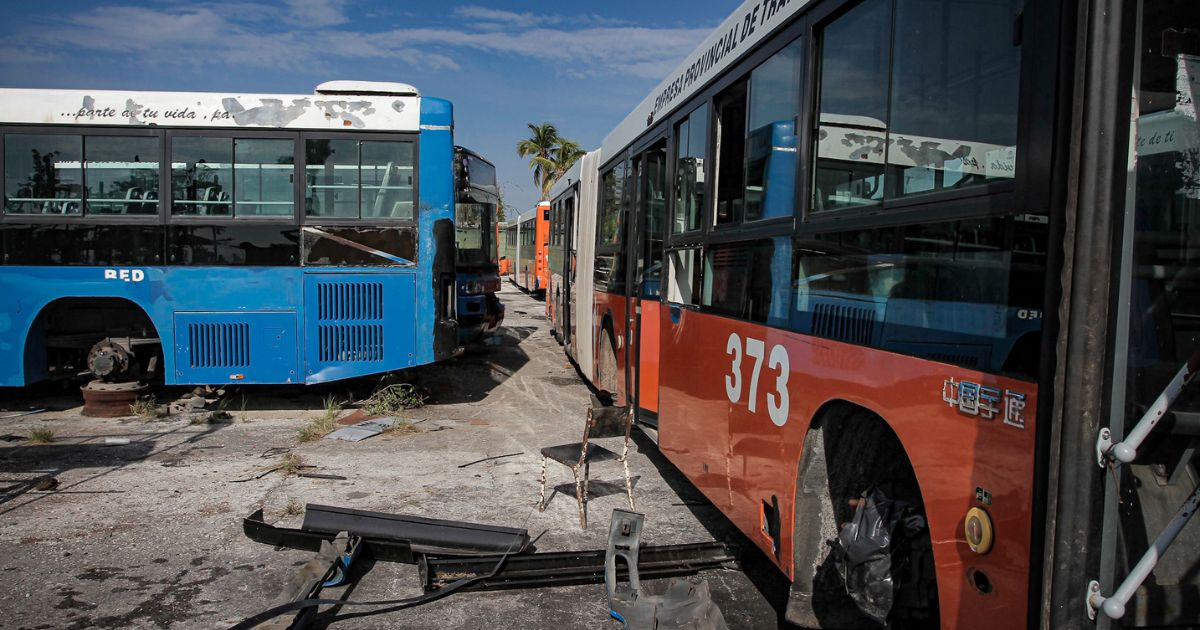
The transportation system in Cuba is experiencing one of its most challenging periods in decades, characterized by halted routes, a severe fuel shortage, and years of accumulated structural deterioration. Despite this, the Minister of Transportation, Eduardo Rodríguez Dávila, continues to announce measures and plans that fail to address the deepening crisis.
During his appearance on the official program Mesa Redonda, Rodríguez Dávila acknowledged the significant impact the sector is facing, attributing much of the situation to what he calls the United States' "energy blockade."
However, his explanations inadvertently highlighted longstanding internal issues: low technical availability, a lack of lubricants, deteriorated infrastructure, and a system incapable of maintaining basic services.
Rodríguez Dávila explained that, due to the fuel shortage, the government has been forced to drastically cut services.
National buses now operate with only a single departure daily, trains run just once every eight days, and the ferry to the Isla de la Juventud is limited to two weekly trips. Many other transport services have been entirely suspended.
Local Solutions and Improvisations
Locally, authorities have attempted to mitigate the crisis with makeshift solutions: the use of "medibuses" to transport over 70,000 passengers, the reorganization of electric tricycles, and the involvement of private operators.
Essential services have been prioritized, such as the transportation of more than 12,800 students from special schools and around 2,900 hemodialysis patients.
Promises and Future Plans
Looking ahead to 2026, the minister announced plans for assembling 50 minibuses and 50 hearses, distributing 150 electric tricycles to municipalities, acquiring the first urban electric buses with renewable energy charging stations, 400 electric cars for hemodialysis services, and completing the ambulance fleet.
Furthermore, plans include installing charging stations with solar panels on the national highway and other high-demand areas.
Yet, these promises stand in stark contrast to a reality that has been deteriorating for years without visible structural solutions.
Underlying Issues
Beyond the official narrative, the collapse of transportation is neither a recent phenomenon nor solely attributable to external factors.
For decades, the lack of maintenance, the obsolescence of the vehicle fleet, the scarcity of spare parts, and poor planning have progressively weakened the system, leading to the current situation.
The statistics are clear: state passenger transportation in Cuba plummeted by 93% from January to September 2025, reflecting the extent of the collapse.
In everyday life, this translates into a country where getting around has become a daily ordeal.
Impact on Daily Life
In many cities, services have nearly vanished. In Havana, there were recent instances where all urban routes were suspended due to fuel shortages.
In other provinces, the situation is as dire or worse. In Ciego de Ávila, only two out of 135 bus routes are operational, while trains have been entirely halted due to the lack of diesel.
Nationwide, interprovincial travel cancellations are rampant. In Las Tunas, virtually all bus departures have been suspended, leaving only a nightly service to Havana.
For the population, the consequences are devastating. Long waits, sometimes lasting several hours, have become the norm. In many cases, even paying for transportation is not an option.
The rising cost of tickets, which can multiply in a matter of days, has made mobility an unaffordable luxury for many Cubans.
Wider Implications
Without real solutions, many citizens are forced to walk long distances, rely on bicycles, or depend on an informal market where prices can consume a significant portion of the monthly salary.
Recent accounts describe even a "total void" of transportation in some areas, where vehicles are simply unavailable for hours.
This deterioration also impacts key sectors like health and tourism. Patients needing regular treatments must be transported in precarious conditions or remain hospitalized due to a lack of transportation, while workers face immense challenges in reaching their workplaces.
The current situation highlights not just a temporary crisis but the result of years of neglect and failed decisions.
While the government continues to blame external factors, the everyday reality for Cubans reveals a system that has been progressively crumbling without effective responses.
Meanwhile, official promises accumulate, but the streets tell a different story: crowded bus stops, empty roads, and a country where moving around has become a daily challenge.
Key Questions About Cuba's Transportation Crisis
What are the main causes of Cuba's transportation crisis?
The crisis is primarily attributed to years of inadequate maintenance, obsolete vehicle fleets, a lack of spare parts, and poor planning, compounded by recent fuel shortages.
How has the transportation crisis affected daily life in Cuba?
The crisis has made transportation a daily ordeal, with long waits, service suspensions, and rising ticket costs making mobility challenging for many Cubans.
What measures has the Cuban government proposed to address the crisis?
The government has proposed plans for assembling minibuses and hearses, distributing electric tricycles, acquiring electric buses and cars, and installing solar-powered charging stations.