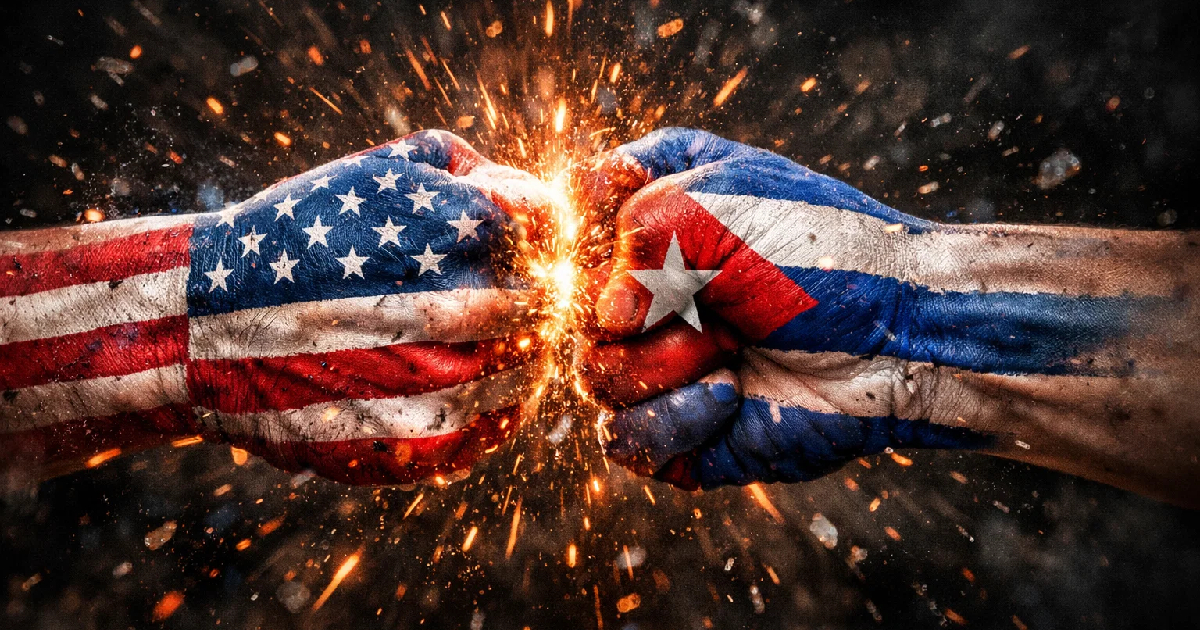
It was inevitable. U.S. Secretary of State Marco Rubio expressed dissatisfaction with Cuba's recent economic reforms, labeling them as "insufficient," while emphasizing the need for a regime change on the island. The diplomatic chess game continues at the highest levels.
Less than a week ago, Miguel Díaz-Canel publicly acknowledged discussions with the northern neighbor and directed his ministers to promote "transformations" intended to stimulate the Cuban economy. On Monday, Vice Prime Minister Oscar Pérez-Oliva Fraga addressed the media, first with NBC and later at a press conference, to discuss reforms in foreign investment policies aimed at attracting capital from the Cuban diaspora, whom the regime has historically disparaged. Rubio immediately criticized these moves as inadequate, suggesting that the regime is bluffing without a strong hand.
The standoff unfolded in the Oval Office on Tuesday morning. Rubio, alongside President Donald Trump and Irish Prime Minister Micheál Martin, told reporters that the economic reforms allowing Cuban-Americans to invest in the island were insufficient. He also reiterated the administration's commitment to achieving a regime change in Cuba, echoing prior comments by Trump about taking decisive action regarding Cuba.
In a bid to discredit the Cuban government's overtures to diaspora investments, Rubio insisted that the regime's political and governmental system is beyond repair, and the economy is dysfunctional. He argued that the announced reforms were not drastic enough to address the issues, urging the regime to make significant trade decisions, thereby directing them on the necessary path forward.
Highlighting the shortcomings of the measures revealed by Pérez-Oliva Fraga, Rubio reiterated that the Cuban economy is a relic surviving on past Soviet and Venezuelan subsidies, which are no longer forthcoming. He concluded that the current leadership lacks solutions, advocating for new leadership to navigate the crisis. This stance aligns with the U.S. administration's position in talks with the Cuban government.
The stark contrast between Cuba's proposed changes in diaspora investments and Rubio's insistence on regime change underscores the wide gap between both parties. Achieving a consensus seems improbable without significant compromises, and the negotiations could drag on indefinitely, especially given the Cuban regime's tendency to delay and deflect issues.
Meanwhile, the regime's media outlets are already pushing back. State-run Cubadebate quoted Díaz-Canel asserting that, even in the worst-case scenario, any external aggressor would face "impenetrable resistance."
This conflict-oriented strategy overlooks the dire humanitarian crisis in Cuba, where mounting protests and social unrest could lead to explosive outcomes. The Trump administration's resolve is well-known, making it a critical moment where neither side can afford delays.
Following the initial move by the regime, which has left Oscar Pérez-Oliva Fraga politically weakened, the future of the vice prime minister and Minister of Foreign Trade and Investment appears bleak. His efforts to entice diaspora investment have failed to impress, signaling the limited offerings of Díaz-Canel's administration.
Reportedly, informed sources in the negotiation have already suggested sidelining the communist leader due to his obstructive nature. If that occurs, Pérez-Oliva Fraga's political career could be effectively over, as his prospects in a future democratic Cuba have evaporated. Yet, despite the setback, he has hinted at the regime's openness to trade with American companies, indicating he remains intent on staying relevant in the power transition. Being related to Fidel and Raúl Castro may not be the advantage he expected, but his determination to remain in the game is evident.
Key Questions on U.S.-Cuba Relations
What were the main criticisms of Marco Rubio regarding Cuba's economic reforms?
Marco Rubio criticized Cuba's economic reforms as insufficient and stressed that a more radical change is necessary to fix the country's economic issues.
How did the Cuban government respond to the criticism from the U.S.?
The Cuban government, through state media, emphasized their resilience against external aggression and asserted their intention to continue with the proposed economic transformations.
What impact did the recent talks have on Oscar Pérez-Oliva Fraga's political standing?
The talks have negatively affected Oscar Pérez-Oliva Fraga's political standing, as his initiatives to attract diaspora investments were deemed unsuccessful, diminishing his future prospects.