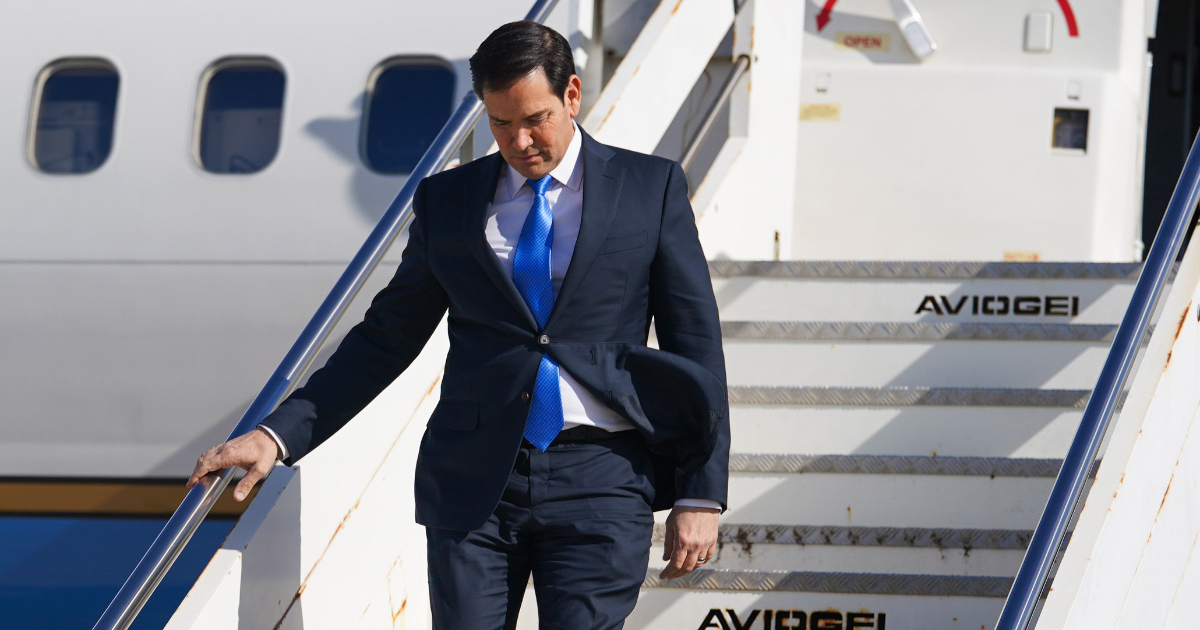
The New York Times has publicly addressed U.S. Secretary of State Marco Rubio after he dismissed a report by the newspaper as "fake news." The report discussed alleged conditions set by Washington in its interactions with the Cuban regime.
Through spokesperson Charlie Stadtlander, the Times stood by the accuracy of its reporting, emphasizing that Rubio has yet to present any factual counterarguments to the published content.
According to the statement shared by the user, Stadtlander posted on X: "Secretary Rubio: As our article indicates, this information is based on discussions with four individuals knowledgeable about the U.S.-Cuba talks."
Stadtlander also highlighted that the Times' journalists reached out to the State Department "well before publication" to request comments and received no objections regarding the information they were about to release.
The response concluded with a firm assertion: "Neither you nor anyone else has provided any factual refutation to the information. Our reporting is truthful and accurate."
The Times' response came in the wake of Rubio's denial of the article published on March 16, in which the newspaper claimed that the Trump administration had set the removal of Miguel Díaz-Canel as a condition for advancing negotiations with Havana.
The journalistic piece cited four anonymous sources familiar with the discussions between the two governments.
Rubio's Reaction and the Media's Credibility
Rubio responded to the publication on X with a particularly harsh critique of the media and their sources.
"The reason so many American media outlets continue to publish fake news like this is that they keep relying on charlatans and liars who claim to be well-informed as their sources," the U.S. diplomat asserted.
One of the most contentious aspects of the report was not just the alleged ousting of Díaz-Canel but also the actual scope of the described change.
The Impact of U.S. Conditions on Cuban Power Dynamics
The New York Times itself noted that the United States "so far is not pushing for any action against members of the Castro family, who remain the main power players in the country."
This statement sparked criticism among Cubans both inside and outside the island, as it was interpreted to mean that the potential removal of the current leader would not necessarily lead to a deep transformation of the system.
Many reactions agreed on a central idea: that Díaz-Canel does not represent the true core of power but is instead a figure subordinate to a political-military elite where Raúl Castro's influence remains significant.
From this perspective, any change limited to replacing the president would be seen as cosmetic, insufficient to alter the existing power structure in Cuba.
Broader Implications and Future Prospects
The report also mentioned other potential objectives for Washington, such as the release of political prisoners and gradual economic reforms, including increased openness to foreign investment.
However, these elements were overshadowed by the debate over whether a potential negotiation with Havana would lead to a real transformation or merely a superficial reconfiguration of the same political system.
This controversy is also part of a broader context. Since the beginning of the year, Rubio has maintained that the Cuban crisis is a result of the island's own political and economic model, and both he and Trump have insisted that any progress in relations will depend on internal changes in Cuba.
Meanwhile, Díaz-Canel recently acknowledged the existence of contacts with the United States while continuing to attribute the energy and economic crisis to U.S. sanctions.
Thus, the public response from The New York Times to Rubio has transformed the dispute into more than just a diplomatic denial: it has become an open clash between the Secretary of State and one of the leading U.S. newspapers over the credibility of their sources, the scope of the contacts with Havana, and the nature of the changes Washington might be willing to accept in Cuba.
Understanding the U.S.-Cuba Diplomatic Tensions
What was the main accusation by Marco Rubio against The New York Times?
Marco Rubio accused The New York Times of publishing "fake news" regarding alleged conditions set by Washington in its interactions with the Cuban regime.
How did The New York Times defend its report?
The New York Times defended its report by stating that it was based on conversations with four well-informed individuals and that no factual refutations were provided by Marco Rubio or anyone else.
What were the potential objectives of Washington mentioned in the report?
The report mentioned potential objectives such as the release of political prisoners and gradual economic reforms, including increased openness to foreign investment.