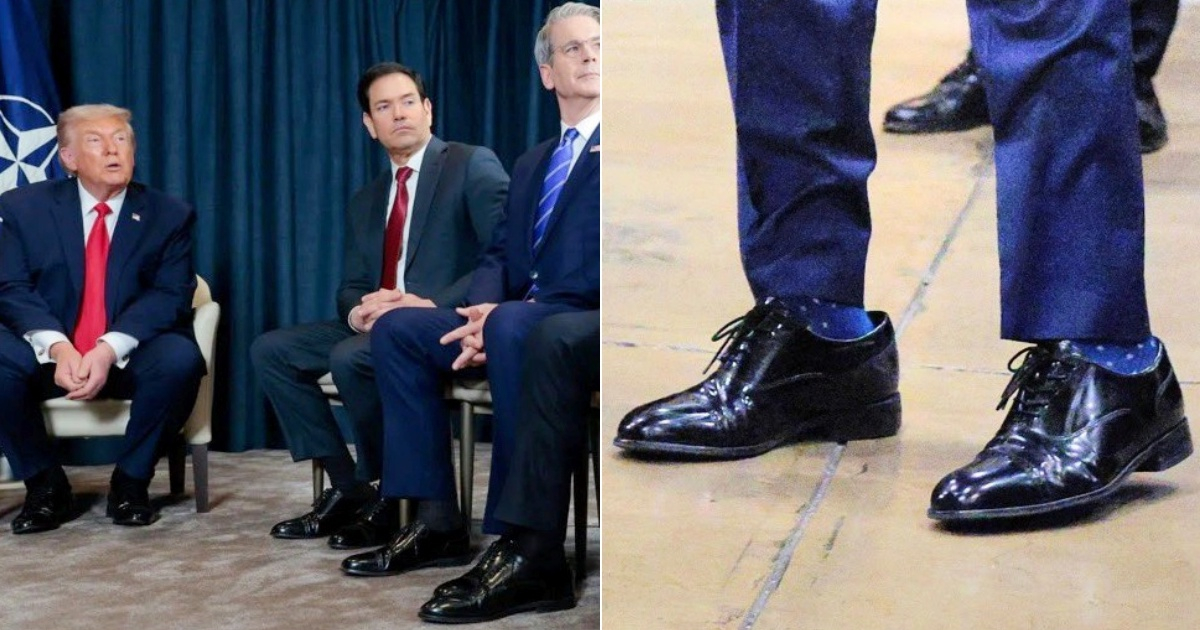
In Donald Trump's White House, where every action can turn into a political signal, a seemingly trivial practice has become a peculiar mechanism of control, belonging, and aesthetics: the president gives shoes to those around him.
Not just any footwear, but a specific model that, according to a recent revelation by The Wall Street Journal, has turned into an unofficial uniform within his inner circle.
Far from being a mere eccentricity, this habit has gained symbolic weight among advisors, secretaries, and influential figures in the Trump orbit. Many interpret it as a sign of presidential approval and, simultaneously, a difficult expectation to avoid.
The Ritual Begins with a Glance
According to sources cited by the WSJ, the routine often plays out in private meetings and informal gatherings.
Trump scrutinizes his interlocutors, not just their gestures or arguments, but also their shoes.
If he finds the footwear lacking, his comments are blunt.
Sometimes, he goes further: he estimates the person's shoe size by sight and instructs an aide to order a pair.
Days later, a brown box from Florsheim appears on the recipient's desk, sometimes accompanied by a brief note or even signed by the president himself.
The gesture doesn't end there. Trump has adopted the habit of directly inquiring if the gift has been received and, in some cases, checking visually if the shoes are being worn.
From Gift to Internal Code
Over time, what started as a personal touch has evolved into a widespread practice within the presidential environment.
High-level officials, advisors, and political allies have received their pair. Among them, according to the WSJ, are Vice President J.D. Vance, Secretary of State Marco Rubio, Secretary of Defense Pete Hegseth, Secretary of Commerce Howard Lutnick, and Secretary of Transportation Sean Duffy, as well as media figures like host Sean Hannity.
The repetition of the gesture has created a kind of internal code. "All the guys have them," a White House official told the cited newspaper. Another added with irony: "It's hilarious because everyone is afraid not to wear them."
That phrase summarizes the real impact of the gift: beyond courtesy, there's implicit pressure. Not wearing the shoes in Trump's presence could be seen as a lack of harmony or, at the very least, an awkward sign.
Trump's Image Obsession
One of the most telling episodes of this practice occurred during a meeting in the Oval Office. According to J.D. Vance, Trump looked at the footwear of several attendees and expressed his disapproval.
He then pulled out a catalog, asked for sizes, and ordered new pairs.
His comment that followed, for many, encapsulates his understanding of personal image: "You can tell a lot about a man by his shoe size."
The scene not only illustrates his obsession with details but also his tendency to intervene in areas that, in other contexts, would be irrelevant in high-level politics.
Shoes That Don't Always Fit
Trump's method—often guessing shoe sizes "by eye"—doesn't always yield precise results. Some recipients have ended up with pairs that don't fit properly.
The most visible case has been Marco Rubio, who was photographed wearing shoes notably larger than normal.
The image has sparked a flood of memes on social media in recent days.
According to sources cited by the WSJ, such situations haven't stopped recipients from wearing the footwear, even when uncomfortable, to avoid clashing or displeasing the president.
Aesthetic as an Extension of Power
Trump's interest in appearance has been a constant throughout his career.
His image—dark suit, white shirt, and red tie—has become a carefully constructed personal brand. But that control isn't limited to his own appearance.
The president has shown his disapproval of what he considers aesthetic errors, like wearing light or brown shoes with dark suits.
In his view, such combinations disrupt visual coherence and project an inappropriate image.
In this context, the Florsheim shoes serve a dual purpose: correcting what he perceives as "bad taste" and homogenizing his team's image.
An Accessible Symbol with Greater Meaning
The model chosen by Trump is a classic black leather Oxford, with laces and a simple design.
A traditional shoe, virtually unchanged for decades, that fits the formal style the president promotes.
What's striking is that it's not an exclusive item. Priced around $145, it's far from the luxury typically associated with Trump's public image.
Founded in 1892 in Chicago by German immigrant Sigmund Florsheim, the brand has been a benchmark of formal American footwear for over a century.
Currently part of the Wisconsin-based Weyco Group, the company has gone through different stages, including a bankruptcy in 2002 before reorganizing.
However, within the White House, the value of these shoes isn't in their price or exclusivity, but in what they represent: a sign of closeness to the president.
Between Loyalty and Discomfort
In addition to some opting to wear the shoes even if they don't fit, to avoid displeasing the president, others have had to set aside luxury brands in favor of the model chosen by Trump, prioritizing the leader's perception over their own preferences.
In that sense, the gesture transcends symbolism and becomes part of the everyday. It's not an item stored away but worn, visible, in every meeting.
Trump was already known for distributing symbolic items to allies and visitors: MAGA hats, presidential coins, signed photos, or markers. But the leap to shoes introduces a different nuance.
Here, it's not just about commemorating an encounter but establishing a behavior pattern. The gift isn't passive: it demands to be worn, displayed, and, to some extent, validated.
In an environment where every detail counts, the footwear has become a silent indicator of alignment with the president.
A Small Detail with Big Revelations
Amid global debates, geopolitical tensions, and high-impact decisions, the image of top officials walking through the White House in matching shoes might seem anecdotal. However, it contains a deeper logic.
Trump's gesture turns an everyday object into a tool of influence. It sets standards, marks affiliations, and, above all, reinforces his presence even in the tiniest details.
Because in his environment, as he himself made clear, even something as simple as a pair of shoes can say much more than it seems.
Frequently Asked Questions About Trump's Shoe-Giving Practice
Why does Donald Trump give shoes to his cabinet members?
Trump uses the practice of giving shoes as a symbolic gesture of approval and as a means to promote a cohesive image among his inner circle.
What kind of shoes does Trump give and why?
Trump gives a classic black leather Oxford shoe from Florsheim, which aligns with the formal style he promotes. It serves both as a correction of what he perceives as stylistic mistakes and to homogenize the team's appearance.
How do recipients feel about receiving the shoes?
Recipients often feel the pressure to wear the shoes to align with Trump’s expectations, even when the shoes may not fit comfortably.