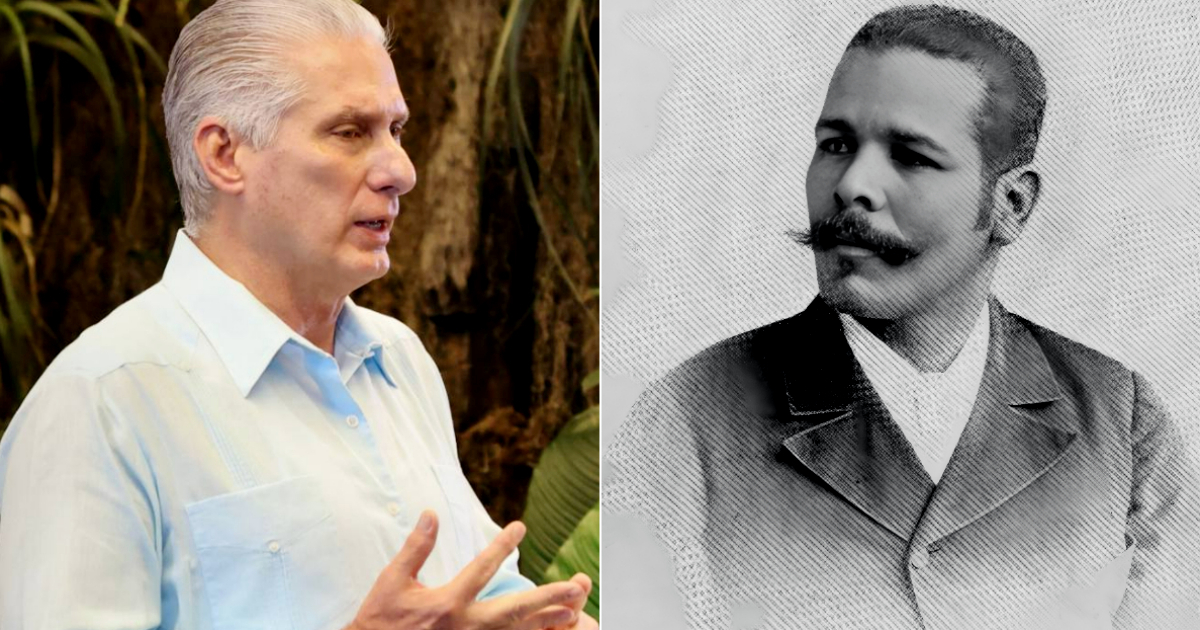
Miguel Díaz-Canel's recent post on the Baraguá Protest unleashed a torrent of reactions on Facebook, predominantly filled with criticism, ridicule, and political rejection of the Cuban leader. This comes at a sensitive time following the official acknowledgment of talks with the United States.
Designated by Raúl Castro, Díaz-Canel wrote on Facebook: "Baraguá invokes the unyielding stance of Antonio Maceo against the Pact without independence: 'We do not understand each other,' he told the Spanish counterpart, rallying his troops to 'break the corojo' shortly thereafter. We shall always owe our dignity to that legacy."
However, this appeal to a symbol heavily used by official propaganda did not garner the anticipated support. Instead, numerous comments reinterpreted Antonio Maceo's legacy against the regime and turned the phrase "We do not understand each other" into a slogan from the people to those in power.
Opposition's Reinterpretation of Baraguá
A prominent pattern was the opposition's appropriation of the Baraguá symbol. Several comments argued that Maceo fought not for a system without freedoms but for the independence and dignity of the Cuban people.
"Baraguá was about saying NO to a pact without freedom. Today, millions of Cubans also say NO to living without rights, without a voice, and without a future," one person wrote. Another echoed this sentiment: "True dignity would be for the Cuban people to live freely, prosper with their work, and not have to leave their country to seek a future."
Many messages flipped Díaz-Canel's historical analogy, casting the Cuban people in Maceo's role while portraying the regime as the opposing side being told "We do not understand each other."
Historical Manipulation Criticized
A significant number of reactions also questioned the political use of history, accusing Díaz-Canel of manipulating patriotic figures to uphold a narrative that clashes with the current reality.
"You manipulate history to your advantage," one user remarked. Another found the comparison "almost disrespectful," reminding that Baraguá occurred "in a war scenario," whereas a contemporary government should focus on "managing the economy, ensuring citizen welfare, and running institutions."
Disconnect Between History and Reality
The public's opinion revealed another dominant theme: the erosion of the heroic narrative amidst the country's material crisis. Many comments countered the official epic with concrete references to hunger, blackouts, shortages, and the deterioration of everyday life.
"With that legacy of dignity, we feed our children, have electricity, water, gas, food, medicine, and a dignified life," one user wrote sarcastically. Another summed up the social fatigue with a blunt phrase: "The history is lovely, but these are different times, and Cuba is dying."
Mockery and Dismissal of Authority
The tension between slogans and starvation surfaced repeatedly. "No one lives off history. The people need food, electricity, medicine," noted one comment. Another added, "Always with history and an empty belly, how long will this go on?"
In numerous messages, the criticism was not only political but also moral: the ruling elite was accused of invoking sacrifices they do not share and demanding resilience from a position of privilege. "It's easy for you to keep living off a people dying of hunger and misery," read one response.
Adding to this was the element of mockery as a form of delegitimization. The post garnered a notable volume of sarcastic comments, verbal memes, and references to Díaz-Canel's physical appearance, his weariness, and a supposed growing fear.
"Your time is running out," "Just leave," "Pack your bags," and "No one wants you in power" were recurring expressions. Beyond the tone, all pointed to the same issue: the questioning of his authority and the perception of a weakening hold on power.
Contradictions and Current Political Climate
Another set of responses linked the post to the current political moment, highlighting the contradiction between Baraguá's rhetoric and the negotiations with Washington. "But you literally just admitted hours ago that you're negotiating," an internet user reproached.
Another sarcastically asked, "Are there or aren't there talks with the USA?" In several comments, the idea emerged that Díaz-Canel is trying to project toughness just as the regime signals retreat or seeks accommodation.
Overall, the invocation of Baraguá failed to rally the debate around revolutionary epic but instead opened a space for many Cubans to reinterpret that symbol as a break with power.
The phrase "We do not understand each other," intended by Díaz-Canel as a tribute to Antonio Maceo's patriotic intransigence, was repurposed by numerous commentators as a declaration of disconnection between the regime and a visible part of the citizenry.
Rather than reinforcing the official narrative, the post seemed to expose its main problem: the gap between the history invoked by power and the concrete experience of a country exhausted by scarcity, emigration, repression, and a lack of prospects.
In this divide, Baraguá ceased to be merely a regime-manipulated symbol, becoming once again, at least in the comments, a battleground of contention.
Understanding the Public's Reaction to Díaz-Canel's Remarks
Why did Díaz-Canel's post receive so much criticism?
Díaz-Canel's post was criticized because it attempted to use historical symbolism in support of the regime, which many Cubans felt was a manipulation of history that did not reflect their current reality of scarcity and lack of freedoms.
What is the significance of the phrase "We do not understand each other" in this context?
Originally used by Antonio Maceo in the historical context of Baraguá, the phrase "We do not understand each other" was repurposed by commentators as a message of disconnection and dissent from the Cuban people towards Díaz-Canel's regime.
How did the public reinterpret the legacy of Antonio Maceo?
The public reinterpreted Antonio Maceo's legacy as opposing the current regime, arguing that Maceo fought for the independence and dignity of the Cuban people, not for a system that restricts freedoms.