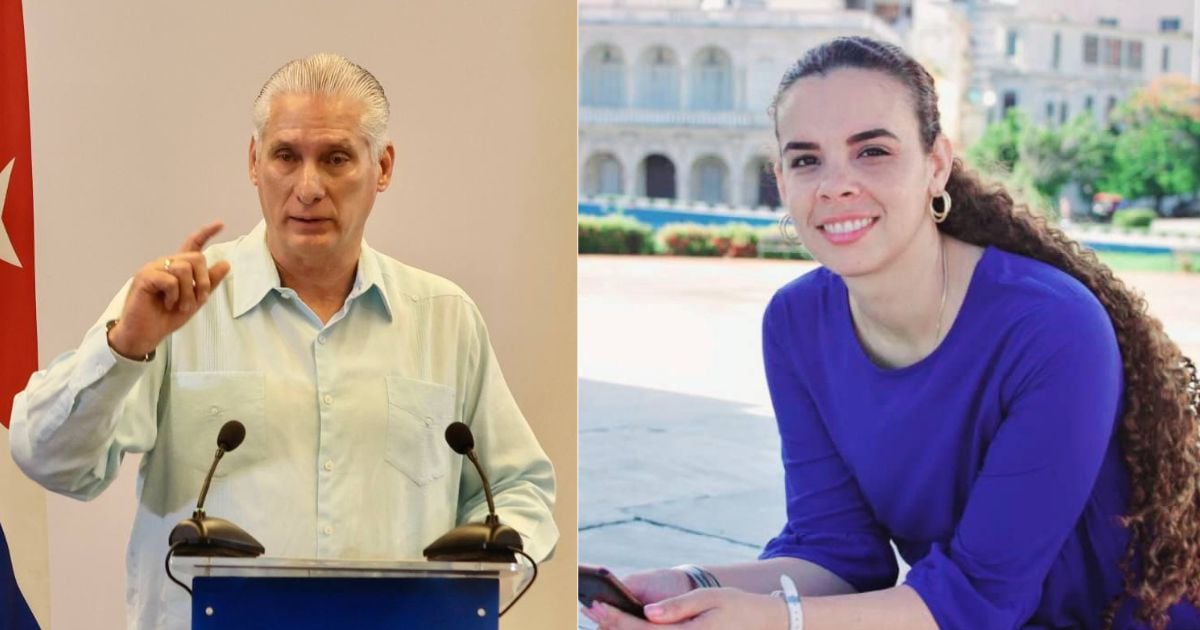
In the realm of official Cuban discourse, presidential addresses serve not only to inform but are woven into the narrative of "resistance," becoming chapters of so-called "collective glory."
This interpretation was shared on Facebook by Meyvis Estévez, the First Secretary of the Union of Young Communists (UJC), who offered her followers an enthusiastic and syrupy take on the recent speech by President Miguel Díaz-Canel.
According to Estévez, Díaz-Canel's speech exemplified "transparency" and served as a reminder that building the nation is a collective effort. She noted that the president addressed the "complexities of the energy blockade" and reaffirmed sovereignty as a non-negotiable right, a message she claimed bolstered the "commitment" of the youth.
Her post was filled with the usual slogans and the optimism typical of the island's political elite: a committed youth, a courageous people, and a nation informed and united in constructing "the Cuba we deserve."
However, as is often the case in the digital age, when comments aren't restricted, the public can quickly shift the narrative.
Aside from a few government loyalists who rushed to use the obligatory hashtags—#CubaIsFirm, #CubaWillOvercome, or #UJCofCuba—and expressed their support for the "statesman," the youth leader, and the political project, the overall tone of the discussion soon veered towards skepticism.
Critics emerged, targeting Díaz-Canel's hesitant speech and questioning the supposed "transparency" that led him to admit to conversations with the United States—talks everyone knew about but that he had denied until shortly before his address. Others mocked the vast chasm between political slogans and the harsh realities of daily life in Cuba.
Many users openly voiced their discontent with the government, posting messages like "Down with the dictatorship," "Homeland and Life," and calling for a "free Cuba." Sarcasm and exhaustion were palpable, as people asked where this narrative of resistance could lead when the populace can no longer endure even a minute more.
What "commitments" does the UJC secretary see when the young population, frustrated by the lack of freedom and opportunities, is emigrating worldwide?
Where is the "collective glory" in enduring over 30-hour blackouts, struggling to work without transportation, surviving on a month's salary that barely covers three or four days' worth of food, and watching the president on national television ask for more "creative resistance" during scarce moments of electricity?
Does Meyvis, so generous with her praise for her political superior, the intimidating First Secretary of the PCC, inhabit a Cuba that does not reflect the reality of millions of her fellow citizens?
Or perhaps when she spoke of "not being spectators, but active protagonists," she was referring to the youths in Morón who set fire to PCC symbols and furniture? Or maybe she was thinking of those who have been banging pots and pans in Havana and Matanzas neighborhoods for over a week? Or the people in Santiago de Cuba, recalling the indomitable spirit of their mambí ancestors?
Most likely, she was addressing the young political prisoners, those who received harsh sentences of 12, 15, 18, and even 25 years for demanding freedom, health, and food on July 11 and 12, 2021...
The script followed by the smiling and disciplined "leader" seemed to omit the real-life movie her commenters were projecting.
"The Cuba we deserve," she said. Indeed, we are heading there, but on different paths.
Understanding the Discrepancies in Cuba's Political Narrative
What was the main message of Díaz-Canel's speech according to Meyvis Estévez?
Meyvis Estévez described Díaz-Canel's speech as an example of "transparency" and emphasized that nation-building is a collective task. She also highlighted the president's discussion of the energy blockade's complexities and his reaffirmation of sovereignty as an inalienable right.
How did the public react to Estévez's interpretation of the speech?
The public reaction was largely critical, with many questioning the supposed transparency of the speech and highlighting the disconnect between political slogans and daily hardships. Critics also openly voiced their discontent with the government, using messages that called for change and freedom.
What are some of the challenges faced by Cuban citizens that contradict the official narrative?
Cuban citizens face numerous challenges such as prolonged blackouts, inadequate transportation, and insufficient salaries that barely cover basic needs. These hardships starkly contrast with the government's narrative of resilience and collective effort.
Why is there a significant youth emigration from Cuba?
Youth emigration from Cuba is driven by frustration over the lack of freedoms and development opportunities. Many young people see little hope for a prosperous future in the current political and economic climate.