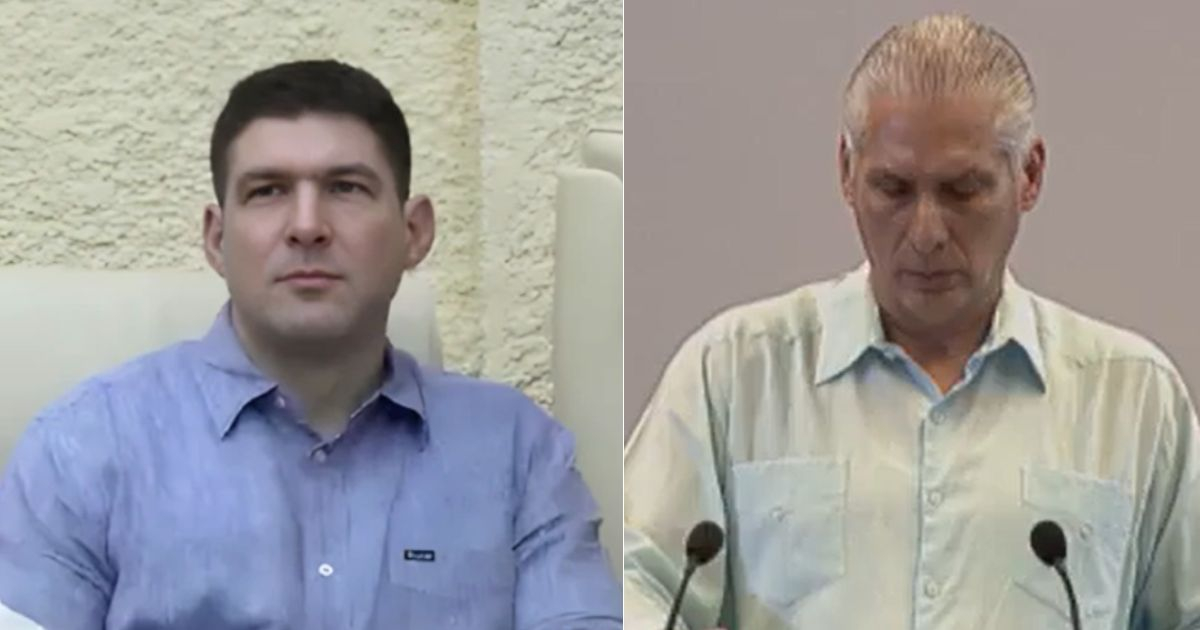
There was almost a sense of pity.
That is, if it weren't for the harm he has inflicted on the country as the president appointed by the Castro regime since 2018...
If it weren't for the fact that with reckless zeal, he issued the disastrous "combat order" for the armed populace to strike the defenseless on that infamous July 11, 2021...
If it weren't because he has consistently endorsed and defended every new repressive measure, every new ploy by the Cuban power structure to continue to degrade the impoverished in an environment lacking any democratic guarantees...
If not for all of that, indeed, Miguel Díaz-Canel on March 13, 2026, would have almost seemed pitiable.
With dark circles under his eyes. Gaunt. Hesitant. Rocking on his feet like a child's toy. His shirt hanging loosely, as if borrowed from Prime Minister Manuel Marrero, according to jokes circulating on social media. Forgetting the last name of his "friend," the president of Mexico. Calling Randy "Landy," one of his most dedicated sycophants. Stammering, with eyes sunken over pronounced cheekbones. And a scalp revealing barren patches.
Nearly on the verge of tears, like a child overwhelmed by a challenge. That's how he appeared at the "presentation" (not a real dialogue, with real press, as neither existed).
In his speech, in the tone in which it was delivered, and notably in what he failed to articulate, there was a palpable vulnerability that almost invited one to console him. Don't worry, Canelito, everything will be alright, Grandpa Raúl will help you out before Uncle Sam, or rather Uncle Trump, gets upset.
Across from him, in the audience, many shared the same somber mood. Arleen, devoid of her usual sycophantic humor, rushed through each new "question," praying the audience wouldn’t notice the pre-recorded nature of the "live" session. Legañoa, in a low, condescending tone, inquired about conversations with the U.S. government that he himself had recently dismissed on national television as non-existent, as malicious "schemes" by the enemy. Most remained silent, dispirited, lacking the "creative resistance" or "revolutionary energy" to showcase in the president's choreographed dialogue, as predetermined questions were laid out for him to expound on a hastily prepared power point.
Yet, someone in the back, with a gaze of arrogant calm, inspired a different sentiment. A sense of authority. A different backing.
The people of Cuba are now familiar with him. In the age of social media, where information spreads rapidly, his name and profile are the talk of the town, even public figures make jokes at his expense.
With the build of a bodyguard and the demeanor of an enforcer. A rugged profile, yet with defined angles and muscles. His eyes sink into a sinister focus. His gestures, robust, indicative of clumsiness even in secrecy; yet he embraces it, without complexes, in a "mailof" manner, because in the Royal House, toppling a glass or delivering a punch isn't a grave offense.
There he was, stoic and expressionless, El Cangrejo. Raúl Guillermo Rodríguez Castro. The head of Raúl Castro's security detail, but without Raúl. Essentially, a bodyguard out of his "guarding" realm.
The same lieutenant colonel or colonel from the Ministry of the Interior, who had "inexplicably" appeared hours earlier in reports of Canel's meeting with the top party, state, and ministerial leadership, where it was announced, as rumored, that negotiations with the United States were underway to resolve "bilateral differences."
A figure who doesn't belong to any formal power structure on the Island but carries the surname and audacity of his grandfather, and the ambition and calculation, it seems, of his father, the late general Luis Alberto Rodríguez López-Callejas, head of the military conglomerate GAESA, the custodian of Cuba's economy.
This very figure, according to credible media reports, has met with members of Marco Rubio's team, the U.S. Secretary of State; who jets in and out of Cuba on private planes for business transactions; and who lives, like the Castro-communist elite, untouched by the dire hardships plaguing the Cuban populace.
This imposing young man observed Canelo with the calm authority of a teacher overseeing an exam. Let's see, what will you say? Go on, you can do it. But don't make mistakes, remember, this is an evaluation.
And as the saying goes, an image can sometimes speak louder than a thousand words. From this "presentation," we are left with the image of both faces, the expression of both demeanors. Even if El Cangrejo appeared only briefly, it was with complete definition.
Who truly holds the reins of power in the country? How many more shaky appearances does Canelo have left? Will they continue directing the cameramen to highlight the lineage of the nation's rulers at public events? Will the script for the Castro family include a more prominent role for the Grandson?
How far will the reach of this empowered "crustacean" extend?
Questions. Questions. Don't miss the next episode. The drama is only beginning.
The Real Power Dynamics in Cuba
Who is El Cangrejo in the Cuban political landscape?
El Cangrejo, or Raúl Guillermo Rodríguez Castro, is the head of Raúl Castro's security detail and is known for his influential presence despite not holding an official position in the Cuban power structure. He is the grandson of Raúl Castro and often seen as a behind-the-scenes power player.
What role does Miguel Díaz-Canel play in Cuba's government?
Miguel Díaz-Canel is the president of Cuba, appointed by the Castro regime in 2018. Despite his position, there is speculation about his actual power and influence, as he often appears overshadowed by other figures such as El Cangrejo.
Are there ongoing negotiations between Cuba and the United States?
Reports suggest that there are indeed negotiations taking place between Cuba and the United States to address "bilateral differences." However, the details and outcomes of these talks remain largely speculative.