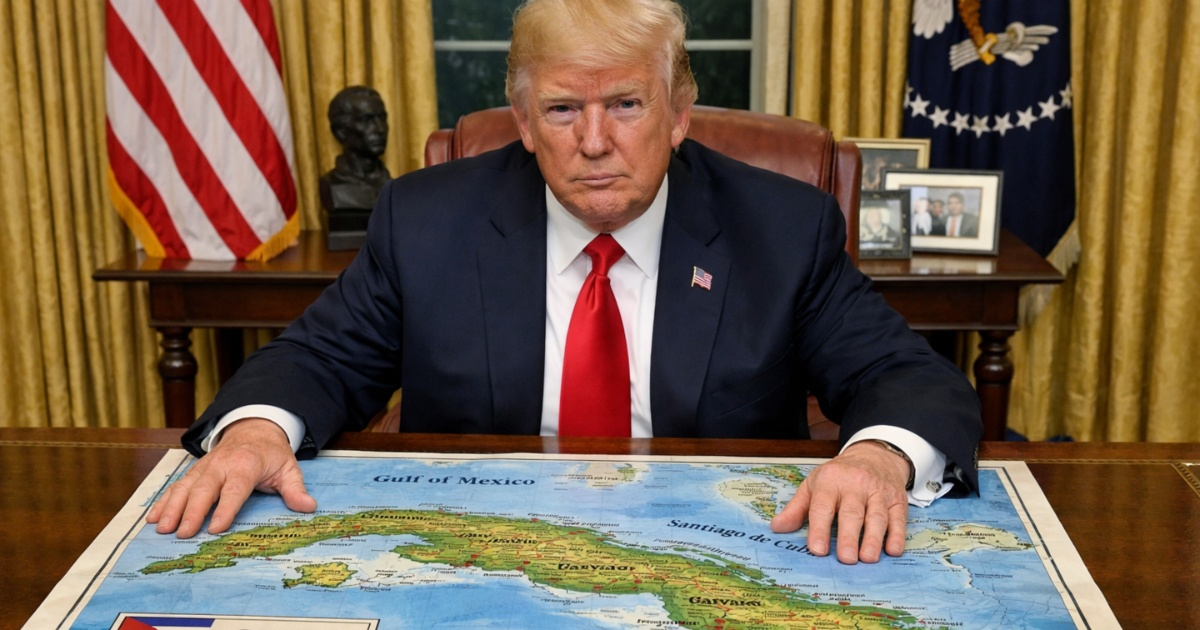
President Donald Trump has firmly dismissed the idea of military intervention by the United States in Cuba. During a direct inquiry from the Washington Examiner about potential operations on the island, the president made it clear that such actions would not take place. The concern was whether such operations might ignite further conflicts with drug cartels and other anti-American entities in Latin America.
The president's response was succinct and definitive: “That’s not going to happen.” This statement was made during a telephone interview with the media outlet on Thursday morning, as they sought to uncover Trump’s plans regarding Cuba.
The newspaper raised the possibility that a military operation in the Caribbean nation could spark fresh regional tensions, to which Trump responded by denying that scenario.
The Washington Examiner's question stemmed from Trump’s earlier remarks, where he suggested that Cuba might be next on his agenda following operations in Iran. However, in this instance, Trump distanced himself from the idea of a military intervention, stating again, “that’s not going to happen,” without elaborating on the future policy direction towards Havana.
The comment about Cuba emerged during a broader discussion focusing on the war with Iran and Trump’s international stance.
Following over a week of military campaigning in Iranian territory, Trump was not keen to discuss the possibility of receiving the Nobel Peace Prize, a topic also raised during the call. “I don’t know,” he replied when asked if Operation Epic Fury might assist him in achieving such recognition. “I’m not interested.”
The report places these remarks in a particularly tense context. The United States is investigating a Tomahawk missile strike on Shajarah Tayyebeh primary school in Minab, Iran, on February 28, the first day of the war, which resulted in the deaths of approximately 175 young girls.
Trump himself stated he would accept the findings of his administration’s investigation into that attack, while also hinting that Iran might be responsible.
In this context of military aggression in Iran, speculations about the White House’s next moves, and questions about Trump’s foreign policy in the hemisphere, the president’s words regarding Cuba represent a clear distinction from the possibility of U.S. military action on the island.
A "Friendly Takeover"?
The U.S. president previously suggested that Cuba might end up under a “friendly takeover.” He emphasized the severe economic and energy crises confronting the Cuban regime. “They’re running on what they call fumes. They have no energy, no money. They’re in serious trouble from a humanitarian perspective,” he noted.
Trump also stated that the Cuban government had long relied on support from Venezuela, particularly through oil supplies, but that situation has changed. The president added that his administration has increased economic and political pressure on the Cuban regime and expressed that the situation could be resolved through a deal.
Negotiations with Cuba
Trump’s remarks came just a day before Miguel Díaz-Canel confirmed that Cuban officials have been engaged in talks with U.S. government representatives, aiming to "seek solutions through dialogue to bilateral differences."
Díaz-Canel specified that the discussions have been conducted at the highest level: "Led by the Army General as the historical leader of our revolution and by me, and coordinated with the top structure of the party, the state, and the government," he declared, explicitly referring to Raúl Castro.
This announcement signifies a 180-degree shift from the official stance maintained for weeks. The leader described four objectives of the discussions: identifying the most severe bilateral issues, finding solutions, assessing both parties' willingness, and exploring areas of cooperation for regional security.
He also mentioned that "international factors have facilitated these exchanges" and that the Cuban side demands that the process proceed "on the basis of equality and respect for the political systems of both states."
Frequently Asked Questions about U.S.-Cuba Relations
Why did Trump rule out military action in Cuba?
President Trump ruled out military action in Cuba to avoid escalating conflicts with drug cartels and other anti-American entities in Latin America.
What was the context of Trump's remarks on Cuba?
Trump's comments on Cuba were made during a broader discussion on the war with Iran and the U.S.'s international stance, amidst ongoing military operations in Iranian territory.
How has the Cuban government responded to U.S. pressure?
The Cuban government, led by Miguel Díaz-Canel and Raúl Castro, has engaged in high-level talks with U.S. representatives to address bilateral issues and explore cooperation for regional security.