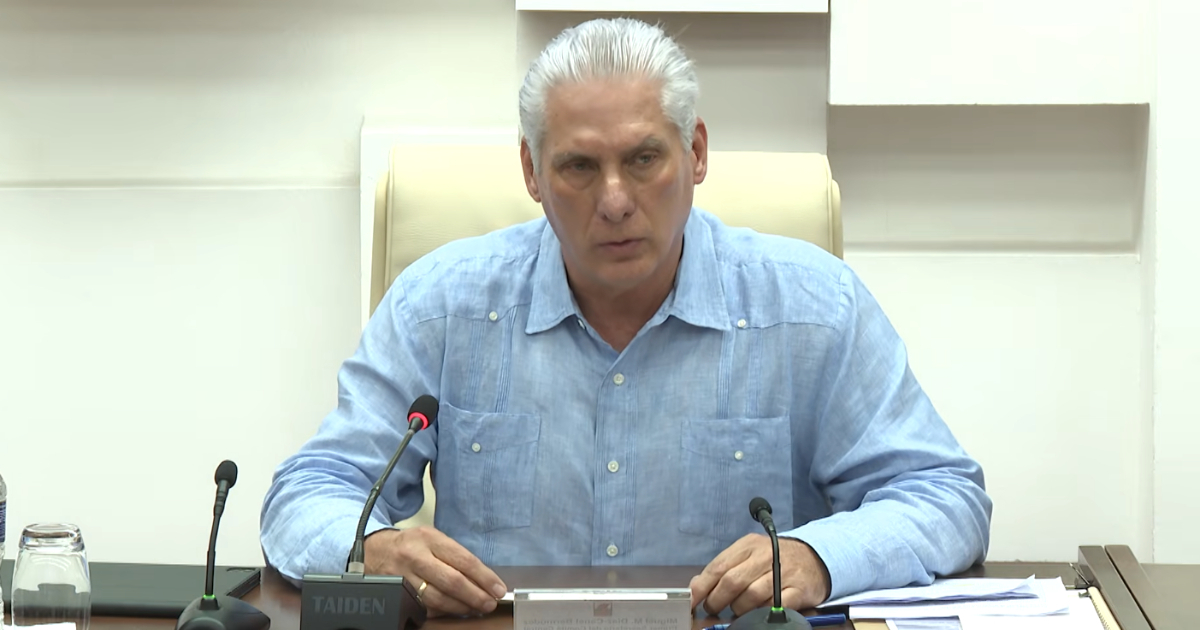
Recent remarks by Miguel Díaz-Canel revealing that Cuban officials have engaged in discussions with representatives from the United States government have sparked a wave of reactions among Cubans on social media. The responses were marked by criticism, disbelief, and frustration over the ongoing situation on the island.
Many comments highlighted the contradiction between Díaz-Canel's admission and the regime's prior denials. For weeks, Cuban authorities had refuted the existence of political negotiations with Washington.
On January 12, Díaz-Canel himself had dismissed claims of any discussions beyond technical migration contacts. In February, Carlos Fernández de Cossío, the Deputy Foreign Minister, insisted that political dialogue "had not started." Yet, the leader eventually acknowledged that Cuban officials have been in talks with U.S. representatives to "seek solutions through dialogue to bilateral differences," referring to negotiations between Havana and Washington initiated by Raúl Castro.
Social Media Reactions
The reactions from social media users were swift. The statements from Díaz-Canel prompted a flood of critiques of the regime and questions about the credibility of his assertions. One widely shared sentiment was: "Dictators don't leave, they must be ousted, remember that."
Some comments focused on the inconsistency between previous statements and the current acknowledgment by the Cuban government. "Didn't they say it wasn't happening?" asked one user. Similarly, another questioned, "Weren't they saying it was all Trump's lies? That there were no talks?"
Public Skepticism and Sarcasm
Disbelief was also evident in many messages. One user wrote, "So, yes or no? You can't trust these people." For others, the admission seemed overdue, given that the situation was already known publicly. As one comment put it, "The whole world knew it, nothing new."
Sarcasm was prevalent too: "I knew it, you knew it, they knew it, everyone knew it... And he's just finding out..."
Criticism of the Regime's Practices
Others criticized the anticipation surrounding the announcement. One user noted, "Well, I went back to sleep, got up early for nothing." Some directly questioned Díaz-Canel’s role in the political system, saying, "Always been a puppet," or pointing out, "You acknowledge now that Raúl Castro is in charge, and you're his puppet."
The criticisms extended to what some see as a habitual practice of the regime: denying certain information and later admitting it once it becomes undeniable. "That's to show once again they always lie," stated one comment. Another user echoed, "It's always the same: they claim everything's a lie, then say the opposite when convenient."
Economic and Energy Crisis
Some saw the admission as a sign of political pressure on the Cuban regime. A widely shared comment stated, "Hahaha they're so scared they've had to admit they're talking to Washington."
The economic and energy crisis in the country also fueled reactions. One user lamented, "I have no power." Another described a family's plight amid blackouts: "I haven't heard from my mom for 36 hours, no water, no electricity, no medicine; Cuba's paralyzed. What more do they want from Cubans?"
Many insisted the announcement doesn't offer immediate solutions to the country's problems. A comment summed it up: "So, was there a conversation or not? They're keeping people confused."
Díaz-Canel confirmed that Cuban officials have engaged in talks with U.S. representatives to explore solutions to bilateral issues. He explained these exchanges are under the direction of the regime's historical leadership, noting, "Led by the General of the Army as the historical leader of our revolution and me," explicitly referring to Raúl Castro.
The confirmation comes after weeks of public denials by Cuban authorities regarding political negotiations with Washington, contributing to the skepticism reflected in many comments.
This acknowledgment occurs amid a severe energy crisis on the island. Following the January 3rd arrest of Nicolás Maduro, Cuba lost a significant portion of the Venezuelan oil that supported its electrical system, exacerbating blackouts nationwide.
Concurrently, Washington has increased political and economic pressure on Havana, with reports of contacts between U.S. authorities and figures close to Raúl Castro's circle.
In this context, Cuban state television recently showed Raúl Guillermo Rodríguez Castro, grandson of the former Cuban leader known as "El Cangrejo," attending a high-level meeting about U.S. relations, which highlighted the ongoing discourse between the two countries.
Among Cubans reacting on social media, a mix of skepticism, regime criticism, and fatigue prevailed over a situation many deem unsustainable. As one of the most shared comments concluded: "Dictators don't leave, they must be ousted, remember that."
Understanding the U.S.-Cuba Dialogue
What prompted Díaz-Canel to admit to the talks with the U.S.?
Díaz-Canel's admission followed weeks of public denials by Cuban authorities about political discussions with Washington, likely prompted by increased political pressure and the need to address bilateral differences.
How have Cubans reacted to the confirmation of these talks?
Cubans have reacted with skepticism, criticism, and frustration, expressing disbelief in the regime's statements and highlighting the ongoing economic and energy crisis.
What is the significance of Raúl Guillermo Rodríguez Castro's involvement?
Raúl Guillermo Rodríguez Castro's presence at a high-level meeting indicates the continued influence of the Castro family in Cuba's political affairs, despite the leadership change.