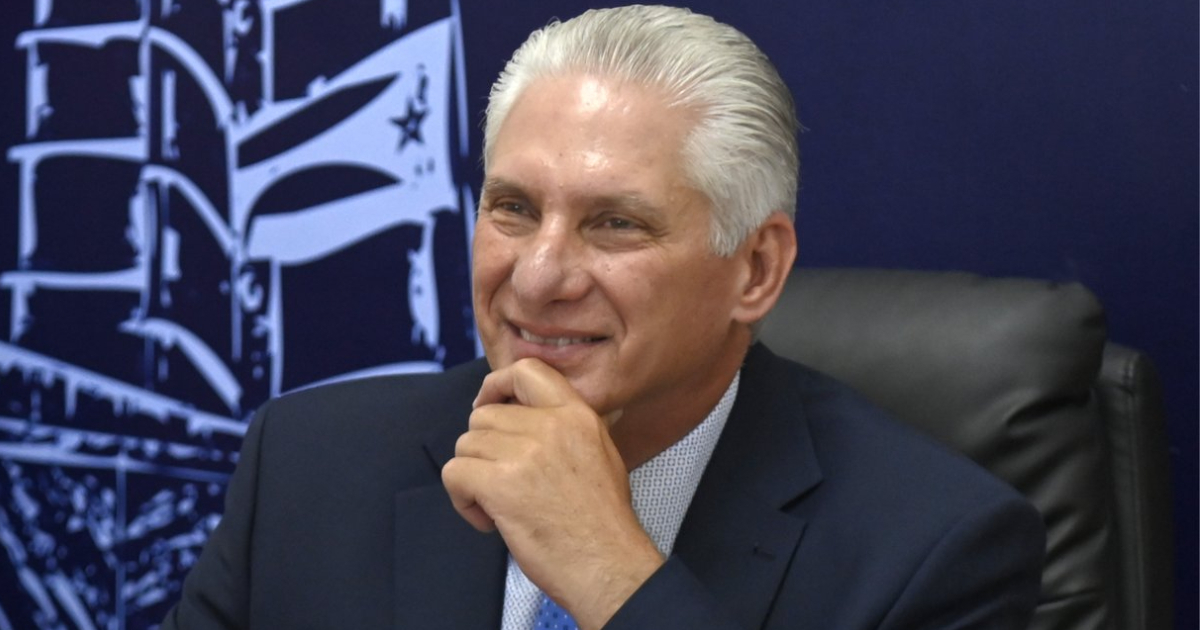
Shortly after being launched, two polls conducted by CiberCuba regarding Miguel Díaz-Canel's upcoming televised appearance reveal significant skepticism among Cubans. A total of 699 individuals participated in the surveys held via WhatsApp and Facebook, with the prevailing opinion being that the president will not bring anything new to the table.
On WhatsApp, 261 people participated: 195 chose "Nothing new" (75%), 53 opted for "More of the same" (20%), while only 13 believed in "Real changes" (5%). The Facebook poll, with 438 votes, mirrored these results closely: 78% went for "Nothing new," 18% for "More of the same," and 4% for "Real changes." Combined, both polls indicate that 537 votes—around 77% of participants—expect Díaz-Canel to announce nothing novel, 132 people (19%) foresee more continuity, and about 30 (4%) anticipate genuine changes.
The question posed was straightforward: "What do you think Díaz-Canel will announce today?" with three possible answers. The results underscore a pervasive skepticism among CiberCuba followers, whose Facebook page boasts over 6 million followers, about half of whom are based in Cuba. CiberCuba's WhatsApp channel, with more than 351,000 subscribers and a reach of 450,000 accounts—95% from within Cuba—echoed the same widespread sentiment.
Comments on the post echoed these sentiments. "Nothing new jjj," wrote Dallami Mayo. Yarumy Duran Bordeloy was more blunt: "Option zero." Hector VF offered a political perspective: "What Cubans truly want won't be announced by the regime; it will be revealed by the United States when the time comes. This is just another distraction strategy to keep people occupied."
Historical Context and Public Discontent
This Friday's address was announced as a follow-up to the February 5 dialogue, where Díaz-Canel admitted to a "severe fuel shortage," called for "creative resistance," and compared the crisis to the hardships of the 1990s Special Period. That speech was derided on social media as "empty rhetoric" and "more of the same," with the prevailing sentiment being: "Only those with power will watch," a nod to the frequent blackouts.
Since then, conditions have not improved. On March 7, the Communist Party of Cuba acknowledged "very difficult times" and reiterated the call for "creative resistance," a phrase now mocked with the saying "You can't eat creative resistance." On the same day and the next, prolonged blackouts sparked pot-banging protests in Marianao, Regla, Boyeros, El Cotorro, and Matanzas.
Crisis Indicators and International Perception
The electrical shortfall exceeds 2,000 MW, according to the Cuban Electric Union. The GDP has been shrinking for five years, with a projected 5% drop by 2025. The Cuban peso trades at 560 pesos per euro on the informal market, against an average salary of 6,830 pesos (about 12 euros). Tourism has plummeted from 4.7 million visitors in 2018 to 1.8 million in 2025. Additionally, the flow of Venezuelan oil stopped after Nicolás Maduro's capture on January 3, and an executive order by Trump on January 29 declared Cuba an "unusual and extraordinary threat," imposing tariffs on countries selling oil to Cuba.
The skepticism reflected in the polls aligns with the mood captured by international betting platforms: Polymarket assigns a 28% chance of the regime's fall before December 31, 2026, while Kalshi estimates a 48% likelihood of Díaz-Canel's departure before 2027, with $2.7 million in wagers placed. Cuban deputy Carlos Miguel Pérez Reyes encapsulated the sentiment on March 3 with a phrase that resonates now more than ever: "Necessary discourse, but implementation is needed."
Understanding Cuban Public Opinion on Díaz-Canel's Leadership
Why do many Cubans believe Díaz-Canel will not announce anything new?
Many Cubans are skeptical due to the persistent lack of significant changes or improvements in their living conditions under Díaz-Canel's leadership, as well as repeated calls for "creative resistance" without tangible results.
What are some indicators of Cuba's current economic crisis?
Key indicators include an electrical shortfall exceeding 2,000 MW, a shrinking GDP expected to fall by 5% by 2025, a depreciated Cuban peso, and a significant drop in tourism from 4.7 million visitors in 2018 to 1.8 million in 2025.