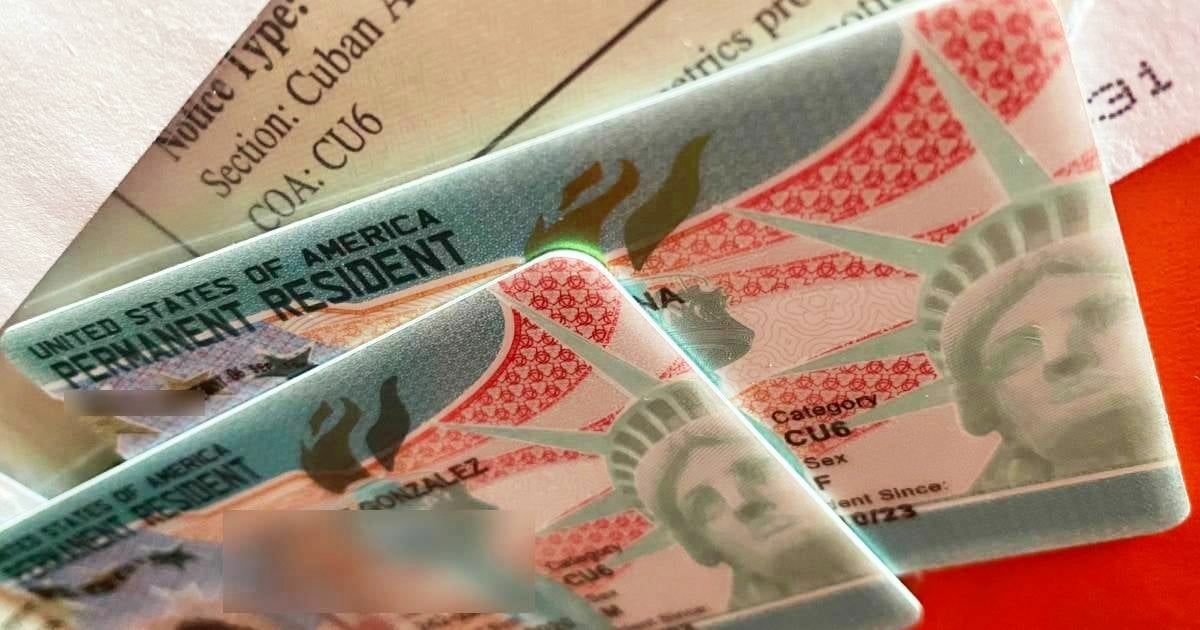
Thousands of Cubans residing in the United States, who are eligible for permanent residency, are facing increasing uncertainty due to the halt in their immigration processes.
In response, a team of attorneys is preparing a federal lawsuit against the U.S. Citizenship and Immigration Services (USCIS) to compel the government to advance thousands of stalled applications.
This legal initiative is spearheaded by immigration lawyer Claudia Cañizares and attorney Mark Prada. They argue that the suspension has significantly impacted numerous Cuban applicants who entered the country through various immigration channels and subsequently applied for permanent residency under the Cuban Adjustment Act.
Cañizares highlighted the substantial number of cases affected. "Our goal with this lawsuit is to push these processes forward, demonstrate the harm being inflicted on this community, and eventually secure approval of their residency," she stated in a recent interview with journalist Maylin Legañoa for Telemundo 51.
The Scope of the Problem
According to her estimates, over 100,000 cases might be impacted by the suspension or delay in processing green card applications.
During the waiting period, many applicants have not only seen their applications pause but also faced additional obstacles. In numerous cases, work permits have been denied, causing serious financial and legal difficulties for families already in the process of adjusting their immigration status.
Who Can Join the Lawsuit?
The legal action primarily targets Cuban nationals who entered the United States through specific migration programs and later applied for permanent residency under the Cuban Adjustment Act. Potential beneficiaries include:
- Cubans who entered through the Family Reunification Program.
- Individuals admitted under Humanitarian Parole.
- Immigrants who arrived with CBP One appointments.
- Applicants for residency under the Cuban Adjustment Act.
- Individuals not currently detained by immigration authorities.
Legal and Financial Considerations
Cañizares noted that, as a class-action lawsuit, there is a possibility that the federal government might reach a judicial agreement to expedite pending case reviews.
She also assured that participants have protection mechanisms against potential reprisals from joining a legal action against a federal agency. "In such cases, protections are requested so that individuals do not suffer retaliation," she explained.
Joining the lawsuit comes with costs. The legal team stated that fees vary based on family composition, starting at $4,000 for an individual, increasing to $6,000 for couples or single mothers with children, and reaching $8,000 for families with more than four members. Financing options and flexible payment plans are available for those interested in participating.
If the litigation results in a government agreement, some cases might be resolved relatively quickly. "If we reach an agreement with the government, it could be granted as soon as within one, two, or three months," Cañizares indicated.
How to Get Involved
Interested individuals can contact the legal firm directly at 305-680-0036. The team recommends sending a text or WhatsApp message with the phrase: "I am interested in joining the lawsuit." Alternatively, one can complete an online form, after which the legal team will follow up with calls or send additional information via email.
Background and Context
The suspension of numerous immigration processes stems from a broader policy adopted during Donald Trump's administration, which temporarily halted the processing of various immigration benefits—including asylum, permanent residency, and naturalization—for citizens from 19 countries deemed high-risk, including Cuba and Venezuela.
This policy was formalized through a USCIS memorandum issued in December 2025, instructing officials to pause multiple applications pending a comprehensive national security review. The order also called for reassessing previously approved immigration benefits for applicants from those countries.
The policy is also linked to the presidential proclamation known as the "travel ban," signed in June 2025, which restricted the issuance of several visa categories for Cuban citizens, including tourist, business, study, and academic exchange visas.
As a result, thousands of immigrants already in the United States—many admitted through humanitarian programs or family reunification processes—have been left in a migratory limbo while awaiting the processing of their permanent residency applications.
The impending federal lawsuit seeks to pressure authorities to reactivate these files and provide an answer to those who claim to have met all the requirements to regularize their status in the country.
FAQs on the Federal Lawsuit for Cuban Residency Applications
What is the purpose of the federal lawsuit?
The lawsuit aims to compel USCIS to advance stalled applications for permanent residency, primarily affecting Cuban nationals.
Who is eligible to join the legal action?
Cuban nationals who entered the U.S. through specific migration programs and applied for residency under the Cuban Adjustment Act are eligible.
Are there any costs involved in joining the lawsuit?
Yes, costs vary based on family composition, with fees starting at $4,000 for individuals and increasing for larger families.