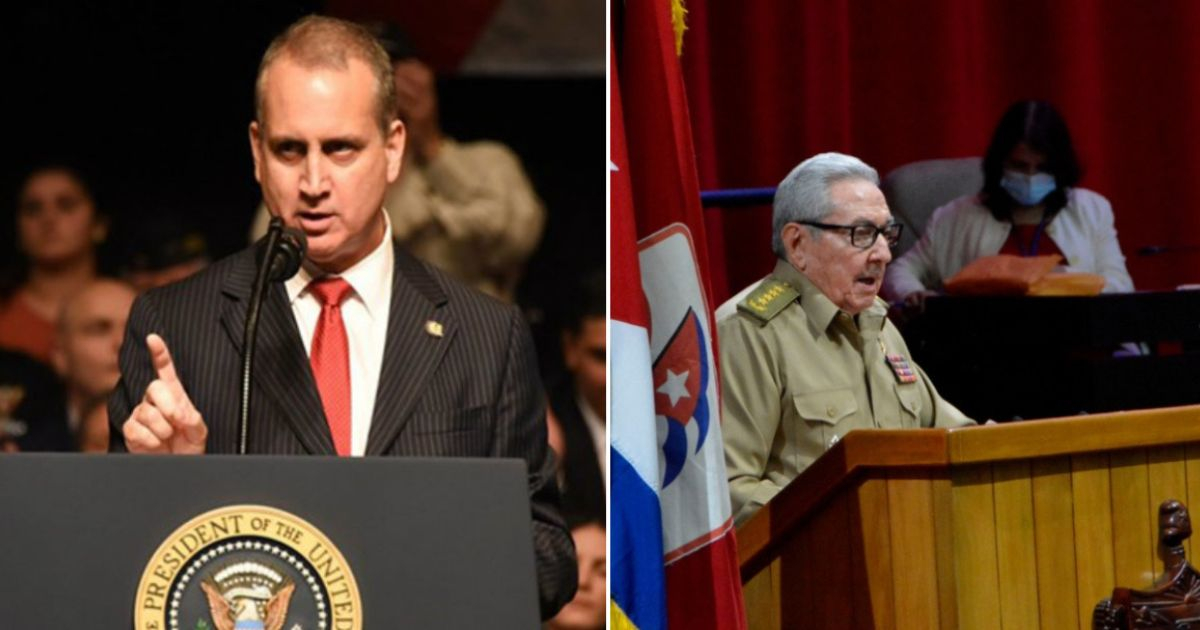
The Trump administration has been conducting covert discussions with members of Raúl Castro's inner circle, as disclosed by Cuban-American Congressman Mario Díaz-Balart.
This revelation, reported by the Miami Herald, highlighted statements from the Florida Republican regarding indirect communications between Washington and key figures associated with the long-time leader of Cuba's communist regime.
"There have been conversations with multiple individuals surrounding Raúl Castro, virtually everyone in his inner circle, at the highest levels, but these are not negotiations," Díaz-Balart stated.
The congressman likened these interactions to previous dialogues the U.S. administration had with Venezuelan leader Nicolás Maduro prior to his capture in a military operation earlier this year.
Although officially retired, the 94-year-old Raúl Castro is still regarded as the most influential figure within Cuba's political framework.
His family, along with high-ranking military officials, exerts control over essential sectors of the economy through the business conglomerate GAESA.
It was previously reported that advisors to Secretary of State Marco Rubio met last month with Raúl Guillermo Rodríguez Castro, Raúl Castro's grandson, during a meeting held on the Caribbean island of Saint Kitts.
However, Díaz-Balart emphasized that the U.S. administration's interactions with Castro's circle have been more extensive than previously acknowledged.
Among those who might be part of this inner circle are Colonel Alejandro Castro Espín, Raúl Castro's son; his daughters Mariela Castro and Deborah Castro; and senior military officials linked to the regime's economic control.
In recent days, Trump has indicated his intention to focus on Cuba following the resolution of the situation with Iran, reiterating his belief that the Cuban regime could soon collapse.
The American president also stated that Cuban government leaders are seeking a deal with Washington amid increasing economic pressure.
Measures implemented by his administration include halting oil shipments to the island from Venezuela and Mexico, exacerbating Cuba's ongoing energy crisis.
According to sources cited by the Miami Herald, among the ideas discussed in these informal exchanges are potential economic agreements that could make Cuba reliant on U.S. oil.
Díaz-Balart insisted that the Trump administration does not plan to make deals that would keep the Castro family in power.
"Partial changes are not acceptable; the concept of Raúl without Raúl is not acceptable to this administration," the congressman declared.
Meanwhile, Cuba is experiencing one of its worst economic and energy crises in recent memory, with prolonged blackouts, fuel shortages, and increasing social unrest among the populace.
Insights into U.S.-Cuba Relations
What are the key objectives of the U.S. in engaging with Raúl Castro's circle?
The U.S. aims to explore potential economic agreements that could increase Cuba's reliance on American resources, while also applying pressure to facilitate political changes away from the Castro family's influence.
How has the Trump administration impacted Cuba's energy crisis?
The administration has intensified Cuba's energy crisis by cutting off oil supplies from Venezuela and Mexico, compounding the island's economic difficulties.
Who are some of the notable figures in Raúl Castro's inner circle?
Notable figures include Raúl Castro's son, Colonel Alejandro Castro Espín, his daughters Mariela and Deborah Castro, and senior military officials involved in economic management.