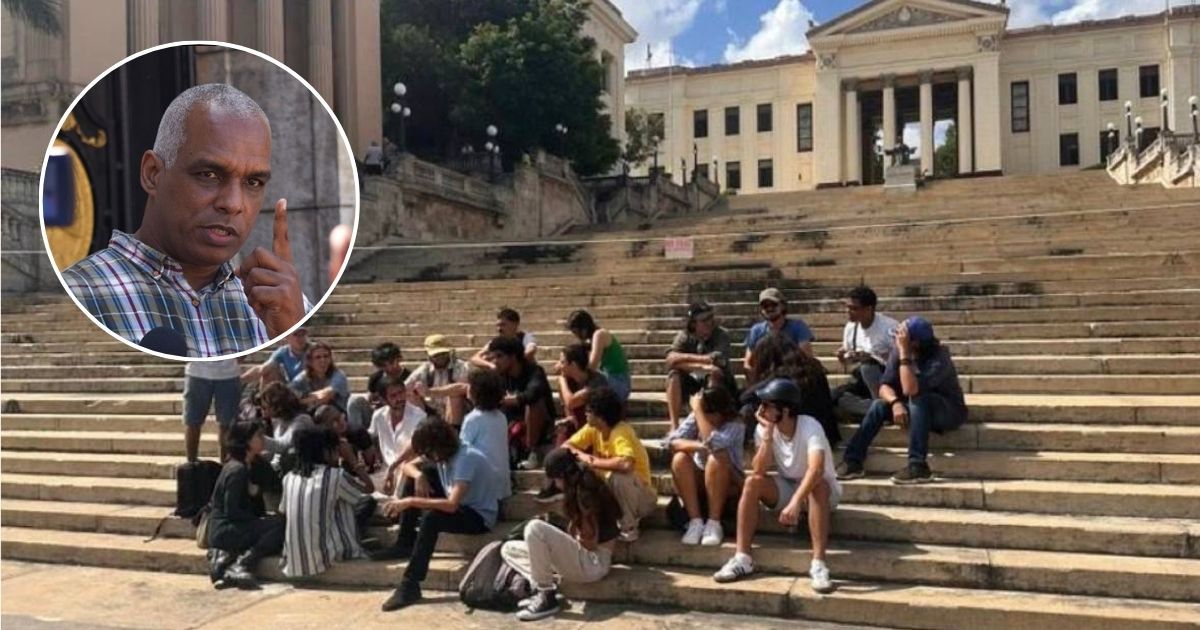
On Monday, approximately thirty students staged a sit-in on the steps of the University of Havana to express their discontent over power outages, lack of connectivity, and the broader impact of the ongoing crisis on higher education. This demonstration prompted Modesto Ricardo Gómez, the First Deputy Minister of Higher Education, to visit the site in an attempt to dissuade the students from continuing their protest.
The EFE news agency reported that Miriam Nicado Garcíala, the rector of the University of Havana, also appeared at the scene to help calm the peaceful protest.
During his interaction with the students, Gómez urged them to end the demonstration, stating, "This won't solve the problems we face." To which one student replied, "Because you haven't listened to us from the start."
After nearly two hours of negotiation, the students agreed to relocate within the university to continue discussions with the authorities. Following these talks, the Deputy Minister told the press that the hardships the country faces are due to the U.S. "petroleum blockade," which he described as an assault "devastating an entire society."
According to Gómez, the energy crisis affecting Cuba is a direct result of this external pressure, leading to an "extremely severe" situation across various sectors, including higher education.
The peaceful protest began around 10 a.m. when a student sat on the first step of the iconic staircase with an umbrella and a backpack, responding to a call circulated on social media. As time passed, more students joined the protest, accompanied by university faculty, administrative staff, and State Security agents.
Throughout the demonstration, students voiced their frustration over the challenges of studying amidst frequent power outages, which also disrupt internet access and mobile phone service. One student questioned a dean, asking, "How many hours of electricity did you have last week? And do you have connectivity when the power is out?" according to EFE.
Other students highlighted that many university attendees from the provinces have been unable to submit assignments or participate in academic activities due to the lack of connectivity.
Understanding the Impact of the U.S. "Petroleum Blockade" on Cuban Education
Why did the students at the University of Havana protest?
Students protested due to ongoing power outages, lack of internet connectivity, and the negative impact these issues have on higher education in Cuba.
What was the Deputy Minister's response to the protest?
The Deputy Minister, Modesto Ricardo Gómez, attributed the country's energy crisis to the U.S. "petroleum blockade," labeling it as an aggressive action harming Cuban society.
What challenges do students face due to the energy crisis?
Students face difficulties such as frequent power outages that hinder their ability to study, access the internet, and use mobile phones, affecting their academic performance.