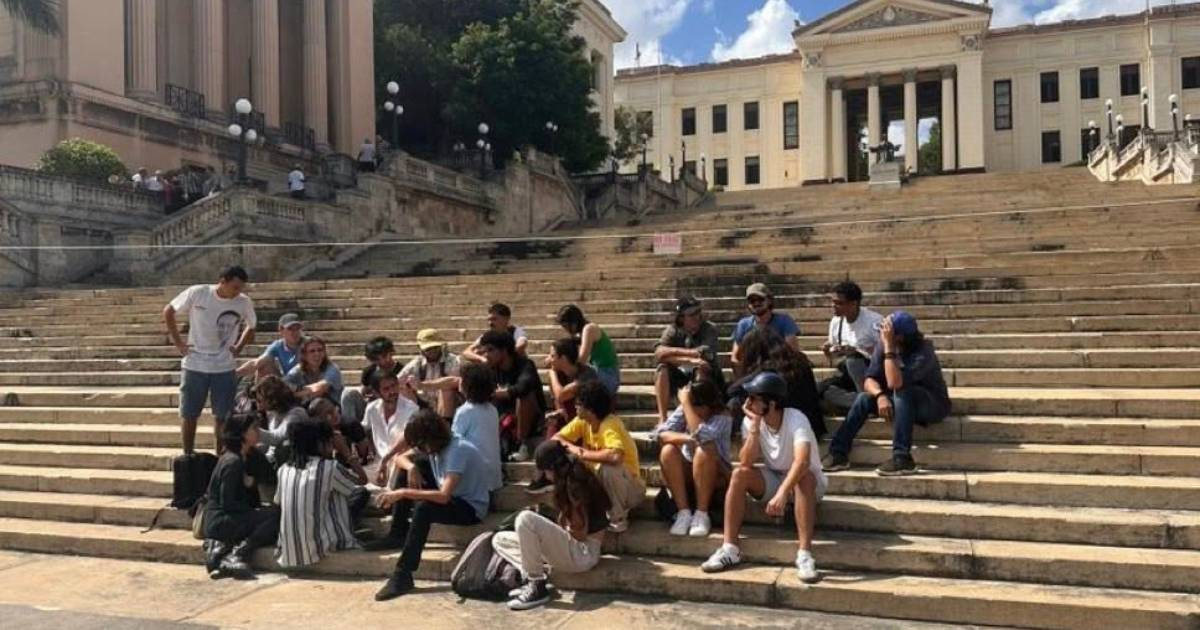
The student protest that erupted on Monday at the steps of the University of Havana took a significant turn when demonstrators opted to enter the institution to meet with university officials.
CNN's correspondent in Cuba, Patrick Oppmann, reported on social media platform X that the students moved inside the campus to engage in discussions with university staff and administrators.
"Update: The students have entered the university to meet with officials and administrators. The students claim that the power outages, transportation crisis, and rising internet costs have made it nearly impossible to study," the journalist noted.
The protest began as a peaceful sit-in on the historic steps of the Havana campus, led by around twenty students who were voicing the challenges they face in continuing their education amid the country's severe energy crisis.
The students are particularly critical of the decision to maintain hybrid or remote classes in several Cuban universities, despite the frequent power outages and connectivity issues affecting much of the nation.
According to statements shared by activist Magdiel Jorge Castro, many students believe it is unfeasible to continue studying under these conditions, as the lack of electricity and limited internet access prevent stable participation in virtual academic activities.
Compounding these difficulties is the deterioration of public transportation and the high cost of mobile data, factors which, according to the students themselves, exacerbate the situation and make the educational process nearly impossible.
The discontent appears not to be limited to the University of Havana. Testimonies shared on social media indicate similar unrest among students at other institutions, such as CUJAE and the University of Information Sciences (UCI).
During the initial hours of the protest, independent journalist Camila Acosta reported that students remaining on the steps were surrounded by State Security agents.
Amidst the tension, the University of Havana's leadership reportedly convened a director's council to address the situation created by the growing student dissatisfaction.
The meeting with university officials could represent the next chapter in a protest that highlights the direct impact of the country's energy and technological crisis on the everyday lives of young Cubans.
Understanding the Student Protests in Cuba
What sparked the student protests at the University of Havana?
The protests were sparked by students voicing their frustration over power outages, transportation issues, and high internet costs, which they claim make studying nearly impossible.
How are the students addressing their grievances?
The students have entered into discussions with university officials in an attempt to address their concerns regarding the energy crisis and its impact on their education.
Are other universities in Cuba experiencing similar protests?
Yes, there are reports of similar unrest at other institutions, including CUJAE and the University of Information Sciences (UCI).