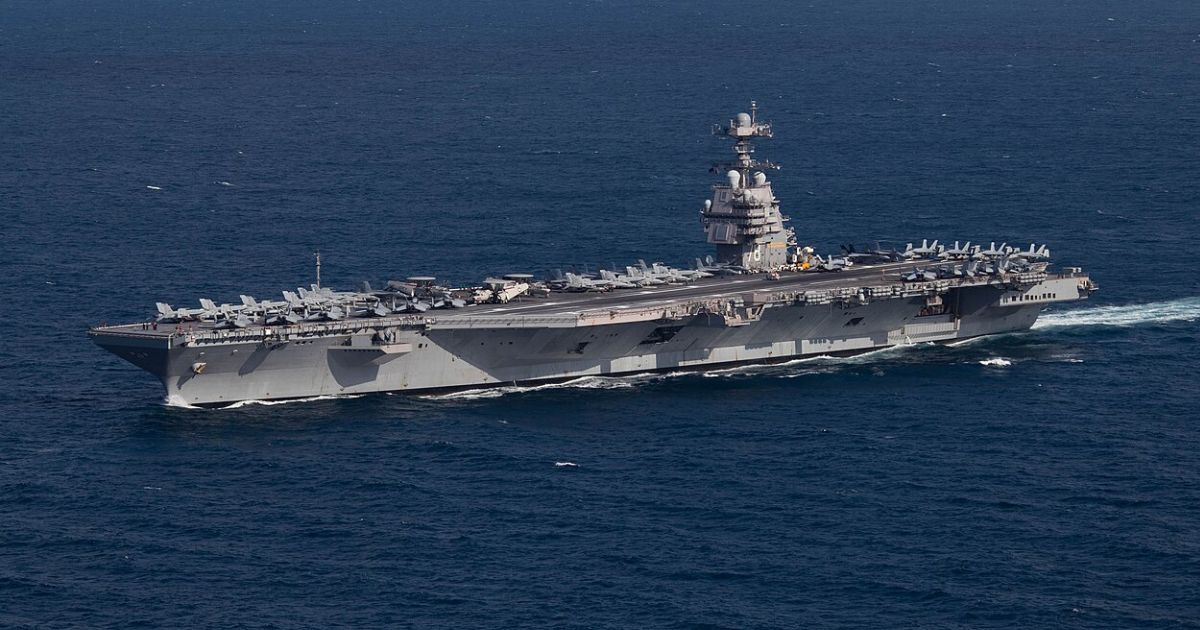
The world's largest aircraft carrier, the USS Gerald R. Ford, has successfully navigated the Suez Canal, arriving in the Red Sea on Saturday. This move brings the U.S. military presence closer to Iran amidst ongoing conflict involving the United States, Israel, and Tehran. Deployed from the Caribbean in mid-February by order of then-President Donald Trump, the nuclear-powered vessel boasts a crew of approximately 4,500 and houses over 75 aircraft.
Before its passage through the Suez, the Ford stopped at the Souda Bay naval base in Crete for refueling and technical checks, accompanied by the destroyer USS Mahan. The Ford then continued its journey on February 26, escorted through the canal by the USS Bainbridge.
This deployment comes amidst an unprecedented escalation of hostilities. On February 28, the United States and Israel initiated Operations Epic Fury and Roaring Lion, launching a coordinated air assault with around 200 combat aircraft targeting over 500 sites in Iran. These targets included nuclear facilities at Natanz, Isfahan, and Fordow, as well as Iranian Revolutionary Guard headquarters and naval assets. In the first 72 hours, more than 1,700 airstrikes were carried out.
Among the significant Iranian casualties was Supreme Leader Ali Khamenei, who was killed alongside his wife and a 14-month-old granddaughter during a bombing of his residence. On March 3, Israeli forces targeted the Assembly of Experts headquarters in Qom, disrupting succession plans. The Iranian navy suffered the loss of 17 ships, a submarine, and 11 additional vessels in the Gulf of Oman.
Iran retaliated with Operation True Promise 4, launching over 500 ballistic missiles and more than 2,000 drones against Israel and U.S. bases in Kuwait, Bahrain, Qatar, the UAE, Jordan, Saudi Arabia, and Iraq. On March 1, a drone attack killed four U.S. soldiers in Kuwait. Additionally, Tehran declared the effective closure of the Strait of Hormuz on March 2, a vital oil transit route, leading to over 150 oil tankers being stalled and a 7% spike in Brent crude prices.
With the Ford's arrival in the Red Sea, the U.S. now operates two carrier strike groups in the region for the first time: the Ford in the Red Sea and the USS Abraham Lincoln in the Arabian Sea, collectively deploying 13 destroyers armed with Tomahawk missiles and over 120 aircraft. This extensive naval power is unparalleled in recent Middle Eastern history.
On Friday, Admiral Brad Cooper announced a new offensive phase targeting the permanent destruction of Iran's ballistic missile industrial base. On Saturday, Trump claimed Iran had surrendered following an announcement by Iranian President Masud Pezeshkian to cease attacks on neighboring countries. However, Trump demands an unconditional surrender, threatening "a very hard hit" on previously unconsidered targets if Tehran fails to comply.
Key Questions on USS Gerald R. Ford and Middle East Tensions
What is the significance of the USS Gerald R. Ford's deployment to the Red Sea?
The deployment of the USS Gerald R. Ford to the Red Sea signifies an increased U.S. military presence in the region, aiming to deter Iranian aggression and support allied operations amidst escalating tensions.
How has Iran responded to U.S. and Israeli military actions?
Iran has retaliated by launching Operation True Promise 4, involving a barrage of ballistic missiles and drone attacks against Israel and U.S. military bases across the Middle East.
What impact does the closure of the Strait of Hormuz have on global oil markets?
The closure of the Strait of Hormuz, through which 20% of the world's oil passes, has caused a significant disruption, leading to a backlog of over 150 oil tankers and a 7% increase in Brent crude oil prices.