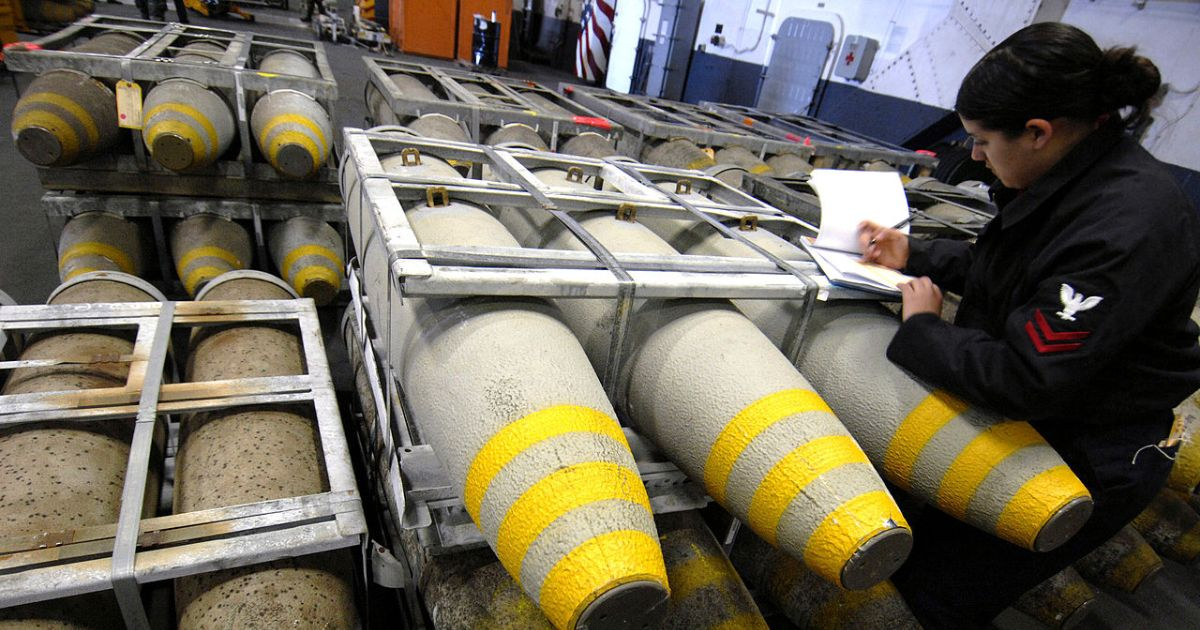
The U.S. Department of State has greenlit an urgent sale of 12,000 BLU-110A/B general-purpose bombs, each weighing 1,000 pounds, to Israel. This deal, valued at $151.8 million, was sanctioned by Secretary of State Marco Rubio through a special waiver that bypasses Congressional review.
The approval is based on the Arms Export Control Act. According to the State Department, "the Secretary of State has determined and provided a detailed justification that there is an emergency necessitating the immediate sale to the Government of Israel of the defense articles and services described." The primary contractor, Repkon USA, is based in Texas, and some of these munitions will be supplied from existing U.S. military stockpiles.
This transaction occurs amid the ongoing joint war between the United States and Israel against Iran, which commenced on February 28 with "Operation Epic Fury." In the initial days of the conflict, the Iranian Supreme Leader Ali Khamenei, along with his wife and a granddaughter, were killed, alongside top military officials like Defense Minister Aziz Nasirzadeh and Revolutionary Guard Commander Mohammad Pakpour. Other reports suggest civilian casualties in Iran have reached 1,300.
Iran countered with "Operation True Promise 4," launching over 500 ballistic missiles and 2,000 drones targeting Israel and U.S. bases in the region.
The BLU-110A/B bombs are general-purpose casings that can be fitted with JDAM guidance kits, transforming them into precision-guided munitions with a GPS accuracy range of 10 to 13 meters. This type of munition is among the most frequently used by the U.S. Air Force and Navy.
The State Department defended the operation by stating that "the proposed sale will enhance Israel's ability to address current and future threats, bolster its national defense, and serve as a deterrent against regional threats."
Simultaneously, President Donald Trump announced on his social media platform Truth that leading U.S. defense contractors, including Lockheed Martin and Northrop Grumman, have agreed to quadruple the production of advanced weaponry. "We aim to reach maximum production levels as swiftly as possible," Trump declared.
This isn’t the first emergency arms sale to Israel under the Trump administration. In February 2025, packages worth $7.4 billion were approved, followed by an additional $3 billion in late February, encompassing bombs, warheads, and Caterpillar D9 bulldozers; and in January 2026, another $6.67 billion package including Apache AH-64E helicopters, JLTV vehicles, and Namer armored equipment. In all instances, Rubio employed emergency mechanisms to bypass Congressional scrutiny.
U.S. defense giants project capital expenditures to reach $10.08 billion in 2026, marking a 38% increase from 2025, as reported by Melius Research.
Key Aspects of U.S. Emergency Arms Sale to Israel
Why did the U.S. approve the emergency sale to Israel?
The sale was approved to address an emergency situation that requires immediate defense support for Israel, enhancing its capability to counter current and future threats, and acting as a deterrent against regional adversaries.
What is the significance of the BLU-110A/B bombs?
BLU-110A/B bombs are significant as they are general-purpose munitions that can be upgraded with JDAM kits for precision targeting, making them a critical component of both the U.S. Air Force and Navy arsenals.
How has Iran responded to the U.S. and Israel's actions?
Iran launched "Operation True Promise 4," deploying over 500 ballistic missiles and more than 2,000 drones targeting Israel and U.S. military bases in the region.