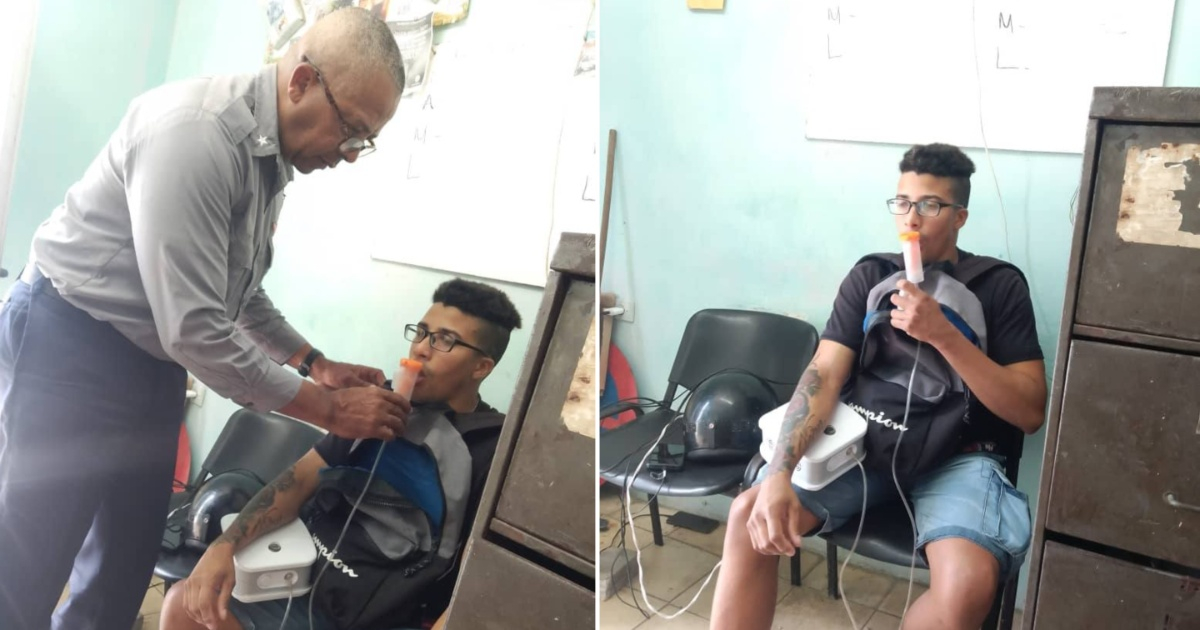
In an incident highlighting the precarious state of essential services in Cuba, a 29-year-old man was forced to seek refuge at a National Revolutionary Police (PNR) station in Centro Havana to use an electricity-dependent device during an asthma attack. This occurred amidst a widespread disruption to the National Electric System (SEN), as reported by the Municipal Assembly of People's Power in the area.
The incident took place on the morning of March 5th. According to the official account, Marlon Cala Torres managed to recover after approximately 30 minutes, thanks to a generator at the police station.
Identified as Marlon Cala Torres, the young man resides at Zanja number 378 between Gervasio and Cerrada del Paseo in the Los Sitios neighborhood of Centro Havana. He arrived at the PNR station with "severe shortness of breath" due to an "asthma crisis."
The municipal assembly's report on Facebook emphasized the device's reliance on electricity, a critical component unavailable due to the SEN's collapse.
While the exact type of equipment used by Cala Torres wasn't specified, it was clear that it required electrical power during his respiratory distress.
The official narrative framed the event as institutional support, titled “Gestures We Should Not Overlook.” It credited the police station's generator for enabling the young man's recovery to “normal breathing.”
The official statement added a political angle, portraying the police as ever-ready to assist the needy. “For the people, the blue-clad heroes in Cuba will always be available to help and rescue those in need,” it mentioned.
However, the incident sparked critical responses from the public. One of the more scathing comments criticized the system: “The revolution takes away a leg, then gives you a crutch, and you have to be thankful; hypocrisy at its finest.”
Critics questioned why a police station had access to generator power while households and other essential services remained in the dark. One user sarcastically suggested that families with sick children or those lacking power should also flock to the station to charge phones, run fans, or preserve food.
Further criticism focused on the allocation of energy resources during the emergency. One online commentator provocatively asked if a police station was more critical than a household needing electricity, implying that such logic would require shifting basic public services to other institutions.
In agreement, another comment succinctly put it: “Oh, so there's power at the PNR but not at the medical post.”
The blackout, stemming from an unexpected shutdown of the Antonio Guiteras thermoelectric plant in Matanzas, Cuba's largest, left much of western Cuba without power from Wednesday night. The Havana Electric Company reported that gradual restoration began early Thursday, prioritizing essential services like hospitals and water supply systems.
The Ministry of Energy and Mines announced that by 5:01 a.m., the National Electric System was reconnected from Guantánamo to Pinar del Río, though power generation units were still being incrementally brought online.
Understanding Cuba's Energy Crisis
What caused the power outage in Cuba?
The blackout was triggered by the unexpected shutdown of the Antonio Guiteras thermoelectric plant, the largest in the country, impacting the National Electric System.
How did the power outage affect essential services?
The power outage left many areas without electricity, but the restoration process prioritized essential services, including hospitals and water supply systems.
How did the public react to the incident at the police station?
Public reactions included criticism of the system's priorities, questioning why a police station had generator power while other essential needs remained unmet.