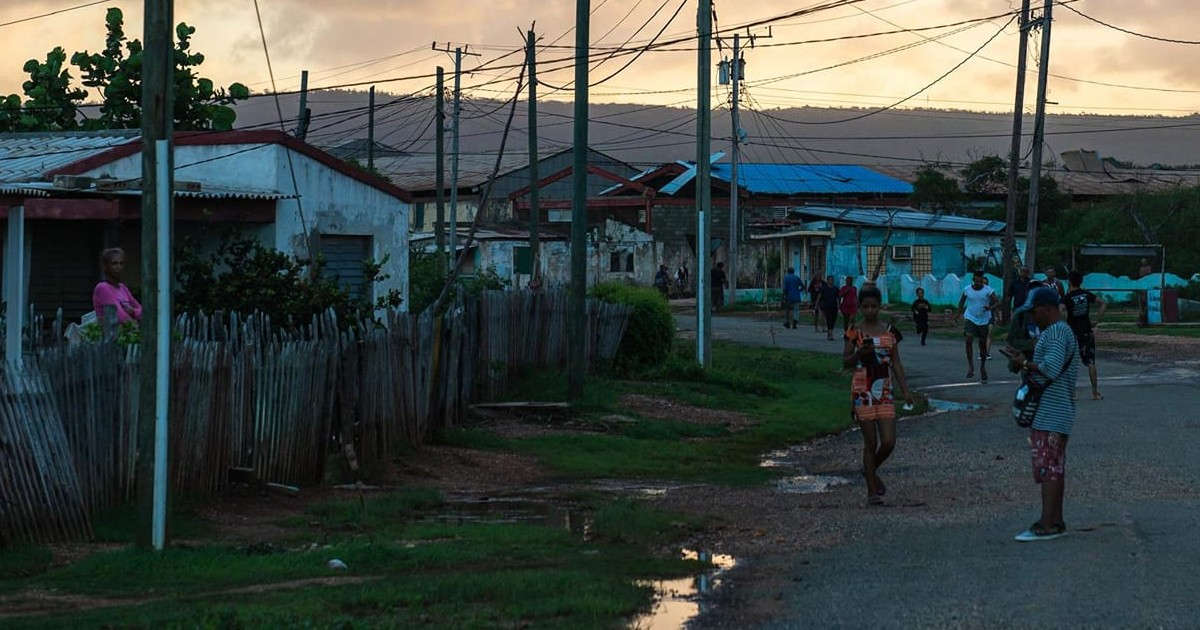
Cuba is grappling with a severe power crisis that has left millions enduring widespread blackouts, highlighting the government's failure to provide a reliable energy supply.
The Electric Union (UNE) reported that on Tuesday, power service was disrupted due to a capacity shortage, with outages continuing into the early hours of Wednesday.
At 7:10 pm, the shortfall in power generation reached a peak of 1,917 MW, plunging much of the nation into darkness during critical times.
As of 6:00 am Wednesday, the National Electric System (SEN) had a capacity of only 1,180 MW, while demand soared to 2,250 MW, leaving 1,050 MW of demand unmet.
At midday, the power deficit remained around 1,050 MW, underscoring the inability of the country to balance electricity generation with consumption.
During peak hours, the forecast predicted an availability of 1,180 MW against a demand of 3,100 MW, with a shortfall of 1,920 MW possibly leading to blackouts nearing 1,950 MW if conditions don't improve.
The ongoing issues reveal the consequences of inadequate maintenance and an aging power generation infrastructure.
Four units are out of service due to malfunctions in the Mariel, Felton, and Antonio Maceo power plants, while three other plants in Mariel, Nuevitas, and Carlos Manuel de Céspedes in Cienfuegos are undergoing maintenance.
Additionally, there are limitations in thermal generation with 460 MW offline, exacerbating the system's vulnerability to demand.
The 51 new solar photovoltaic parks managed to contribute 4,332 MWh with a peak capacity of 741 MW, which is insufficient to offset the thermal generation shortfall.
The situation in the capital was particularly dire. The Havana Electric Company reported a service disruption lasting 19 hours and 20 minutes on Tuesday, with a maximum impact of 325 MW recorded at 7:10 pm.
An emergency required a 60 MW reduction, and by the end of the report, six blocks and emergency circuits remained offline, totaling 270 MW, with restoration expected only in the morning.
The company warned that energy contingency disruptions remain unscheduled and depend on SEN availability.
The frequent and prolonged power shortages underscore the Cuban government's inability to maintain energy infrastructure and provide essential services.
As the population endures severe restrictions, reliance on renewable sources such as solar energy, still in its infancy, barely alleviates the crisis.
The persistence of blackouts of this magnitude highlights the urgent need for structural changes that move beyond improvisation and reliance on limited power generation.
Understanding Cuba's Energy Crisis
What is causing the power outages in Cuba?
The power outages in Cuba are primarily caused by the government's inability to maintain its energy infrastructure, leading to inadequate power generation and widespread blackouts.
How much power is Cuba short of meeting its demand?
Cuba is currently facing a power shortfall of approximately 1,920 MW during peak demand times, which could result in blackouts affecting up to 1,950 MW if conditions do not improve.
What measures are being taken to address the crisis?
The Cuban government is attempting to address the crisis by relying on new solar photovoltaic parks, although these efforts are insufficient to compensate for the thermal generation shortfall.