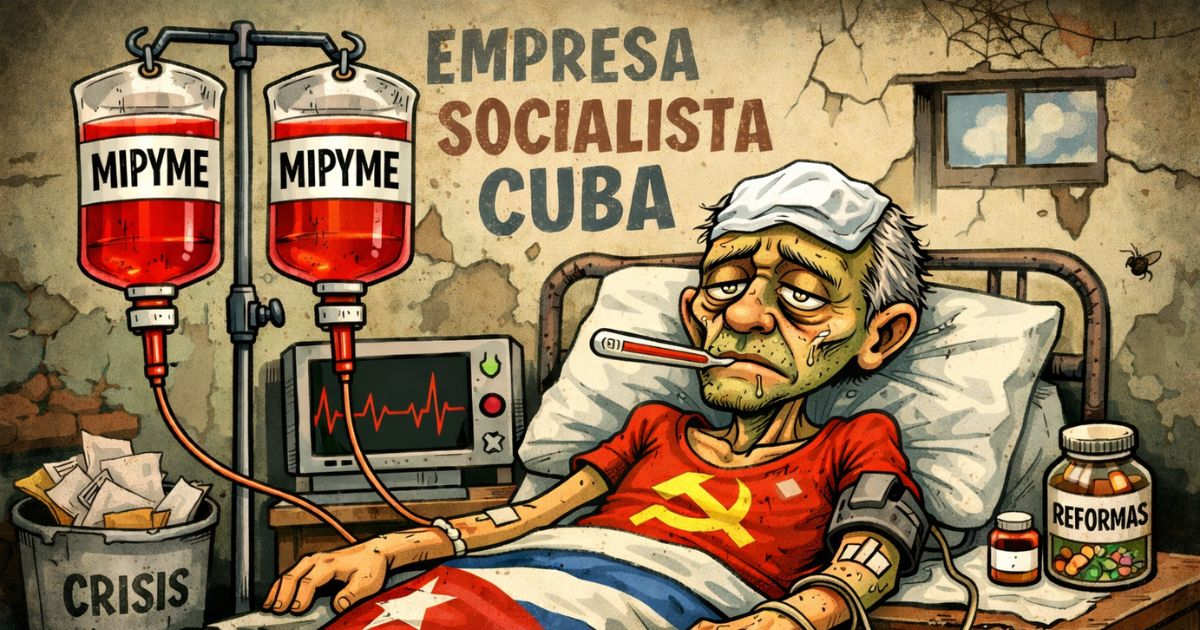
This week, the Cuban government introduced a new measure, Decree-Law 114/2025, published in the Official Gazette. This move allows private businesses to "partner" with state-owned entities. Presented as a groundbreaking opening, in reality, it's a last-ditch effort to infuse life into entities that have been failing for decades.
The Persistent Failure of State Enterprises
It's not just that Cuban state enterprises are in crisis; they are the crisis. This is the same model that dismantled the nation's once-thriving agricultural sector, which was the Caribbean's breadbasket. It’s the system that led to the downfall of the hemisphere’s most efficient sugar industry and left hotels, factories, and hospitals in ruins. No superficial reform can alter this, as the issues are inherent to the system itself.
When a business cannot fail, does not compete, and answers only to a Party bureaucrat, it ceases to be a true business. Instead, it becomes a bottomless pit consuming the nation’s resources and the energy of its people. Simply labeling it a "state enterprise" does not change its nature.
The Illusion of Partnership
According to the decree, partners can "freely agree" on participation percentages. This sounds promising until you realize that any subsequent change requires approval from the Ministry of Economy and Planning. Additionally, the request must have the backing of the relevant state entity's head. The Ministry can also reject the partnership if it deems it a threat to "public order or national security," a vague clause that can be applied at the regime's discretion.
In essence, you can partner with the Cuban state only when it decides, under conditions it approves, and for activities it authorizes. Such remarkable freedom.
The Extractive Nature of the Regime
The Cuban regime does not reform; it extracts. Historically, when the private sector thrived, it was collectivized to seize the harvest. When small entrepreneurs emerged, they were suffocated with regulations and taxed beyond what any state enterprise faced. The establishment of foreign currency stores and schemes like CUC and MLC were designed to funnel dollars into state coffers.
Decree-Law 114 follows the same pattern with a new appearance. Despite adversity, the Cuban private sector has shown its capability to produce, innovate, and survive with minimal resources. Instead of removing the chains, the regime has chosen to tether it to the failing state enterprise in hopes that it can revive the dead.
This is not the logic of a reformer opening markets but that of a vampire seeking fresh blood as its own supply dwindles. And like any vampire, it won’t release its victim willingly. It will continue to drain until nothing remains—or until someone drives a stake through its heart.
What Cuba Truly Needs
Cuba doesn’t need more decrees. What the nation requires is for the state to vacate spaces it has no business occupying. Inefficient state enterprises should be dissolved, privatized, or converted into genuine cooperatives with real autonomy. Cubans should be able to start businesses without seeking permission from multiple bureaucratic bodies. Private property should be a genuine right, not a privilege granted and revoked at the regime's whim.
None of this will happen under Decree-Law 114. Nor under 115, or 200. Because this change would mean the Communist Party relinquishing the economic control that remains its sole real power.
Meanwhile, the regime will continue hosting funerals disguised as celebrations, calling them reforms.
Understanding Decree-Law 114/2025 and Its Implications
What is Decree-Law 114/2025?
Decree-Law 114/2025 is a measure introduced by the Cuban government allowing private businesses to partner with state-owned entities, purportedly representing an opening for private enterprise in Cuba.
Why is the partnership described as an illusion?
The partnership is seen as an illusion because the state retains full control over the terms and continuation of the partnership, including the ability to reject it based on broad criteria like "public order" or "national security."
How does this decree impact the Cuban private sector?
The decree potentially ties the private sector to failing state enterprises, restricting its ability to operate independently and stifling its innovation and growth.