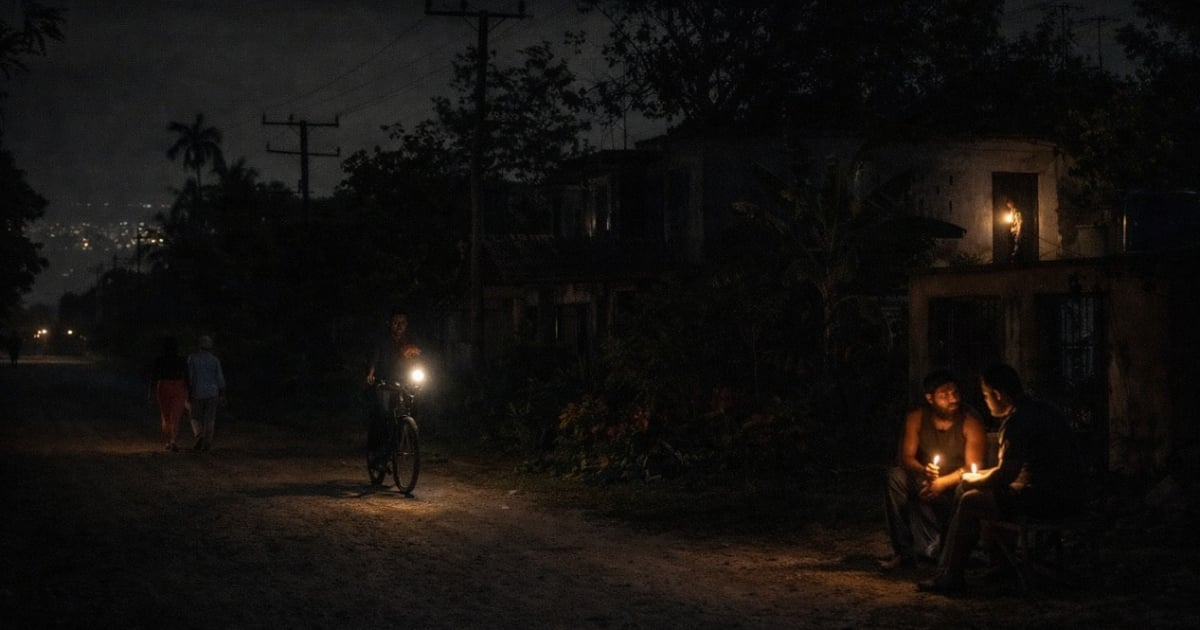
Cuba is currently enduring one of its most severe energy crises, with a nearly 2,000 megawatt (MW) shortfall resulting in widespread power outages across the island.
The National Electric System (SEN), according to the Unión Eléctrica (UNE), remains severely impacted by insufficient generation capacity, a situation that persisted throughout Monday and continued into the early hours of the following day.
The peak deficit reached 1,947 MW at 7:20 pm on Monday, slightly below the forecast of over 2,000 MW, highlighting the extent of the energy collapse.
As of 6:00 am today, the SEN's available capacity was a mere 1,155 MW against a demand of 2,220 MW, leaving 1,072 MW unmet. An estimated shortfall of 1,100 MW was projected for midday.
This critical situation stems from a system weakened by years of inadequate investment and structural maintenance.
According to official reports, six generating units are currently offline due to breakdowns: one at the Mariel thermoelectric plant, another at Santa Cruz, another at Felton, and three at the Antonio Maceo plant.
Additionally, three more units are halted for scheduled maintenance at Mariel, Nuevitas, and the Carlos Manuel de Céspedes thermoelectric plant in Cienfuegos.
Thermal generation limitations have also sidelined 379 MW of capacity.
Plans for peak hours include bringing unit 3 of the Rente plant online with 35 MW. However, even with this addition, the estimated availability would be 1,190 MW against a projected demand of 3,150 MW.
This implies a deficit of 1,960 MW and a forecasted impact of 1,990 MW if current conditions persist, potentially leaving nearly two-thirds of the nation's consumption unmet.
Meanwhile, the UNE reported that 51 new solar photovoltaic parks produced 4,132 MWh, delivering a maximum power output of 602 MW during peak solar hours.
While this solar generation offers some relief, it falls short of addressing the system's significant structural deficit.
The situation in Havana is equally dire.
On Facebook, the Havana Electric Company announced that the city experienced an 18-hour and 15-minute power outage on Monday. The peak impact was 360 MW at 9:00 pm.
An additional 60 MW was affected by an emergency, and the entity reported that restoring service was impossible due to the national deficit.
As of the official statement's closure, six blocks and emergency circuits, totaling 294 MW, remained offline, with restoration expected in the morning.
However, the impact on other blocks and circuits due to "energy contingency" remains unscheduled and depends on SEN's availability, leaving countless households uncertain about when electricity will return.
The recurring breakdowns, prolonged maintenance, and thermal limitations highlight an electrical grid that has reached a critical point after years of accumulated degradation.
The constant outages, some lasting over 18 hours daily in certain areas, not only disrupt economic activities but also deeply affect daily life, forcing residents to endure heat, water shortages, and food preservation challenges.
Official figures reveal a widening gap between available capacity and actual demand, while a structural solution remains elusive.
The deficit nearing 2,000 MW confirms that the energy crisis is not merely incidental but the result of a system operating at its limits, demanding more than temporary measures for recovery.
Understanding Cuba's Energy Crisis
What is causing the widespread power outages in Cuba?
The widespread power outages in Cuba are primarily due to a nearly 2,000 MW shortfall in the National Electric System (SEN), exacerbated by years of insufficient investment and maintenance.
How are solar photovoltaic parks contributing to Cuba's energy situation?
The 51 new solar photovoltaic parks in Cuba contribute by generating 4,132 MWh, with a maximum power output of 602 MW during peak solar hours. However, this is insufficient to offset the significant structural deficit of the energy system.
What measures are planned to address the power deficit during peak hours?
To address the power deficit during peak hours, plans include bringing unit 3 of the Rente plant online with an additional 35 MW. However, this measure is not enough to meet the projected demand.