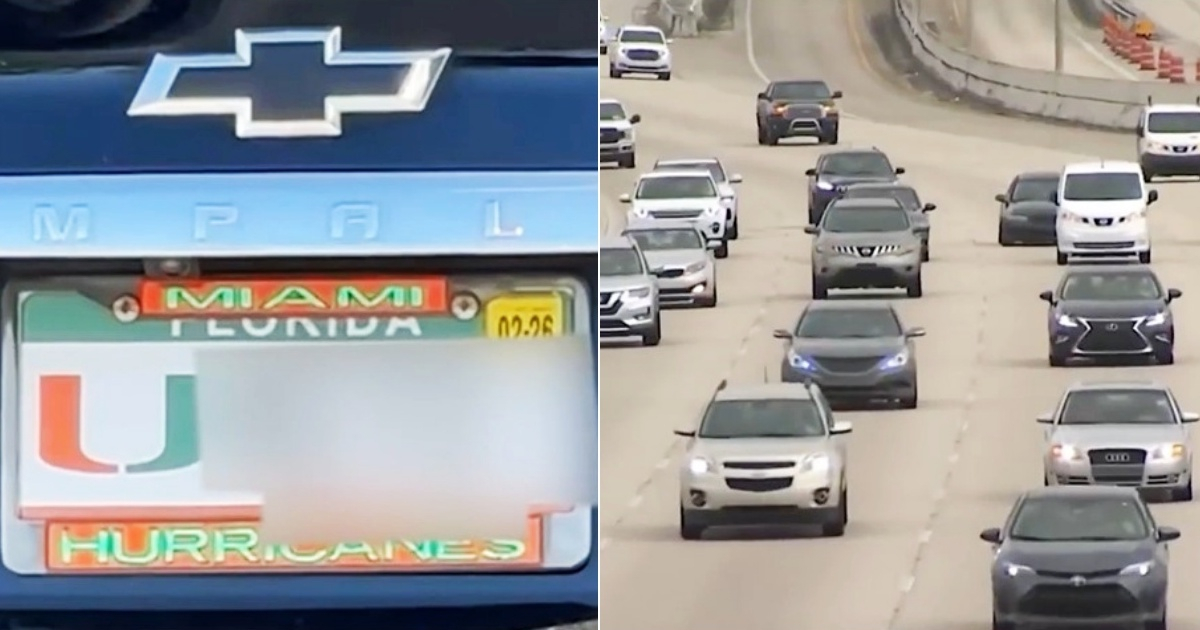
State Representative Doug Bankson, who sponsored statute 320.061, announced that legislative text is now available to amend the law that, since October, has turned certain license plate modifications into a misdemeanor.
In just a few months, the law has led to numerous fines, criminal charges, and even arrests due to the use of decorative frames.
Bankson stated in a press release that the legislation "was never intended to address or impact license plate frames." Once the confusion became apparent, he began collaborating with law enforcement and the Florida Department of Highway Safety and Motor Vehicles (FLHSMV) to clarify the law’s intent.
“The bill on license plate inversion never aimed to address or impact frames," Bankson emphasized in statements reported by the local press. "Once I realized the confusion, I immediately began working with state law enforcement and the FLHSMV to correct the error for both officers and the public, as well as to amend the statute’s language,” he added.
He elaborated that they now have the legislative text ready to rectify this misunderstanding and provide clarity so that no one is unjustly stopped or fined because of license plate frames.
Ambiguity and Legal Consequences
The proposal comes after months of controversial law enforcement, which escalated a violation related to anything "interfering with the ability to record any feature or detail on the plate" to a misdemeanor offense punishable by up to 60 days in jail.
Since its implementation in October, the law has caused uncertainty both among drivers and police agencies. The main question has been what exactly constitutes a “feature or detail” whose obstruction would classify the act as a crime.
The case of Demarquize Dawson highlights the issue. He was arrested because the frame on his rental car partially covered the letter “S” on his plate. Later, the police in Davie dismissed the arrest, acknowledging that the law’s original wording was “vague and open to misinterpretation.”
Legal Perspectives and Uneven Enforcement
In South Florida, the legal firm Ticket Toro has documented the law's impact. Founder Charlie Whorton noted that around 1,000 drivers have been fined since the law's enactment. Using court data, the firm developed an interactive map showing how citations are distributed across jurisdictions.
The application has been inconsistent, according to lawyers. A driver might face criminal charges in one city for having a frame, while in a nearby jurisdiction, they might not be penalized at all.
Attorney Christine Whorton stated, “We are not against a law that stops someone from deliberately covering their plate.” However, her colleague Anna Quesada pointed out that if enforced at a criminal level, the law must be unambiguous. “We are saying that if these laws are to be enforced criminally, they should specifically state what is lawful, allowing all drivers in Florida to understand the legality clearly,” Quesada emphasized.
Quesada shared that one of her clients faced misdemeanor charges because of a frame installed by the dealership. After achieving a dismissal from a judge, they aim to appeal the case as it is considered “a matter of significant public interest needing definitive resolution.”
Official Clarification: Frames Allowed Without Obstruction
Amid the controversy, the FLHSMV issued a formal clarification in December: license plate frames remain legal as long as they do not block essential elements. “Following widespread online user confusion, the Florida Department of Highway Safety and Motor Vehicles issued a clarification,” reported NBC Miami, emphasizing that frames are still allowed “as long as they don’t cover key identifiers.”
The agency specified that the following cannot be covered:
- The alphanumeric identifier (letters and numbers).
- The registration sticker located in the upper right corner.
The law also prohibits altering the plate's original color, applying sprays or tints, using clear or smoked covers, inserting LED lights directly on it, or any mechanisms that hide or change the plate's visibility.
Penalties can range from $500 fines for covering or modifying a plate up to $5,000 and five years in prison if the accessory was used to commit or facilitate a crime.
Drivers Remain in Limbo
While Bankson's proposed amendment is pending, some drivers continue to face repercussions. Iñigo Aldecoa received a $176 fine for a frame that, according to him, was installed by the dealership when he purchased his vehicle. “I just bought this car, and literally the dealership put this frame on,” he explained.
In cities like Miami Beach—leading in such infractions according to Ticket Toro's map—enforcement has been particularly strict.
In light of the uncertainty, Edwin López, the Chief of Police in Doral, advised drivers to remove the frame if there are doubts about its legality.
As legislative corrections are underway, the debate now centers on whether the amendment will adequately resolve the ambiguity that allowed a common accessory to become a criminal issue in certain cases.
Understanding Florida's License Plate Frame Law
What changes are being proposed to Florida's license plate law?
The proposed amendments aim to clarify the language of the law to prevent unjust penalties for using decorative frames, ensuring that only intentional obstructions of essential plate details are penalized.
What are the consequences of violating the current license plate frame law?
Violations can lead to fines ranging from $500 to $5,000, and in some cases, up to five years in prison if the frame is used to conceal a crime.
How has the enforcement of this law been inconsistent across Florida?
The enforcement varies by jurisdiction, with some areas imposing penalties for frames while others do not, leading to confusion and legal challenges.