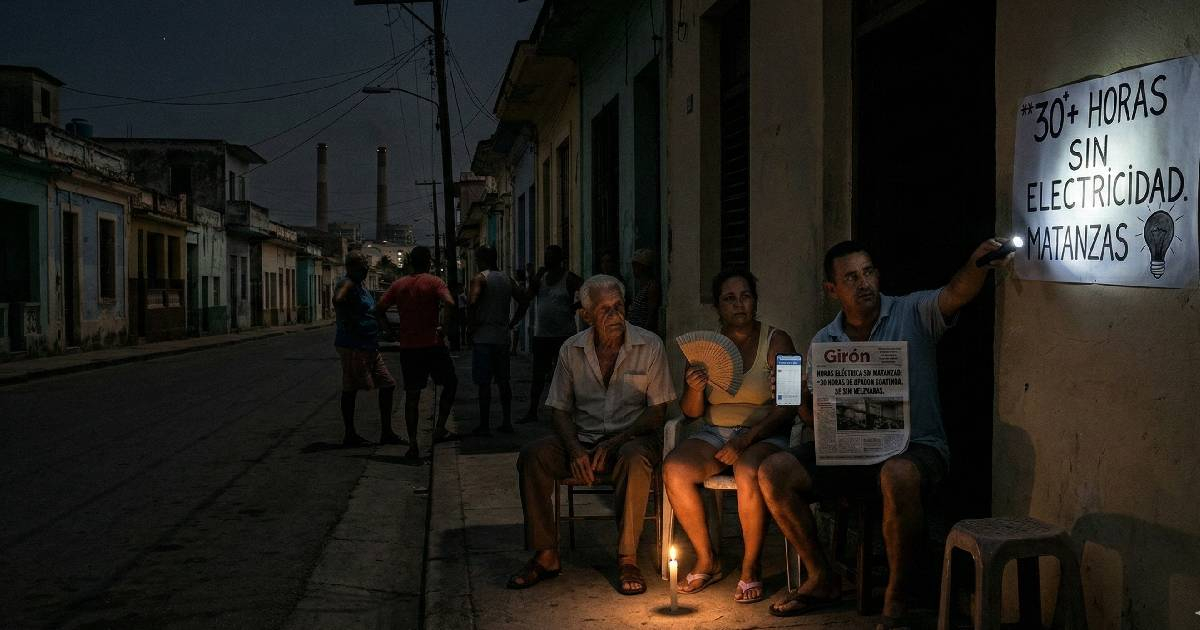
On Saturday, the Matanzas Electric Company announced that the province remains under severe electrical restrictions, with some areas experiencing more than 30 hours of continuous blackouts due to a structural deficit within the National Electric System (SEN).
According to a report shared by the official newspaper Girón on Facebook, as of 11:40 a.m., the western province was facing "maximum blackout conditions," with 82 MW impacted by a national demand that reached 2,060 MW.
This situation arises amidst numerous breakdowns and maintenance activities at the country's thermal power plants.
Significant issues include malfunctions at unit 5 of the Mariel Thermal Power Plant in Artemisa, unit 2 of the Santa Cruz del Norte plant in Mayabeque, unit 2 of the Felton plant in Holguín, and units 5 and 6 of the Antonio Maceo (Renté) plant in Santiago de Cuba.
Additionally, maintenance is ongoing for unit 6 at Mariel, unit 5 at Nuevitas in Camagüey, and unit 4 at Carlos Manuel de Céspedes in Cienfuegos. As of Sunday, thermal generation limitations have resulted in 420 MW out of service, according to the Electric Union's informative note on the SEN's status.
Nationwide, the peak impact on Saturday reached 1,718 MW at 7:10 p.m. By March 1st, SEN's availability at 6:00 a.m. was 1,257 MW compared to a demand of 2,203 MW, with 775 MW already affected at that time.
For Sunday night's peak, a forecasted availability of 1,532 MW is expected against an estimated demand of 3,180 MW, leading to a projected shortfall of 1,648 MW and a possible impact of 1,678 MW.
Authorities plan to incorporate distributed generation to partially alleviate the situation, including the Mariel fuel setup with 105 MW, the Melones power barge with 45 MW, four engines from the Regla barge (Havana) with 35 MW, and six fuel engines from Moa (Holguín) with 90 MW.
Meanwhile, in comments posted on the Girón newspaper page, numerous users questioned the distribution of blackouts.
Residents in Cárdenas reported up to 48-hour disruptions with only four hours of service, calling for greater equity in circuit rotation.
Others noted that Varadero, despite low hotel occupancy, continues to enjoy stable electricity, while areas like Jagüey Grande reported up to 47 hours and 30 minutes without power.
In response to the criticism, the media explained that circuits with a 3x6 rotation are not included in the provincial demand because their role is to maintain SEN stability, which is considered "very fragile" at present. Only two substations in the province can support the necessary frequency shift for this setup.
The national report also highlighted that 51 new solar photovoltaic parks generated 4,647 MWh on Saturday, with a maximum output of 802 MW at midday.
However, this contribution has not been sufficient to offset the thermal collapse or prevent prolonged disruptions in provinces like Matanzas, where the population, like the rest of the country, faces continuous power cuts amidst an energy scenario showing no immediate signs of stabilization.
Understanding the Energy Crisis in Matanzas
What is causing the prolonged blackouts in Matanzas?
The prolonged blackouts in Matanzas are due to severe restrictions on electricity supply, compounded by a structural deficit within the National Electric System and issues at various thermal power plants.
How are residents in Matanzas affected by the power outages?
Residents in Matanzas report experiencing up to 48 hours of blackout with limited service, leading to calls for fairer distribution of power outages and better circuit rotation.
What measures are being taken to address the power shortages?
Authorities plan to introduce distributed generation, such as fuel setups and power barges, to partially alleviate power shortages in Cuba.