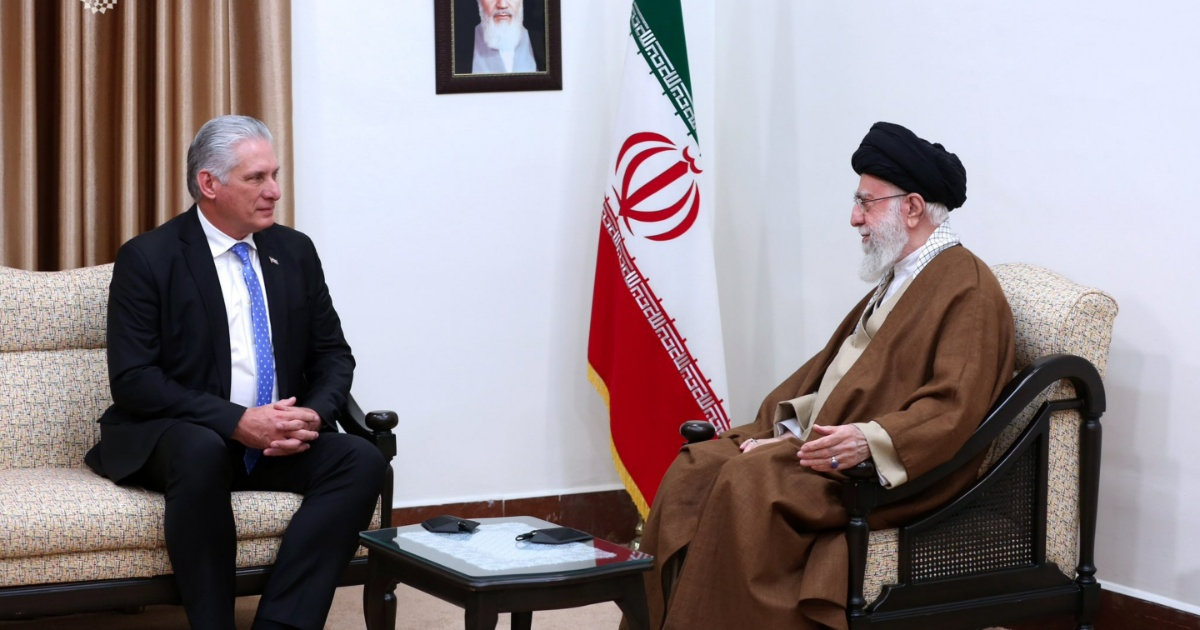
Cuban President Miguel Díaz-Canel expressed his sorrow over what he described as the "murder" of Ayatollah Ali Khamenei, labeling it an "appalling act," but carefully avoided direct reference to the United States.
"We extend heartfelt condolences to the people, government, and President Dr. Massoud Pezeshkian for the assassination of the Supreme Leader of the Islamic Republic of Iran, the Grand Ayatollah Seyed Ali Khamenei, extending sympathies to his family," Díaz-Canel wrote on X.
He added, "This reprehensible act constitutes a flagrant violation of all norms of international law and human dignity. In Cuba, he will be remembered as a distinguished statesman and leader of his people, who fostered the development of friendly relations between Cuba and Iran."
On Saturday, the Iranian government officially confirmed the death of the supreme leader following attacks by Israel and the United States.
Iranian state media, including HispanTV, reported that Khamenei was "martyred in the Zionist-American aggression," referring to the bombings targeting Iranian regime installations amid the ongoing military escalation.
Following the announcement, authorities declared a 40-day public mourning period and a seven-day suspension of activities nationwide, a measure that halts state institutions and official events.
The message disseminated through channels linked to the Iranian government described Khamenei’s death as "martyrdom" and directly held Israel and the U.S. responsible for the death of the country’s top religious and political leader.
Previously, U.S. President Donald Trump had suggested that Khamenei might have died in the attacks that took place overnight.
In retaliation, the Islamic Revolutionary Guard Corps (IRGC) announced assaults on 27 U.S. military bases in the Middle East and targets in Israel, including Tel Aviv. The offensive aims to avenge the supreme leader's death.
Explosions have been reported in Doha, Kuwait, and Dubai, while Qatar's Ministry of Defense claimed to have intercepted up to 18 ballistic missiles targeting its territory.
The Speaker of the Iranian Parliament, Mohammad Bagher Ghalibaf, declared, "We will retaliate against the Americans and Israelis," warning that they would suffer "such severe blows that they will beg for mercy."
President Trump threatened on Sunday to strike Iran with "unprecedented force" if Tehran follows through on its vow to launch a "historic offensive" against the U.S. and Israel in retaliation for the ayatollah's death.
So far, three American soldiers have died following the retaliatory attacks, while 200 Iranians have perished, according to the Red Crescent, in the bombings that persist this Sunday, also resulting in the deaths of seven senior officials of the Islamic Republic.
Current Tensions Between Iran and the United States
What was the response of the Iranian government to Khamenei's death?
The Iranian government declared a 40-day period of public mourning and a suspension of activities nationwide, holding Israel and the U.S. responsible for Khamenei's death.
How did the U.S. react to the threats from Iran?
President Trump threatened to strike Iran with "unprecedented force" if Tehran carries out its threat of launching a "historic offensive" against the U.S. and Israel.