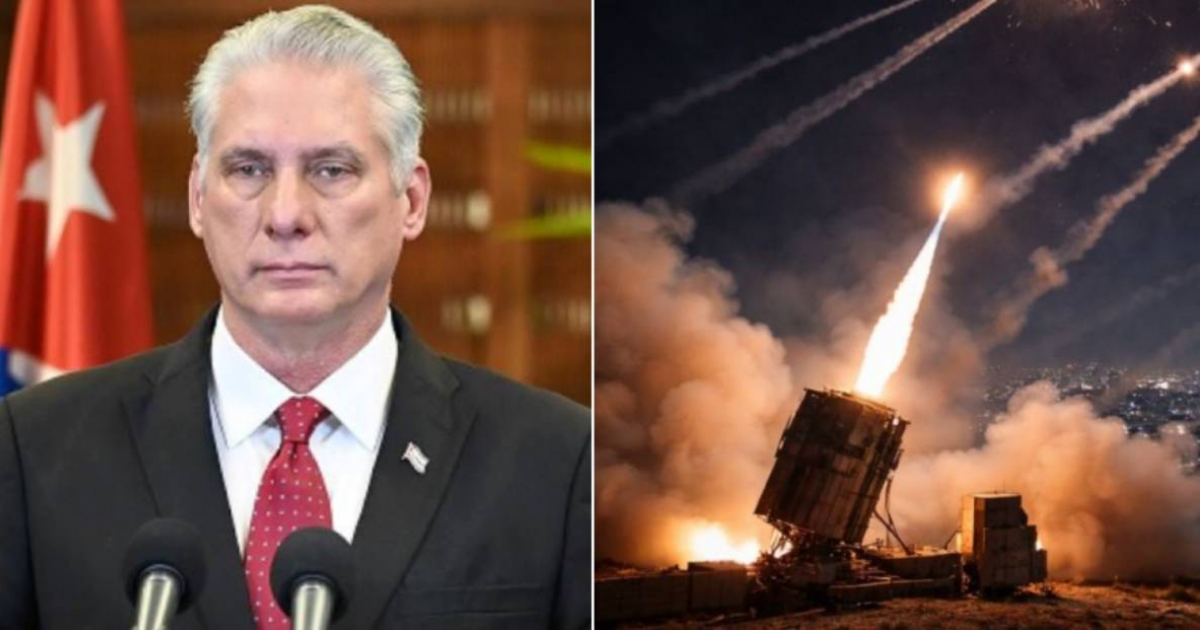
Cuban leader Miguel Díaz-Canel made a public statement on February 28 in response to the military strike by Israel and the United States against Iran, vehemently condemning the operation.
In a post on social media platform X, Díaz-Canel labeled the attack as a "blatant violation of International Law and the UN Charter."
"The assaults carried out on February 28 by Israel and the United States, violating Iran's sovereignty and territorial integrity, represent a flagrant breach of International Law and the UN Charter," he expressed in his initial message.
In a follow-up post, he stated that the military actions "undermine diplomatic efforts regarding the nuclear issue for a second time and jeopardize regional and international peace and security. The current repercussions in this tumultuous region are clear evidence."
He concluded by urging a global response: "The international community must act promptly to halt this aggression and prevent an escalation with unpredictable consequences."
The "Shield of Judah" Operation: Military Strikes and Iran's Reaction
Díaz-Canel's statement came several hours after the military operation was announced on the morning of February 28. Cuban Foreign Minister Bruno Rodríguez Parrilla was the first from the Cuban government to denounce the aggression.
Israel termed its offensive "Roaring Lion," while the joint action with the United States was called "Shield of Judah."
President Donald Trump confirmed that "U.S. military forces have commenced major combat operations in Iran," asserting that Iran's key nuclear enrichment facilities were "completely and utterly destroyed."
The operation involved aerial and naval raids on infrastructure in Isfahan, Natanz, and Fordow, as well as military and intelligence targets in Tehran.
Israeli Prime Minister Benjamin Netanyahu thanked Washington for its support, describing the action as a decisive step against what he perceives as an existential threat.
In retaliation, Iran launched missiles and drones into Israeli territory. The Islamic Revolutionary Guard Corps announced the beginning of a "broad wave of attacks," as air raid sirens echoed in Tel Aviv and other cities.
The regional tensions have reignited fears of a larger escalation, particularly with Iran's threat to disrupt traffic in the Strait of Hormuz, a crucial passage for nearly 20% of the world's oil supply.
Cuba's Predicament Amid the Crisis
Apart from Havana's rhetorical condemnation, the conflict impacts Cuba at an exceptionally vulnerable time. The island is enduring a severe energy crisis characterized by prolonged blackouts, industrial shutdowns, and significant disruptions in healthcare services.
Since January 3, after Nicolás Maduro fell from power in Venezuela, the supply of Venezuelan oil, which sustained Cuba's energy system for 25 years, ceased.
This was exacerbated by an executive order issued on January 29 that imposed tariffs on countries selling crude oil to Cuba, leading Mexico to suspend its supplies.
With minimal reserves and no international credit, any increase in oil prices—which had already surpassed $73 a barrel before the attack—worsens Cuba's situation, despite Trump's assurance of lifting tariffs on those trading oil with the island.
Analysts caution that a potential closure of the Strait of Hormuz could push oil prices above $100, a scenario untenable for the Cuban economy.
The strike against Iran also fits into a strategic sequence that the White House itself has linked to Venezuela and Cuba. Following Maduro's capture on January 3 and the oil embargo on Havana on January 29, the February 28 offensive against Iran completes a trilogy Washington presents as part of a broader policy against regimes deemed hostile.
This past Friday, Trump announced a possible "friendly and controlled takeover" of Cuba and confirmed that Marco Rubio is engaged in "high-level" talks with the Cuban regime.
In this context, Díaz-Canel's statements contrast sharply with the internal reality of fuel shortages, inflation, and a nearly collapsing electrical system. The Middle East conflict is far from distant for the island: it could hasten a crisis already racing against time.
Impact of Global Tensions on Cuba's Energy Crisis
How is the Middle East conflict affecting Cuba?
The conflict exacerbates Cuba's energy crisis by potentially driving up oil prices, making it harder for the island to secure affordable energy supplies.
What was the response of Cuban officials to the U.S. and Israeli attack on Iran?
Cuban officials, including Díaz-Canel and Foreign Minister Bruno Rodríguez Parrilla, condemned the attack as a violation of International Law and called for global action to stop further aggression.
What are the potential consequences for Cuba if the Strait of Hormuz is closed?
Closure of the Strait of Hormuz could lead to a significant increase in global oil prices, potentially surpassing $100 per barrel, which would severely impact Cuba's already strained economy.