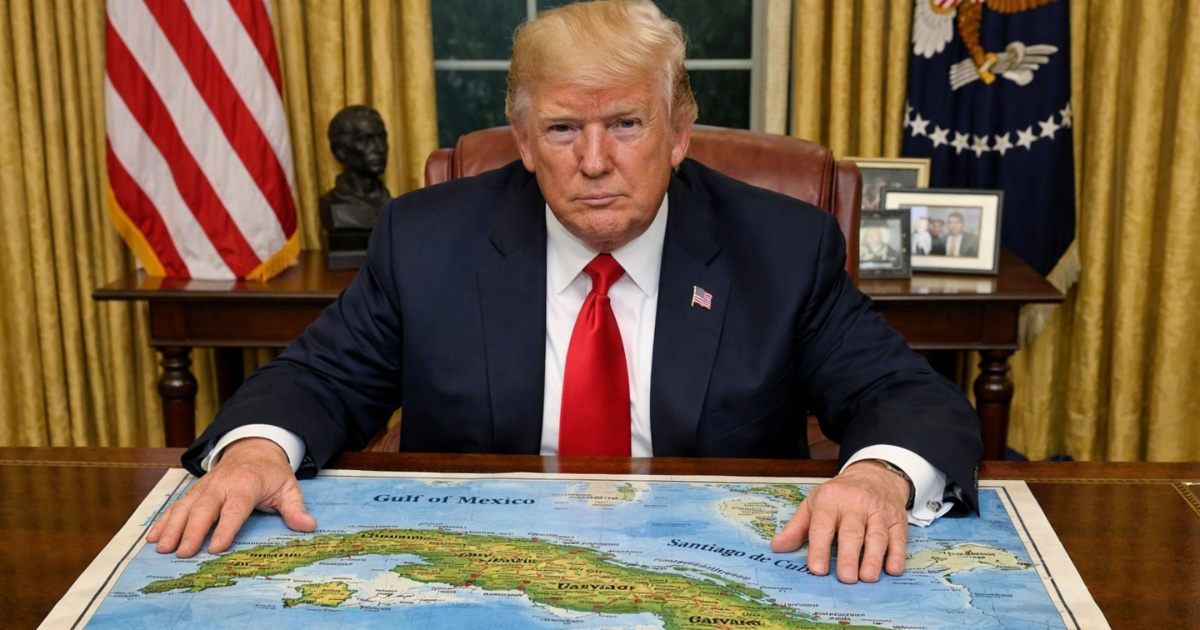
President Donald Trump of the United States announced on Friday that his administration plans to initiate a "friendly and controlled takeover" of Cuba. These remarks were reportedly made during a discussion with journalists at the White House.
As of now, no official documents, decrees, or detailed plans have been released to clarify the actual implications of such a statement. However, the president used this phrase while discussing his administration's intended approach towards the island nation.
Behind the Remark
During the interaction with reporters, Trump characterized Cuba as a "failed nation," asserting that the Cuban government is "in communication" with the U.S. and is experiencing "a very severe situation." He also claimed that "they want our help," and mentioned that Secretary of State Marco Rubio is "handling it at the highest level," suggesting ongoing diplomatic engagements.
Strategic Overtones
The term "friendly and controlled," as cited, seems—based on the reported context—to indicate a political or strategic maneuver rather than a military one. In simpler terms, it might involve taking control of strategic variables such as energy flows, economic incentives, and negotiation levers.
Potential Implications
1) Energy as a Central Lever: Washington has aimed to limit Cuba's access to imported fuel while easing some restrictions to permit shipments to the Cuban private sector. This strategy seeks to reorganize dependencies in a country where fuel is crucial for transportation, agriculture, electricity generation, and even supplies.
2) Discreet Diplomacy: Trump noted that Rubio is engaged in high-level discussions with the regime. This suggests a parallel negotiation track, which typically involves demonstrable gestures of goodwill, limited exchanges, and gradual, reversible conditions.
3) Gradual Economic Reconfiguration: The approach suggests increasing Cuba's reliance on supplies and mechanisms linked to the U.S., akin to a transformation model through dependency. This would mean introducing specific support areas (private sector, logistics chains, energy) while maintaining control elsewhere.
Learning from Venezuela
Looking at Marco Rubio's plan for Venezuela, a phased approach is evident: stabilization, reordering, and transition. If Trump and Rubio are considering a similar path for Cuba, a "friendly and controlled takeover" might progress as follows:
Phase 1: Stabilization with Critical Resource Control - In Cuba, imported energy is key, aiming to prevent a "disorderly" collapse while stabilizing under specific conditions.
Phase 2: Economic Reconfiguration with Acceptable Actors - This could involve limited openness to the private sector and specific licensing as tools, strengthening alternative economic structures without overtly signaling regime change.
Phase 3: Gradual Political Transformations - Here, "controlled" implies no concessions without verification and reversibility, with political changes like elections and freedoms following economic moves.
If the U.S. implements a strategy in Cuba similar to the one proposed for Venezuela, the island's internal dynamics and power structures could undergo significant changes given the current regime's framework.
The envisioned transition in Cuba would be managed under U.S. leadership, not starting with elections or superficial reforms. AI estimates suggest that stabilization would require $6-8 billion over ten years, recovery $16-23 billion, and transition $20-30 billion.
Why "Friendly" and "Controlled"?
"Friendly" implies a non-military process focused on negotiation, incentives, and pressure, maintaining certain open channels without declaring war. "Controlled" indicates conditionality, supervision, reversible licenses, and a design that minimizes surprises while aiming for a desired outcome.
Even if this were the plan, there are clear hurdles. Firstly, the Cuban state apparatus would likely resist relinquishing real control. Secondly, there would be geopolitical competition from Russia, China, and Iran acting as counterweights. Additionally, the risk of worsening humanitarian conditions exists if energy control is not carefully managed.
As the island confronts one of its worst energy crises in decades, Washington is betting that controlled access to vital supplies might serve as a lever of influence without broadly lifting the framework of sanctions.
Understanding the U.S. Approach to Cuba's Situation
What does a "friendly and controlled takeover" imply for Cuba?
It suggests a strategic approach involving negotiation, incentives, and pressure without military intervention, focusing on controlling strategic variables like energy and economic incentives.
How could energy serve as a lever in this strategy?
Energy could be used to influence stability in Cuba by controlling access to vital fuel supplies, which are critical for transportation, agriculture, and electricity generation.