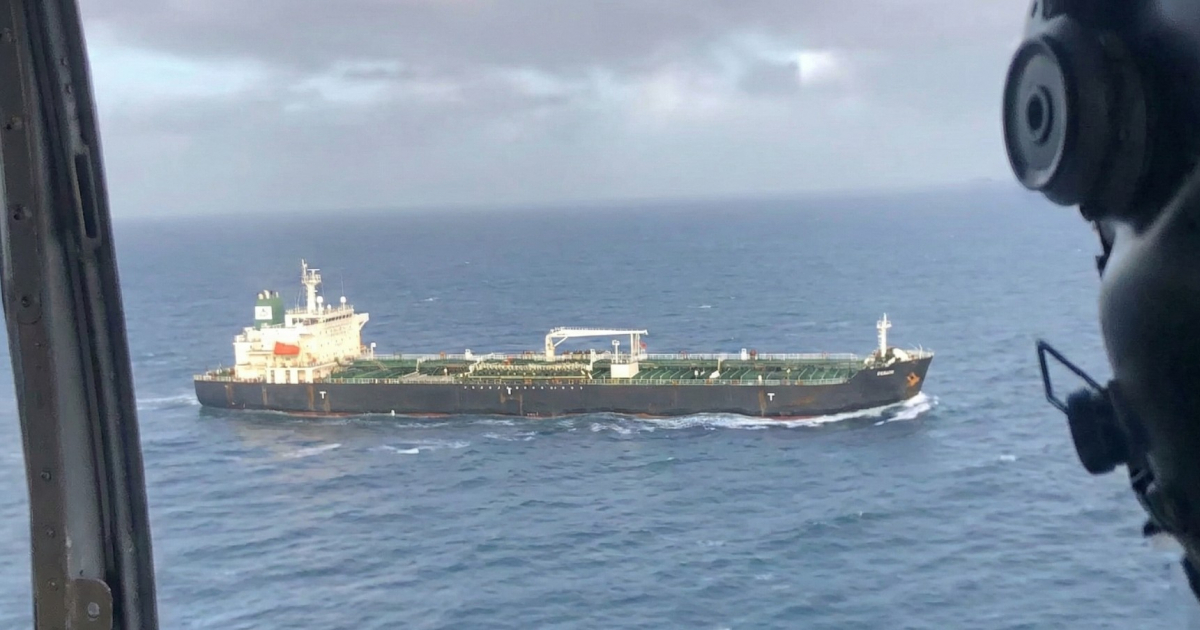
This week, the United States took steps to permanently seize the oil tanker Skipper, which was captured on the high seas in December 2025.
The Trump administration announced on Friday that a civil forfeiture complaint was filed in the U.S. District Court for the District of Columbia. This legal action seeks to confiscate the M/T Skipper and roughly 1.8 million barrels of crude oil supplied by Petróleos de Venezuela, S.A. (PdVSA).
The complaint alleges that the vessel and its cargo are subject to forfeiture because they serve as a source of influence and financial support for the Islamic Revolutionary Guard Corps (IRGC), including the Quds Force, which the U.S. has designated as a foreign terrorist organization.
Oil Bound for Cuba
A portion of the shipment was intended for Cuba. The shipping documents indicated that approximately 1.1 million barrels were to be delivered to Cubametales, the Cuban state-run oil import and export company, which the Office of Foreign Assets Control (OFAC) designated in July 2019.
High Seas Seizure and Transfer to Texas
According to the official documentation, on December 10, 2025, U.S. law enforcement intercepted the Skipper on the high seas under a judicially authorized order. At the time, the vessel was falsely flying a Guyanese flag, rendering it stateless.
Subsequently, the tanker and its cargo were moved to waters off the coast of Texas.
A 'Ghost Fleet' Operations
The complaint describes the Skipper as part of a "clandestine fleet" that has reportedly been active since at least 2021, facilitating the transport and sale of oil products for the benefit of the IRGC.
The document claims that the ship transported crude oil from Iran and Venezuela, delivering it globally through ship-to-ship transfers while disguising its routes with tactics like location forgery, false flags, and other maneuvers to evade sanctions.
For instance, the document alleges that in 2024, the Skipper delivered approximately three million barrels of Iranian crude to Syria and continued transporting illicit oil into 2025, including shipments from Iran "at least twice" that year.
Venezuelan Oil Shipment in November 2025
The document highlights that "most recently," in November 2025, the Skipper loaded around 1.8 million barrels of Venezuelan-origin crude at Venezuela's José Terminal. Shipment data recorded that 1.1 million of those barrels were designated for delivery to Cubametales in Cuba.
The announcement recalls that OFAC sanctioned the Skipper on November 3, 2022, when it was named Adisa, for facilitating the transport of illicit oil.
The complaint asserts that proceeds from the sale of these oil products would finance IRGC activities, including weapons of mass destruction proliferation, terrorism support, and human rights abuses.
The document contends that the so-called "ghost fleet," including the Skipper, is "essential" for generating income for adversarial regimes through the transport of Iranian and other illicit oils.
The case is being investigated by the FBI's Minneapolis office and HSI in Washington D.C., with substantial assistance from HSI New York.
The litigation involves the Money Laundering and Asset Recovery Section of the Justice Department's Criminal Division, federal prosecutors from the District of Columbia, and personnel from the National Security Division.
Insights into U.S. Oil Seizure Operations
Why is the U.S. seizing the Skipper tanker?
The U.S. is seizing the Skipper tanker because it allegedly supports the Islamic Revolutionary Guard Corps (IRGC) by providing financial resources through illicit oil transportation, which is in violation of U.S. sanctions.
What is the significance of the IRGC's involvement?
The IRGC's involvement is significant because it is designated by the U.S. as a foreign terrorist organization, and its activities are linked to terrorism support, weapons proliferation, and human rights violations.
What role does Cubametales play in this situation?
Cubametales is involved because it was the designated recipient of approximately 1.1 million barrels of the crude oil carried by the Skipper, linking Cuban state entities to the illicit oil trade.