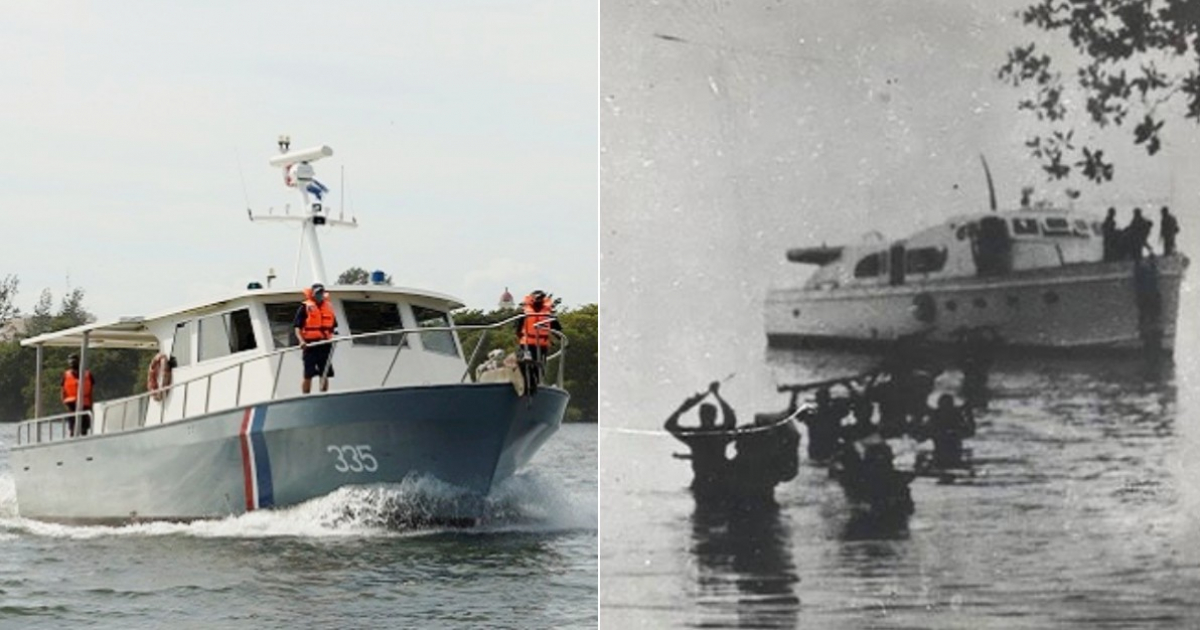
The recent clash in El Pino Channel, located in Cayo Falcones, Corralillo municipality, resulting in the deaths of four Cuban Floridians, has sparked a renewed discussion online about the history of armed uprisings in Cuba and the legitimacy of actions taken by those striving for the island's freedom.
According to the Cuban government, 10 armed men entered the country with intentions to carry out terrorist acts. However, many Cubans view their actions as akin to those of Fidel Castro in 1956 when he sailed on the Granma Yacht to Cuba to oppose Fulgencio Batista.
On Facebook, actor and playwright Yunior García Aguilera sarcastically commented on the challenge of explaining these events to the younger generation. "Teachers in Cuban schools are struggling to explain to their students that those armed men who arrived by boat (the Granma) to Cuba to infiltrate, commit sabotage, and start a war... were not terrorists... Poor history teachers," he wrote.
Revisiting Historical Legitimacy
Activist Glenda Rancano emphasized that Cuban history is replete with armed uprisings and criticized the regime's lack of moral authority in its accusations. "A handful of men climbed the Sierra, resisted, and seized power. What 'laws' are we talking about now? Those that imprison dissenters, stifle free expression, block free and fair elections, and ban independent press, political parties, and peaceful protests?" she questioned. "Back then it was the Granma, now it's any vessel. But the yearning remains the same: a truly free Cuba," she underscored.
On X (formerly Twitter), a user challenged Miguel Díaz-Canel, saying: "They had every right and are called patriots, yet those who do the same today are labeled terrorists. Let's agree on something then: Fidel Castro and the criminals on the Granma yacht were and are terrorists."
Another user commented on the regime's deep infiltration even within Cuban communities in Miami. "So many boats came into Cuba in the 2000s to pick up people, and they never caught anyone; they were waiting for this one."
What Happened in Corralillo?
The Cuban government reported that a speedboat with Florida registration FL7726SH entered Cuban waters on Wednesday with 10 individuals aboard, allegedly on a "terrorist mission."
According to the Ministry of the Interior, a gunfight ensued between the boat's occupants and the Border Guard Troops, resulting in the deaths of four people, while the other six were wounded and apprehended.
Among the deceased was Michel Ortega Casanova, a 54-year-old truck driver from Tampa, a U.S. citizen, and a member of the Republican Party of Cuba. The identities of the other victims have not yet been disclosed.
Authorities reported the arrests of Amijail Sánchez González, Leordan Enrique Cruz Gómez, Conrado Galindo Sariol, José Manuel Rodríguez Castelló, Cristian Ernesto Acosta Guevara, and Roberto Azcorra Consuegra. Another individual, Duniel Hernández Santos, was detained in Cuban territory for his involvement in receiving the group.
After the operation, the government announced the seizure of assault rifles, handguns, homemade incendiary devices, bulletproof vests, telescopic sights, and camouflage uniforms.
Understanding the Cuban Conflict: Key Questions
What triggered the recent debate on Cuba's history of uprisings?
The debate was sparked by a violent encounter in Corralillo, where four Cuban Floridians were killed, leading to discussions about the legitimacy of actions taken by those seeking freedom for Cuba.
How do the events in Corralillo relate to Fidel Castro's Granma expedition?
Many Cubans see parallels between the armed men in Corralillo and Fidel Castro's 1956 Granma expedition, both seen as attempts to fight an oppressive regime.