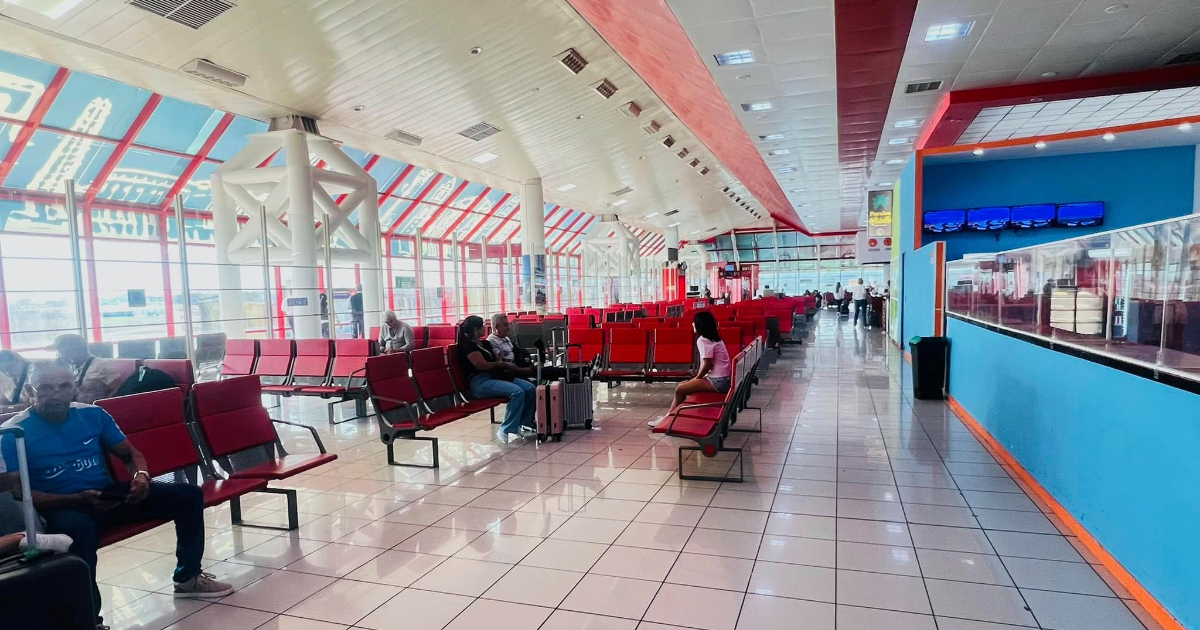
The Cuban Airport and Aeronautical Services Company S.A. (ECASA), a branch of the Ministry of Transport, has initiated a public call to attract advertisers eager to promote their businesses within the country's airport terminals. This initiative comes during one of Cuba's most severe economic and energy crises in decades.
In a post on its official Facebook page, the organization encouraged potential clients to take advantage of the available advertising spaces in Cuban airports. "It's time for your business to soar higher. New clients, new spaces, new opportunities," states the promotional message.
The campaign provides the option to advertise on screens, trolleys, and other mediums within airport facilities, highlighting the potential reach to thousands of travelers and the opportunity to increase brand and service visibility in strategic transit points.
Nonetheless, this initiative unfolds amid a particularly challenging period for Cuba's national aviation. The country faces a structural energy crisis characterized by extended blackouts, halted production, and a nearly total reliance on imported oil. This situation worsened after Venezuelan oil supplies dwindled in early January 2026, following Nicolás Maduro's arrest and the collapse of preferential crude shipment arrangements to the Island.
Further complicating the situation, on January 29, President Donald Trump declared a national emergency concerning the Cuban government and established a mechanism to impose tariffs on countries supplying oil to Cuba. This measure increased uncertainty regarding the already precarious energy supply.
Although this measure was rescinded on February 20 following a Supreme Court ruling that deemed most tariffs imposed under the IEEPA illegal, the White House issued a new order that removed the oil tariff but maintained the national emergency status regarding Cuba. This means that the legal framework for U.S. pressure remains active.
As analyzed in the assessment of the real impact of the new executive order, while the specific tariff mechanism is gone, other legal tools remain that regulate maritime traffic and reinforce control over supply to the Island.
During this period of heightened energy uncertainty, the already fragile fuel supply faced further challenges. The scarcity has impacted transportation, electricity generation, and even airline operations, with reports of operational adjustments, reduced frequencies, and logistical tensions in the sector.
International tourism, a financial cornerstone for the regime, has also struggled to recover to its pre-pandemic levels. The combination of the energy crisis, deterioration of basic services, inflation, and eroding external trust has weakened the country's ability to maintain a steady flow of travelers.
Official data confirms this decline. According to figures released by the National Office of Statistics and Information (ONEI), Cuba received 240,578 visitors in January 2026, 24,255 fewer than in the same month the previous year, representing 90.8% of the 2025 figures. In the international visitor segment alone, there were 184,833 arrivals, 11,512 less than the previous January.
The decline was particularly pronounced in strategic markets. Visits from the United States dropped from 14,027 to 6,970, while the Cuban expatriate community saw a decrease from 21,015 to 12,574 travelers. Arrivals from France, Spain, and Colombia also decreased. This downturn coincides with the exacerbation of the fuel crisis following the Venezuelan supply collapse and subsequent U.S. pressure on energy trade with the Island, factors that have affected both air connectivity and hotel operations.
In this context, the sale of advertising space at airports reflects an urgent need to generate foreign currency income amidst a prolonged economic contraction. The campaign's portrayal of "thousands of travelers" contrasts sharply with a reality marked by operational limitations, energy uncertainty, and an economy under severe internal and external pressure.
Impact of Economic Crisis on Cuban Airports
What is ECASA's role in Cuban airports?
ECASA, or the Cuban Airport and Aeronautical Services Company S.A., is responsible for managing airport operations and services in Cuba, including the recent initiative to attract advertisers to utilize airport spaces for promotion.
How has the energy crisis affected Cuban aviation?
The energy crisis has severely impacted Cuban aviation, leading to operational adjustments, reduced flight frequencies, and logistical challenges due to fuel scarcity and extended power outages.
Why has international tourism declined in Cuba?
International tourism in Cuba has declined due to the energy crisis, deteriorating basic services, inflation, and loss of external trust, making it difficult to maintain a stable influx of visitors.