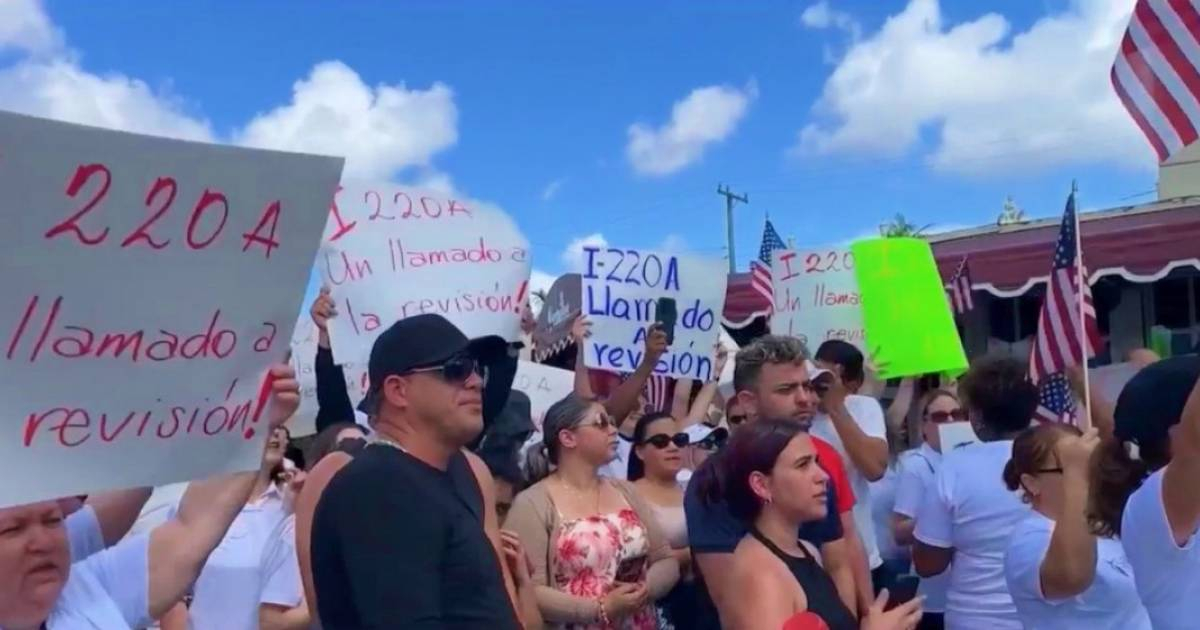
This past Monday, an Atlanta court overturned previous decisions made by the Board of Immigration Appeals (BIA) regarding two Cuban women holding the I-220A form, returning the cases for further administrative review.
The Eleventh Circuit Court of Appeals, located in Atlanta, issued a six-page ruling asserting its jurisdiction over the matter and instructed that the cases be reconsidered.
"After examining the record and considering oral arguments, we conclude that we have jurisdiction over the matter, vacate the BIA's orders in both cases, and remand the records for further proceedings," the federal court stated.
This decision comes in response to an appeal filed by Miami-based attorney Mark Prada during a hearing last December.
Implications for Cuban Nationals
The ruling was highly anticipated by over 300,000 Cubans who received the I-220A, a form of supervised release after being detained at the border, whose applications under the Cuban Adjustment Act (CAA) were subsequently blocked. These individuals are not considered "admitted" nor "parole" recipients.
Immigration lawyer Willy Allen commented on the ruling to CiberCuba, noting that while it is not a definitive victory, it is also not a setback for the plaintiffs.
"Great. The Eleventh Circuit has made its decision. We did not lose. The court has decided to send the case back to the BIA for review and to make a determination," Allen stated.
However, he cautioned that the situation remains uncertain. "The board is, unfortunately, under the control of the Attorney General, and I fear they might either make another negative decision or simply delay the process," Allen added.
A Legal Opening, Not a Final Resolution
The court did not declare that I-220A recipients are automatically eligible for residency nor did it convert the document into a "parole." It also did not order a status adjustment.
Nevertheless, it questioned the BIA's previous analysis and reopened the discussion about the concept of "admission."
The panel emphasized the need to examine under which statute the immigrants with I-220A were detained and processed, observing that the government's stance on applicable legal provisions has shifted.
This inconsistency in admission and registration criteria could significantly impact each case's evaluation.
Practically speaking, the ruling leaves open the legal debate on whether certain I-220A beneficiaries might, upon individual review, meet the requirements of the Cuban Adjustment Act.
"It's not the decision we wanted, but we've gained several points in this battle," said Mark Prada after the decision was announced, as reported by Café Fuerte.
"The Eleventh Circuit rejected the BIA's criteria that a person with I-220A is ineligible for the Cuban Adjustment, and none of the government's arguments were accepted," Prada added.
Geographical Impact and Broader Implications
The decision of the Eleventh Circuit directly affects only the states within its jurisdiction: Florida, Georgia, and Alabama. However, the legal reasoning could influence similar litigation in other parts of the country.
The I-220A form was widely issued to Cubans entering through the U.S. southern border, particularly since 2021. While released under supervision, they were neither formally admitted nor given parole, a status that has historically allowed Cubans to apply for adjustment after a year and a day in the U.S.
The administrative refusal to consider the I-220A as a form of admission left hundreds of thousands without the ability to adjust their status, despite meeting other requirements.
The Atlanta court's ruling on Monday has not immediately resolved this limbo nor guaranteed that all affected individuals will access residency. However, it requires the BIA to revisit its analysis in light of the inconsistencies pointed out by the court, keeping alive a legal battle that might redefine the scope of the Cuban Adjustment Act in the current immigration context.
As of now, uncertainty persists. For many Cuban nationals, Monday's decision represents an opened door, a glimmer of hope, but not a definitive solution.
Frequently Asked Questions About the I-220A Ruling
What does the Eleventh Circuit Court's decision mean for Cuban immigrants with I-220A?
The decision vacates previous BIA orders and mandates a reconsideration of the cases. It opens the possibility for further legal proceedings but does not guarantee residency or parole status for I-220A holders.
Why is the I-220A form significant in the context of Cuban immigration?
The I-220A form was issued to many Cubans who entered the U.S. and were released under supervision. It has become a central issue because recipients are not considered "admitted" or "parole" recipients, affecting their ability to apply for legal residency under the Cuban Adjustment Act.
What are the potential next steps for those affected by the ruling?
The BIA will need to revisit the cases, considering the court's findings. This may lead to new legal avenues for affected individuals, including potential class action lawsuits in other federal courts, like the one pending in Florida.