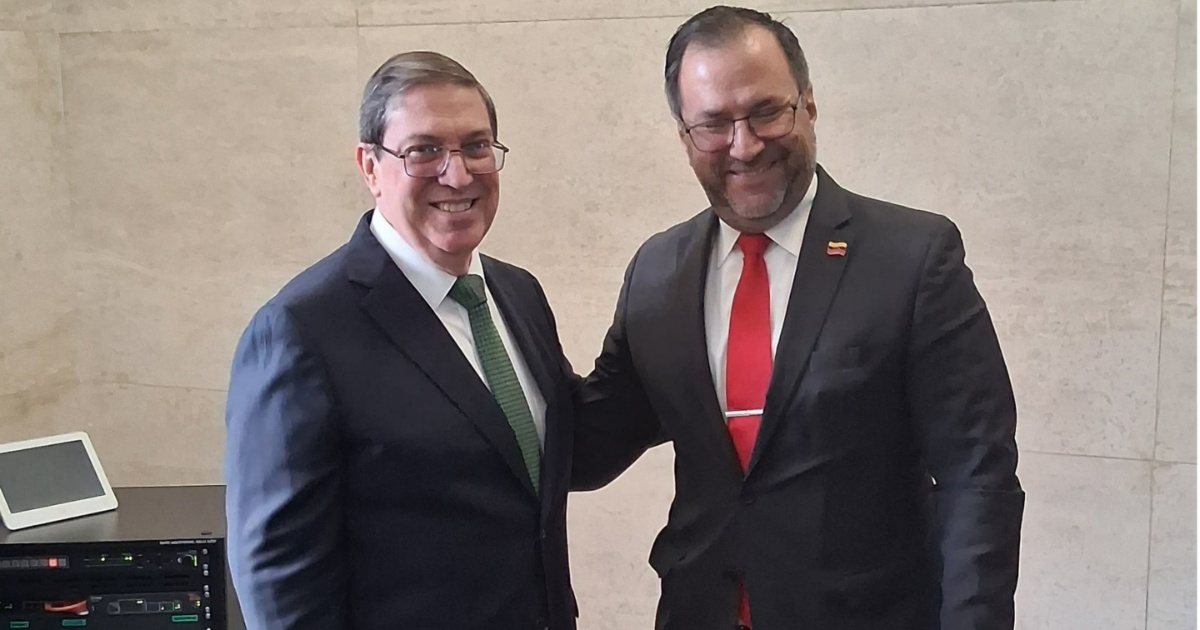
This past Monday, Cuba's Foreign Minister, Bruno Rodríguez Parilla, engaged in talks with his Venezuelan counterpart, Yvan Gil, expressing a desire to further the collaboration between the two nations.
Rodríguez stated on social media, “During the High-Level Segment of the 61st session of the Human Rights Council, I had an exchange with my esteemed friend Yvan Gil, the Foreign Minister of Venezuela. We emphasized the historical solidarity and cooperation that exist between our countries and our commitment to their continuation.”
Despite the rhetoric of continuity, the meeting between the diplomats took place amid a shift in their bilateral relationship.
Over the weekend, Reuters reported on the gradual withdrawal of Cuban advisors and security forces from Venezuela, suggesting a potential dismantling of a military and intelligence apparatus that Havana helped establish in 2008 to safeguard the chavista regime from internal threats and military dissent.
This withdrawal, confirmed by Reuters, takes on greater significance when contrasted with years of Cuban government denials regarding their direct involvement in security and repression activities in the South American nation.
The report indicates that Cuban advisors have been removed from critical positions within the Dirección General de Contrainteligencia Militar (DGCIM), an agency noted for its central role in monitoring, prosecuting, and imprisoning officers suspected of disloyalty.
Additionally, interim President Delcy Rodríguez reportedly replaced Cuban bodyguards with Venezuelan ones, breaking a practice instituted by Hugo Chávez and upheld by Nicolás Maduro, who relied on elite forces sent from Havana for personal security.
The immediate catalyst was the U.S. military operation on January 3, which resulted in Maduro's capture and the deaths of 32 Cuban operatives. Havana acknowledged these casualties, labeling them “internationalist heroes,” a stark contrast to their long-standing denials of Cuban military presence in Venezuela.
On Monday, Rodríguez addressed the UN Human Rights Council, condemning what he described as a global “dictatorship” wielded by Washington and accused the United States of enforcing an international order based on “plunder as an exceptional and supreme right.”
Impact of Cuban Military Withdrawal from Venezuela
What is the significance of Cuban advisors being removed from Venezuela?
The removal of Cuban advisors indicates a potential dismantling of a military and intelligence framework established by Cuba to support the chavista regime. This marks a significant shift given the historical denials of Cuban involvement in Venezuelan security matters.
How did the U.S. military operation on January 3 affect Cuban-Venezuelan relations?
The operation, which led to Maduro's capture and the deaths of 32 Cuban operatives, acted as a catalyst for the Cuban withdrawal. It highlighted the vulnerability of the Cuban presence in Venezuela and prompted a reevaluation of their involvement.