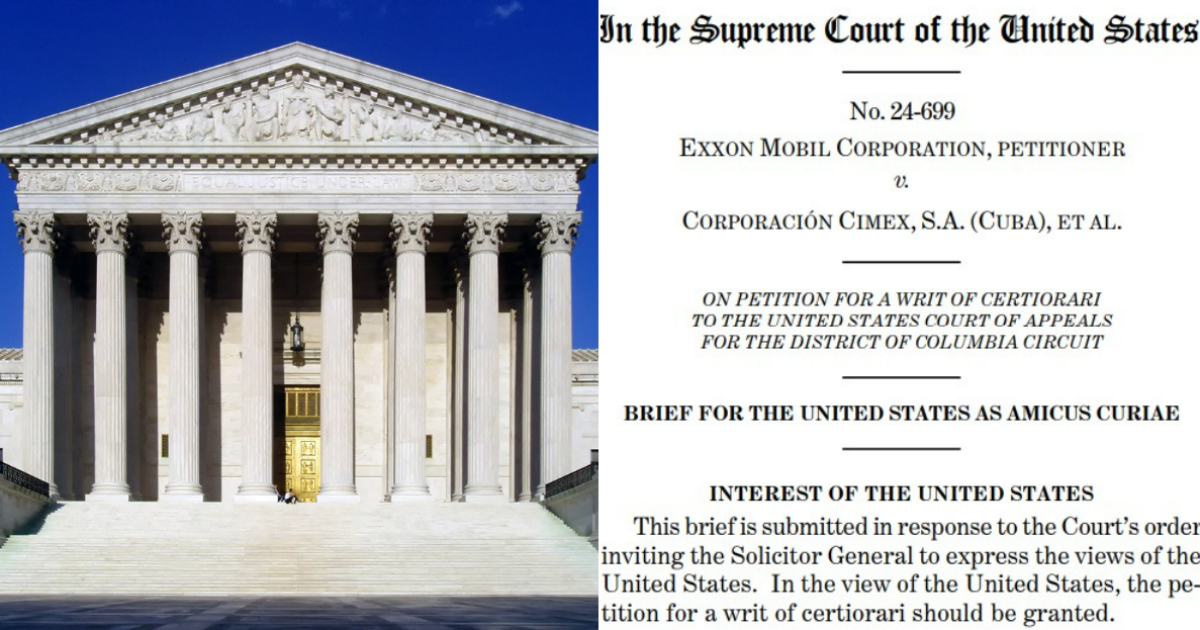
This Monday, the U.S. Supreme Court is hearing a case concerning the reach of Title III of the Helms-Burton Act, which is more than just another legal skirmish over properties seized following the so-called Cuban Revolution.
It's a clear indication of how former President Donald Trump's administration sought to align the judiciary with its foreign policy strategy toward Havana. The two cases under review involve Exxon Mobil's lawsuit against Cuban state companies and Havana Docks' case against several cruise lines, both of which have received robust support from the federal government.
In both instances, the Executive Branch submitted amicus curiae briefs—documents that allow third parties to intervene as a "friend of the court" to offer arguments without being a direct party to the litigation. These briefs emphasized not only technical matters but also highlighted that the interpretation of Title III has direct implications for the strategic interests of the United States.
Title III as a Mechanism for Accountability
The message from the White House is unambiguous: the decisions made by the Court can either bolster or undermine a crucial economic pressure tool against the Cuban regime. In its arguments before the Supreme Court, the government stressed that the U.S. has "significant foreign policy interests" in ensuring that American citizens, whose properties were confiscated by Fidel Castro's regime, receive compensation and in preventing the Cuban state from continuing to profit from those expropriations.
Enacted in 1996, the Helms-Burton Act's Title III was specifically designed to enable lawsuits against those who "traffic" in confiscated properties. However, its application was suspended by successive administrations for over two decades. It wasn't until 2019 that this suspension was allowed to lapse, paving the way for the first lawsuits.
Today, the administration not only upholds this decision but also advocates for a broad interpretation of the law before the Supreme Court. In Exxon’s case, the key issue is whether Cuban state companies like CIMEX can invoke foreign sovereign immunity to block lawsuits. The government argues that Congress crafted Title III to expressly permit actions against "agencies or instrumentalities of a foreign state," and adding further barriers would undermine that legislative authorization.
Ensuring the Law Remains Effective
In the Havana Docks case, the contention revolves around whether a port concession confiscated in 1960, which would have expired in 2004, can serve as a basis for claims about the port's use between 2016 and 2019. The Executive Branch rejects the appellate court's interpretation, which requires analyzing the situation as if the expropriation never happened. The law, they argue, protects not the hypothetical continuation of the original right but the "claim"—the certified demand that emerges after the confiscation.
In both cases, the administration warns that restrictive readings would neutralize a tool created specifically for the Cuban context. One of the most forceful points in the official briefs is the argument that imposing additional conditions—whether through the general regime of sovereign immunity or counterfactual interpretations of temporary rights—would ultimately block most claims.
In Exxon’s litigation, the Executive Branch contends that requiring plaintiffs to overcome the traditional exceptions of the Foreign Sovereign Immunities Act is akin to overlaying a general framework on a specific law crafted by Congress to address confiscations in Cuba. If Title III authorizes suing Cuban state entities, imposing further requirements would make that authorization nearly inoperative.
Justice and Foreign Policy
Beyond the technicalities, the government’s briefs make it clear that these lawsuits are part of a broader strategy. The State Department has publicly underscored that the U.S. has foreign policy interests in promoting democracy in Cuba by holding the regime accountable for illicit confiscations and supporting compensation for American victims of the Castro-era expropriations.
The link between legal action and democratic transition is not implied; it is explicit. The Executive argues that allowing these lawsuits helps deprive the regime of income derived from the exploitation of confiscated assets and strengthens economic pressure to encourage political reforms. Moreover, the President retains the power to suspend the lawsuits if deemed necessary for national interests, reinforcing the idea that Title III is not an isolated judicial instrument but a tool integrated into the architecture of foreign policy.
The fact that the Trump administration chose not to suspend its application and actively defended an expansive interpretation before the Supreme Court indicates a strategic moment. A decision from the Court could have structural implications beyond the specific cases.
A favorable ruling for the government’s position could clear significant obstacles for thousands of certified claims, whose cumulative value amounts to billions of dollars. It would also send a clear message to international businesses and private actors: engaging with confiscated properties in Cuba could result in liability in U.S. courts, even years after the transactions.
Ultimately, the Trump administration is not merely defending two lawsuits. It aims to solidify a legal interpretation that makes Title III a fully operational tool for economic pressure and accountability. The Supreme Court will decide in the coming months whether it shares this vision. However, it is already evident that, for Washington, the dispute over confiscated properties is not merely a relic of the past. It is an active component of the strategy through which the United States seeks to shape Cuba's political and economic future.
Implications of the Supreme Court's Decision on Cuba
What is the significance of Title III in the Helms-Burton Act?
Title III of the Helms-Burton Act is significant because it allows U.S. nationals to sue foreign firms trafficking in properties confiscated by the Cuban government after the Cuban Revolution. It serves as a tool for economic pressure and seeks to hold the Cuban regime accountable for past expropriations.
How could the Supreme Court's decision impact U.S.-Cuba relations?
A Supreme Court decision aligning with the U.S. government's interpretation could reinforce economic pressure on Cuba by enabling more lawsuits related to confiscated properties. This could strain U.S.-Cuba relations by discouraging international businesses from engaging with Cuban assets, thereby impacting the Cuban economy.
Why is the Trump administration supporting the lawsuits against Cuban entities?
The Trump administration supports the lawsuits as part of a broader strategy to apply economic pressure on the Cuban regime. By backing these legal actions, the administration aims to hold Cuba accountable for past confiscations and promote political reforms by cutting off revenue from exploited assets.