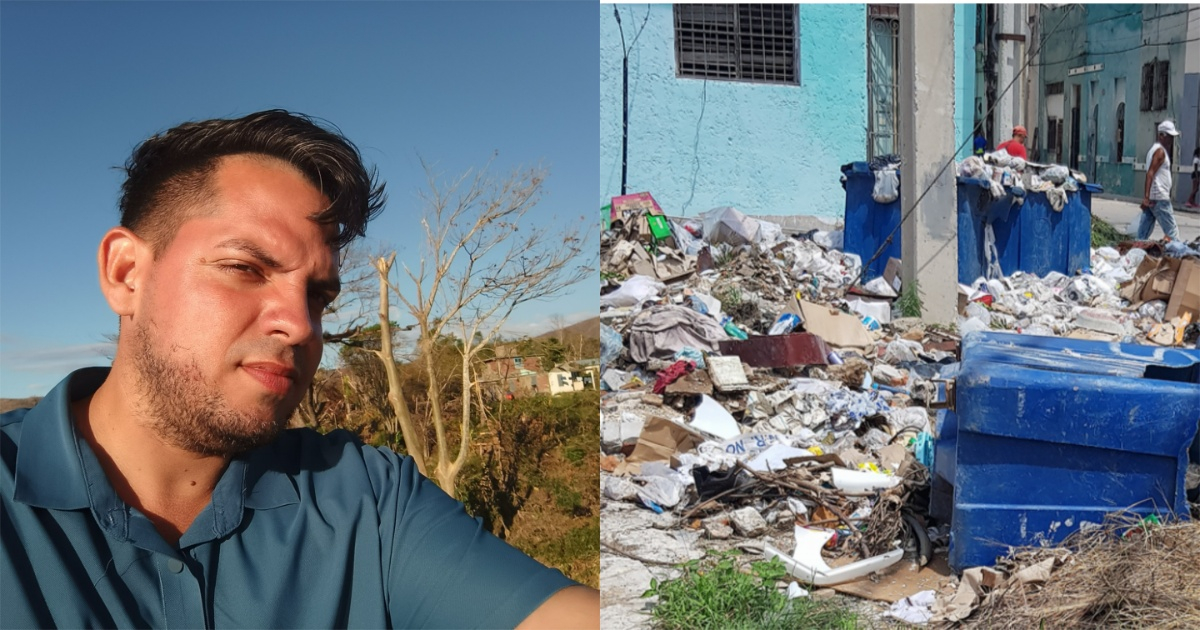
Lázaro Manuel Alonso, a journalist known for his alignment with the official narrative, has openly criticized the waste management situation in Havana. He advocated for "a new strategy to prevent waste from piling up like mountains at street corners."
Alonso's comments came in response to a post by the state-owned monopoly ETECSA, which blamed the public for trash fires near their technological equipment. While acknowledging the incident as "regrettable and irresponsible," Alonso pointed out that the issue is much deeper.
"It necessitates a new approach so that garbage does not accumulate uncollected at corners like mountains. If it was already inadequate before, imagine now, in the context of a fuel shortage," he stated.
The journalist argues that "other methods of managing collection and final disposal need to be considered. It's the responsibility of decision-makers to create this 'alternative way' in collaboration with communities."
"Public services haven't managed daily collections in the past due to limited resources and personnel, and now the situation is exacerbated by the lack of oil. There are local projects that have successfully transformed their environments. Authorities must encourage these initiatives to multiply for the people's well-being and the cleanliness of our neighborhoods," he added.
Waste Crisis in Havana
The escalating waste accumulation in Havana has attracted international media attention, following a report by Reuters on the sanitary crisis plaguing the Cuban capital.
Heaps of trash are piling up at street corners and along avenues, emanating strong odors of decay, swarming with flies, and increasingly attracting rats.
Cited statistics reveal that only 44 out of 106 garbage trucks in the city are operational due to the fuel shortage, significantly slowing down the service.
"It's been over 10 days since a garbage truck came by," a Havana resident commented, highlighting the public's growing frustration.
The Cuban regime attributes the waste crisis to the tightening of U.S. sanctions and a decrease in oil supply — following the suspension of shipments from Venezuela and Mexico — but the reality is that the solid waste issue in Cuba is not a new phenomenon.
For at least two decades, structural inefficiencies, lack of investment in infrastructure, and an outdated vehicle fleet have prevented a sustainable solution to this problem.
The accumulation of waste directly impacts the quality of life for Cubans, deteriorates the urban landscape, and worsens unsanitary conditions in densely populated neighborhoods.
Experts have long warned that the proliferation of vectors such as mosquitoes and rodents increases the risk of contagious diseases, including dengue and leptospirosis.
While the United Nations expresses concern over the island's humanitarian situation, thousands of Cubans continue to navigate through mounds of waste in their daily lives, exposing the deeply rooted structural deficiencies that the country has struggled with for years.
Understanding Cuba's Waste Management Dilemma
What is causing the waste management crisis in Havana?
The crisis is attributed to structural inefficiencies, outdated infrastructure, and a significant shortage of fuel, exacerbated by U.S. sanctions and reduced oil shipments from Venezuela and Mexico.
How does waste accumulation affect daily life in Havana?
The accumulation of waste deteriorates the urban environment, worsens sanitary conditions, and poses health risks due to the proliferation of disease-carrying vectors like mosquitoes and rodents.