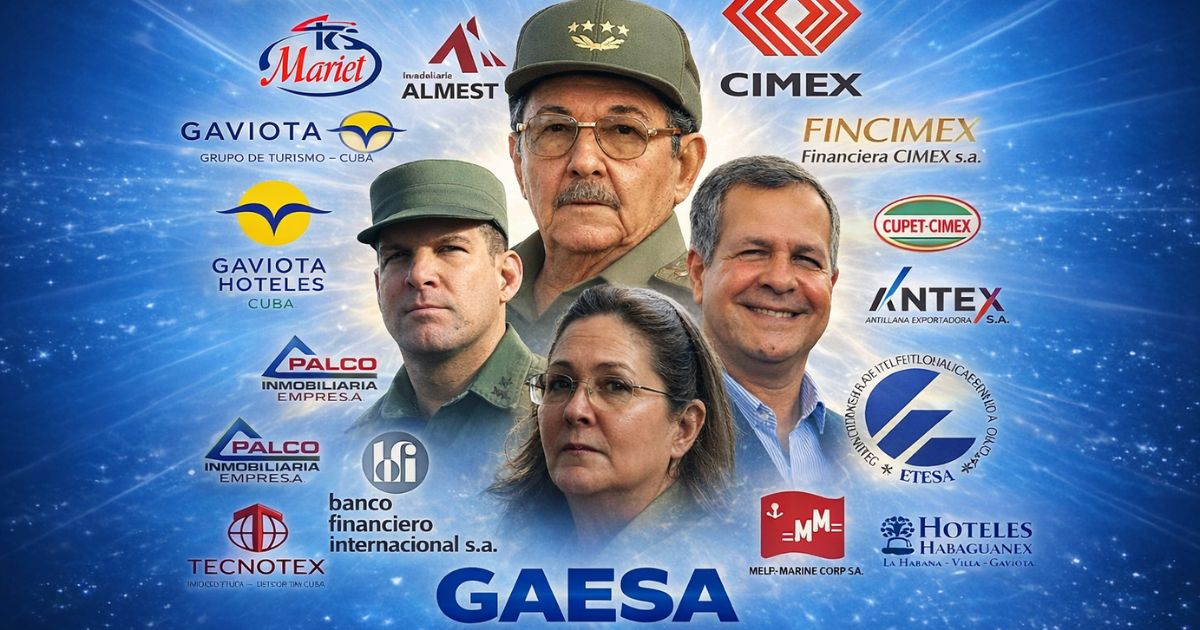
Every Cuban should ponder a crucial question: In a country that claims socialism, where production means supposedly belong to the people, how did a military-run enterprise come to dominate 40% of the national economy, amass $14.5 billion in bank deposits, operate without publishing financial statements, evade foreign currency taxes, and avoid accountability to the National Assembly?
This enterprise is known as GAESA (Grupo de Administración Empresarial S.A.). The last two letters, S.A., signify "Sociedad Anónima," a legal form used by major corporations worldwide, from Coca-Cola to Samsung, crafted to grant a company its own legal identity, distinct from its proprietors. In a "socialist" state, such a capitalist business structure enabling complete secrecy about ownership, profits, and fund allocation is a blatant ideological contradiction. Despite its proclaimed socialist roots, the Cuban military established the country's largest economic conglomerate—spanning tourism, banking, commerce, ports, telecommunications, and fuel—under a capitalist corporate guise that shields it from public scrutiny. Cubans have no stake in it nor do they reap any dividends, essentially serving as workers exploited by a private corporation that channels its profits to a military elite.
GAESA was the brainchild of Raúl Castro, helmed for 26 years by his son-in-law, and is currently overseen by his grandson. Born during the 1990s' Special Period following the Soviet Union's collapse, which slashed Cuba's subsidies by up to $6 billion annually, it emerged as a self-sustaining financial arm for the Cuban military. By the late '90s, GAESA's enterprises were covering 80% of the Cuban Revolutionary Armed Forces' operational budget, effectively turning the state into a dependent of its military.
The pivotal figure in GAESA's rise was General Luis Alberto Rodríguez López-Calleja, Raúl Castro's son-in-law, who led the conglomerate from around 1996 until his death in 2022. Under his tenure, GAESA expanded from a modest currency operation to a behemoth consuming whole sectors of the economy, including tourism, retail, banking, port logistics, telecommunications, construction, imports/exports, and remittances. By 2025, leaked GAESA documents revealed its control over 95% of the nation's foreign currency transactions, with revenues exceeding state budget income by 3.2 times, while Cuba's international reserves were held not by the Central Bank, but by GAESA.
As the 2026 crisis unfolded, GAESA's empire began to crumble, although its legal structure and offshore accounts remained unscathed. The conglomerate's overwhelming influence has been likened to giants like Ecopetrol, Petrobras, or PDVSA, but on a scale unprecedented in a single nation's economy.
How GAESA Came to Be
GAESA's origins trace back to the hardships of the 1990s, when Cuba faced severe shortages of money, oil, and food. Raúl Castro, then Minister of the Armed Forces, tasked General Julio Casas Regueiro with creating a business group to generate foreign currency for the military. What began as a military resort initiative soon evolved into a commercial enterprise, setting the stage for GAESA's broader economic reach.
Taking the reins in 1996, López-Calleja transformed GAESA into a vast economic conglomerate, swallowing key sectors across the economy. By 2015, Bloomberg identified him as the leader of Cuba's largest business empire, which included at least 57 companies.
The Expansive Reach of GAESA
Until the 2026 crisis, GAESA's corporate map mirrored Cuba's economy. Operating under the exclusive oversight of a secretive military unit, GAESA maintained its own parallel tax office, exempting it from the national tax system. Key assets included Gaviota S.A., with its extensive holdings in hotels and tourism, and CIMEX, the largest commercial corporation in Cuba. GAESA's control extended to the financial sector through its acquisition of the Banco Financiero Internacional and its reach into telecommunications, logistics, and retail.
Despite its capitalist structure, GAESA's operations remained deeply entrenched in Cuba's socialist narrative, exploiting workers with meager wages while channeling substantial profits to its military overseers. Its international dealings, particularly in Panama, allowed it to evade international scrutiny and sanctions, highlighting the complex web of influence and power that has sustained the regime's economic grip.
The Family Dynasty Behind GAESA
GAESA is more than a military conglomerate; it is a dynastic tool crafted by Raúl Castro to ensure his family's hold over Cuba's wealth, irrespective of who holds the presidency. Following López-Calleja's death, Ania Guillermina Lastres Morera assumed the executive presidency, though the real guardian of the family's interests is Raúl Castro's grandson, Raúl Guillermo Rodríguez Castro, known as "El Cangrejo."
The elimination of the age limit for presidential candidacy hints at potential generational shifts within Cuba's elite, possibly paving the way for Castro family members to maintain their grip on power.
The International Web and GAESA's Future
Despite international sanctions aimed at curbing GAESA's influence, the conglomerate has maintained strong alliances with foreign business partners, navigating global markets with strategic acumen. However, as Cuba faces economic collapse and geopolitical shifts, the long-term viability of GAESA's model remains in question.
As the regime negotiates potential transitions with international actors, including secret talks with the U.S., the fate of GAESA and its entrenched military influence remains a critical factor in Cuba's future. The question is whether a post-GAESA landscape will genuinely differ from the past, or merely rebrand the same power structures under a new guise.
Understanding GAESA's Impact on Cuba's Economy
How does GAESA's control impact Cuba's economy?
GAESA's control over key sectors, including tourism, banking, and retail, centralizes economic power within the military, limiting transparency and public accountability, and directing profits to a small elite rather than the broader population.
What role did GAESA play in Cuba's economic challenges?
GAESA's prioritization of military and tourism investments over essential services like health and education contributed to economic imbalances, exacerbating the hardships faced by the Cuban population.
Who are GAESA's international partners?
International partners include hotel chains like Meliá and Iberostar, as well as companies like Sherritt International, which have collaborated with GAESA to operate in Cuba despite the regime's controversial practices.