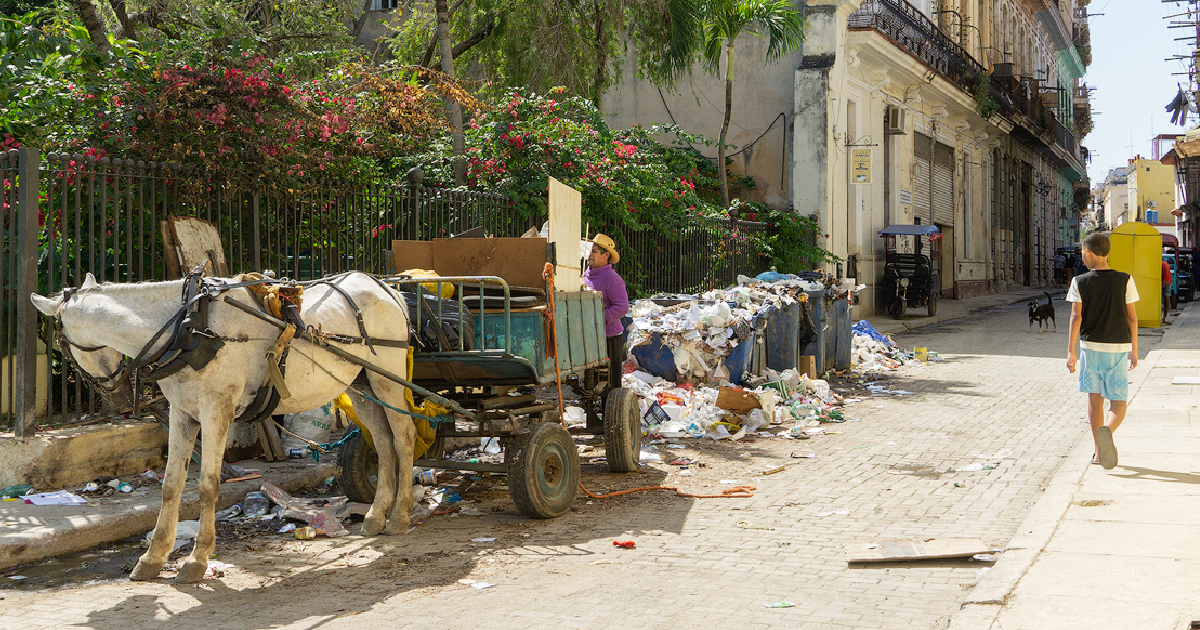
Images circulating on social media depict Cuban cities turning into garbage dumps, with some of these unsightly scenes occurring right outside luxury hotels. This situation has become a hallmark of the "zero option" scenario that has unfolded since Cuba's communist regime began experiencing a decline in Venezuelan oil supplies. Havana exemplifies this chaos.
Faced with a devastating landscape that threatens public health with diseases and respiratory issues from perpetual trash burning and decay, communist leaders have decided to tackle the challenging issue of solid waste collection in the capital. According to an article in Granma, this task "demands more organization and discipline." In reality, it requires much more than that.
As usual, communist officials spend more time discussing problems than solving them. Regarding the garbage crisis in Havana, they've "identified 122 transfer or temporary storage points for urban solid waste, currently being certified by relevant authorities." Based on this identification, "alternatives are being sought to improve the sanitary and environmental conditions of Havana." Yet, despite these lengthy statements, trash continues to pile up on the streets, with no one to collect it, leaving residents frustrated and at a loss.
Once these 122 transfer points are "achieved," which are still undergoing certification (raising doubts about their eventual approval), they aim to increase "storage capacity and collection with alternative transportation before being moved to final disposal," according to Reynol García Moreira, Havana's vice governor.
The question remains: haven't they had 67 years to accomplish this vital task of identifying essential waste management points in a major city? Apparently not. For the communist leadership, the concept of "transfer points" is so novel that it warranted an official visit from specialists across various ministries, including Science, Technology and Environment, Public Health, Energy and Mines, Interior, the National Institute of Territorial and Urban Planning, and the National Institute of Hydraulic Resources, along with political and governmental authorities from municipalities and popular councils to discuss the proposal in detail. Yet, the trash remains uncollected.
A member of the communist entourage told Granma, "what is primarily needed is the cooperation and participation of the population." So, what do they ask of the public? You guessed it: "animal traction equipment, routes, and maps of where garbage should be collected," focusing resources in East Havana or Boyeros. However, officials agree that the biggest challenge lies in Centro Habana, Habana Vieja, Plaza de la Revolución, Playa, and Diez de Octubre, areas with high population density and waste volume.
When it comes to assigning blame for the garbage pile-up, Marrero knows who to point fingers at. He claims the trash isn't collected due to "the tightening of the complete blockade on fuel supplies to our country, increasingly affecting vital sectors for the population." He adds, "life has led us to think and do things differently, seek alternatives, and establish additional commitments, even aware of the objective problems, as was called for in the 11th Plenary of the Central Committee of the Party." The question remains: why wasn't this addressed sooner? Essential issues like waste collection have been neglected by leaders who now wish to "move forward or generalize, in an exceptional situation like this," despite numerous challenges.
Unable to implement effective measures, they revert to their usual rhetoric: "progress cannot be made without discipline, order, control, and without conveying to the people the complexity of the moment and the need to join forces." Yet, the garbage remains uncollected.
"Let's move forward," say the leaders, but how? The answer lies in "integrated community work," echoing the regime's failed orthodoxy of weekend community service. An idea by Esteban Lazo, who is ever ready to uphold the regime's failed orthodoxy to "bring proposals to life and see them realized." Additionally, some delegates to the Municipal Assemblies of People's Power are released from their work duties "to ensure more permanent and effective contact with their constituents and systematically address community concerns." It seems they aim to turn some delegates into garbage collectors.
Another solution is to turn ministerial bureaucrats into garbage collectors. Communist leaders acknowledge that ministries lack fuel to assist with collection but have "officials who can go to municipalities to help, control, promote, and explain," while also recognizing that "delegates alone won't solve the problem without serious work from the Administration Council and functioning mass organizations."
Clearly, the Cuban communist regime is burdened by excessive bureaucracy, necessitating adjustments to function properly. The solution isn't about finding scapegoats but addressing systemic issues. These communist slogans have long lost their effectiveness for Cubans. A different approach is needed, and time is running out. The true culprits occupy higher echelons of power and seem unwilling to take responsibility.
In the same Granma-cited meeting, administration councils identified 52 locations as intermediate points and set up 83 additional points in facilities of the Recycling Business Group, designated for non-state management. One objective was to promote the reorganization of raw material collection points in municipalities to allow greater storage capacity.
Private sector involvement in garbage collection and its role in developing a circular economy, a highly profitable activity in most countries, appears underdeveloped in the communist economy, with little intention from leaders to promote it.
The focus seems to be elsewhere, as authorities prioritize reorganizing electric tricycles. Rosa María Reyes Santiesteban, general director of the Havana Raw Materials Recovery Company, stated, "72 electric cargo tricycles were reorganized, 30 of which are in central municipalities to ensure recyclable waste collection on main streets, and four electric towing tricycles were allocated for commercial fairs in La Güinera, La Cuevita, 100, and Boyeros."
Additionally, "38 electric tricycles and 18 combustion ones were allocated for non-state management collection and other municipal streets, resulting in a 39-ton increase in recovered raw materials last week."
Liván Izquierdo Alonso, first secretary of the Provincial Party Committee in Havana, described the situation as "very complex," noting that "some issues are being addressed at the provincial level and with municipalities, seeking more efficient equipment based on transport capacity."
They aim to mitigate waste accumulation by informing the public that collections will occur twice a week. This decision implies that the actual landfill will shift to overcrowded homes. The situation continues to deteriorate.
The lack of fuel prevents municipalities from receiving ministry support "for urban solid waste collection, making each local workplace more disciplined in waste disposal, as well as non-state management forms." The communist-created mess is incredibly complicated. Ministries providing garbage collection services, workplaces needing discipline with all types of waste, similar demands on families and non-state management forms. We fear the worst is yet to come, with even worse scenes unfolding and trash remaining on Havana's streets.
In this sea of confusion and indecision, Vice Prime Minister Inés María Chapman Waugh appears, stating that "local authorities must have new work systems, and all state and non-state economic actors need to be involved because when people are called upon, they act differently. But this must be done at the municipal level, with an important link among all actors to combat the garbage issue."
A significant point was raised regarding ordinances for cleanliness and waste collection, "which are not designed in municipalities at this time. Ordinances, where they exist, specify when, where, and how waste should be placed, guiding people." It's incredible these ordinances don't exist or haven't been developed. The neglect is staggering.
So, what do the communists propose? Don't get your hopes up—more of the same old rhetoric, wasting time. "Deepening the analysis of municipal experiences," "strengthening territorial ordinances to ensure compliance," "closing ranks and being in the streets, mobilizing people, thinking about how to do more, and how to advance on these accumulating issues." They acknowledge the difficulty but stress that no proposal "can be plagued by bureaucracy" because "actions must be swift and involve the population."
The garbage will continue to accumulate on Havana's streets.
Addressing the Garbage Crisis in Havana
Why is garbage piling up in Havana?
The accumulation of garbage in Havana is primarily due to ineffective waste management strategies, a lack of organization, and insufficient resources such as fuel and transportation. The communist regime's focus on bureaucratic processes rather than practical solutions has exacerbated the situation.
What are the proposed solutions for Havana's waste management issues?
Proposed solutions include identifying transfer points for waste storage, involving the community in waste collection efforts, and reorganizing existing resources such as electric tricycles for transportation. However, these measures have yet to prove effective in reducing the garbage issue.
How has the Cuban government responded to the waste crisis?
The government has called for more community involvement and attempted to organize bureaucratic responses. However, these efforts have been criticized for lacking urgency and effectiveness, with many residents feeling that the government is out of touch with the immediate needs of the city.