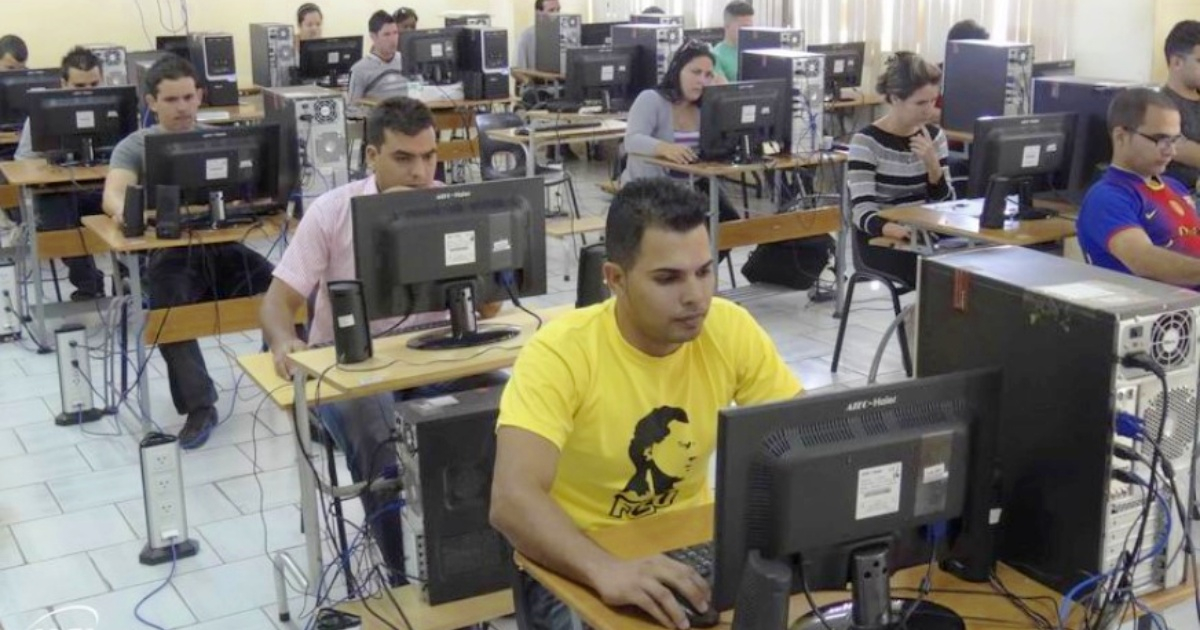
The Electronic Governance Academy (eGA) of Estonia has decided to suspend the delivery of technology equipment intended for the "Cuba Digital" project. This initiative, backed by the European Union, aims to modernize Cuba's public administration.
This action represents a significant halt to one of the most contentious cooperation programs directed towards the island in recent months.
The decision, made in conjunction with the EU delegation in Havana, follows prolonged political debates in Estonia regarding the implications of supporting a communist regime accused of severe human rights violations and close ties with Russia.
Anu Wahtra-Hellat, a communications specialist at the Electronic Governance Academy, clarified the institution's stance, explaining the reasoning behind the move.
"While the Electronic Governance Academy will complete the procurement process as required by public procurement laws, these devices will not be delivered to Cuba at this time. We are waiting for more opportune circumstances in Cuba," she stated to a local Estonian media outlet.
Furthermore, she highlighted that Cuba is facing "a very severe crisis in many aspects."
Technological Procurement and Political Dimensions
The procurement, valued at 441,000 euros, was intended for acquiring information and communication technology (ICT) equipment, with three organizations submitting bids.
Hannes Astok, chairman of the eGA board, clarified that the suspension was not a direct consequence of the recent visit by the Estonian Parliament's Foreign Affairs Committee, although it was discussed during the meeting.
Astok emphasized that the decision was reached last week during talks with the EU delegation and project partners, noting that "Estonian parliamentary committees do not dictate the activities of private law organizations," referring to the formal autonomy of the eGA.
During discussions with the Foreign Affairs Committee, the Academy presented a summary of its over 20 years of work creating open information societies in more than 140 countries, particularly focusing on projects in Ukraine, Moldova, and Montenegro. The situation in Cuba was also addressed.
Parliamentary Debate in Estonia
In January, when the 441,000-euro procurement for Cuba became public, it sparked heated exchanges in the Estonian Parliament's Foreign Affairs Committee.
Marko Mihkelson, the committee's chairman, was among the most vocal critics. He argued that aid programs for Cuba should be reevaluated in light of the new international context following Russia's invasion of Ukraine.
Mihkelson warned that "the intended impact of this project would not benefit the Cuban people, but rather the regime," questioning whether digitalizing the state, under current conditions in the island, would genuinely open society or improve citizen access to public services.
He also pointed out Cuba's active support for Moscow, likening the Havana regime to other authoritarian allies of Russia, such as North Korea or Iran.
In a similar vein, Estonia's Foreign Minister, Margus Tsahkna, announced that his country would formally request the European Union to review its policy towards Cuba and increase pressure on its government.
Tsahkna noted that Estonia had already shifted its stance at the United Nations, ceasing support for resolutions calling for the lifting of the U.S. embargo, citing the repression following the July 11, 2021 protests, restrictions on freedom of expression and assembly, and Cuba's growing cooperation with Russia and Belarus, even in defense matters.
"Cuba Digital": Modernization or State Control?
Launched in 2024, the "Cuba Digital" project is rooted in the 2016 Political Dialogue and Cooperation Agreement between the EU Council and the Republic of Cuba, aiming to modernize the island's public administration.
The EU has allocated approximately 3 million euros to the initiative, led by Estonia's eGA, with the stated goal of modernizing public management and facilitating access to online services.
Spain plays a significant role, contributing 2.3 million euros through FIIAPP, which is involved alongside Spanish entities like the Ministry of Digital Transformation and Public Administration, Red.es, and the Secretariat of State for Telecommunications and Digital Infrastructures, in a project scheduled to continue until July 2028.
Proponents of "Cuba Digital" aim to improve data interoperability, enhance public information exchange security, and develop government service portals, with the Cuban portal Cubagob.cu being a precedent, inspired by Estonia's Eesti.ee digital system.
However, the initiative has faced scrutiny from the outset.
ERR cited Freedom House’s "Freedom on the Net 2024" report, which scored Cuba just 20 out of 100 in digital freedom, highlighting barriers to internet access, content censorship, and user rights violations.
Freedom House condemned the Cuban government for "prohibiting political pluralism, censoring independent media, and repressing basic freedoms," casting doubt on whether technological modernization could lead to greater transparency and citizen access, or merely bolster state control mechanisms.
Even eGA's own Executive Director, Hannes Astok, acknowledged significant challenges to the project's implementation, such as frequent power outages, an eight-hour time difference between Estonia and Cuba, and language barriers.
The freezing of equipment supply marks a significant shift in a project that, until recently, was progressing despite criticisms.
While the procurement process will continue formally due to legal obligations, the political message is clear: Estonia does not deem this the right time to deepen technological cooperation with the Cuban state.
This decision comes amid increasing European scrutiny of relations with Havana, particularly due to its alignment with Russia and the erosion of civil liberties on the island.
Estonia has chosen to freeze the project and, in its own words, await "better times in Cuba."
Estonia's Political Stance on Cuban Relations
Why did Estonia suspend the "Cuba Digital" project?
Estonia suspended the project due to political concerns about supporting a communist regime accused of human rights violations and close ties with Russia.
What were the objectives of the "Cuba Digital" project?
The project aimed to modernize Cuba's public administration, improve data interoperability, enhance security in public information exchange, and develop government service portals.
How did Freedom House rate Cuba's digital freedom?
Freedom House rated Cuba's digital freedom at just 20 out of 100, citing barriers to internet access, content censorship, and violations of user rights.