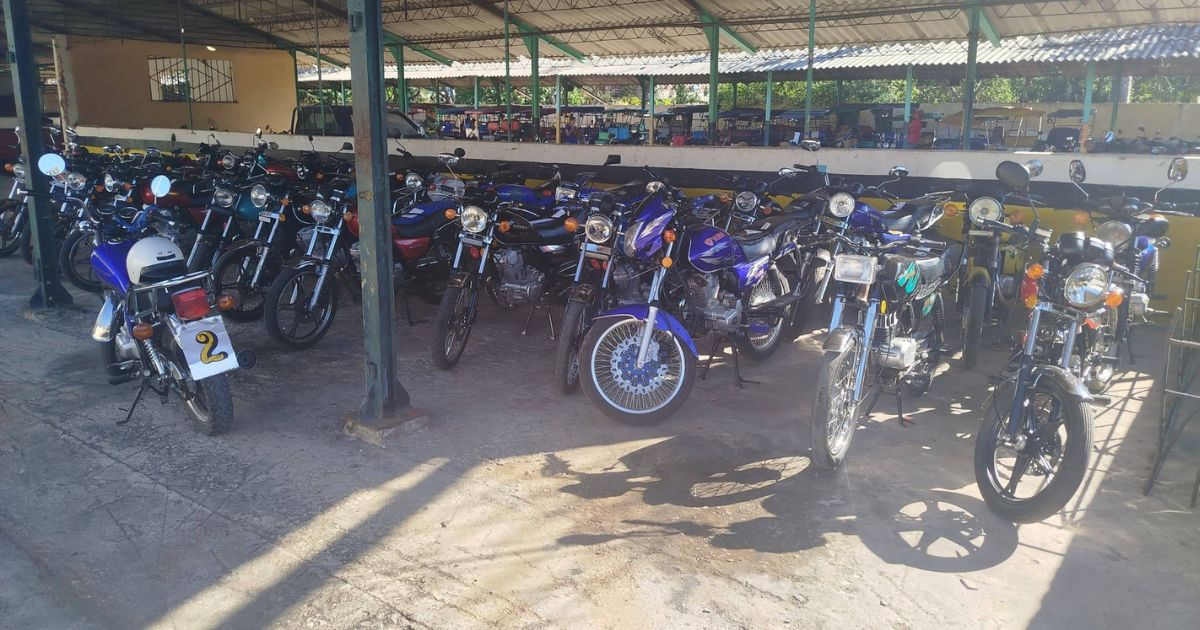
A total of 181 vehicles, including motorcycles, electric tricycles, and motorized tricycles, have been seized in Santiago de Cuba by the Provincial Vehicle Impound Center due to alleged violations of Traffic Safety Law 109.
The state-run broadcaster CMKC reported that these seizures are primarily due to improper parking, driving without a license, poor technical conditions, and modifications to exhaust pipes with resonators.
The report emphasized that "motorcycles, electric tricycles, and motorized tricycles" are among the vehicles held at the "Provincial Vehicle Impound Center" in Santiago de Cuba, a location notorious for alleged theft of vehicle parts.
According to the official source, these vehicles have been detained for breaching the provisions of Traffic Safety Law 109.
The announcement sparked a wave of reactions on social media. Adri Diva questioned the timing of the rigorous enforcement of the law: “Seriously, with the current situation? Now, when transportation is so bad, they decide to be this strict and seize the few means that people have to get around? This is madness.”
Wik pointed out that amid the ongoing fuel crisis, enforcing specific requirements only worsens the situation.
“They’ve chosen the worst possible time for this law,” he wrote, also referring to the supposed demand for gasoline purchase receipts.
Raul Oscar summarized his dissatisfaction with a phrase: “Seizure, prohibition, fine, confiscation, these are the government's favorite actions and words.”
Vita Jiménez González viewed the measure as “an arbitrary action” and questioned why alternative means are immobilized when state transportation is insufficient.
Similarly, Maria Maribel Agramonte questioned whether the decision isn't akin to “an invitation to protests.”
Other users highlighted additional alleged demands. Machiparis Anton Hernandez claimed agents are requesting the “invoice chip for gasoline purchased in dollars” and warned that failure to present it might result in the confiscation of the motorcycle.
On the other hand, Fernando Londres Domínguez acknowledged that “the law must be obeyed,” but argued that immobilizing transport means “during these times of crisis is not advisable.”
The reactions underscore the discontent in a city where power outages, fuel shortages, and reduced state transportation routes have made motorcycles and tricycles essential for daily mobility.
In this context, the strict enforcement of traffic regulations has sparked a new debate about priorities and proportionality.
Meanwhile, in contrast, authorities in Holguín have announced plans to issue temporary special permits for electric tricycles and motorcycles, aiming to support the transport of goods and passengers amid the exceptional situation facing the province and the country.
This measure was announced by René Rodríguez Morales, the Transportation Minister's delegate in Holguín, who explained on Facebook that an official survey and registration of authorized vehicles will be conducted, including collecting data of the owner, registration or invoice, driving license, and current technical inspection.
Understanding the Seizure of Vehicles in Santiago de Cuba
Why were 181 vehicles seized in Santiago de Cuba?
The vehicles were seized due to alleged violations of Traffic Safety Law 109, which include improper parking, driving without a license, poor technical conditions, and modifications to exhaust pipes.
What is the public reaction to the vehicle seizures?
The public reaction has been largely negative, with many criticizing the timing and strict enforcement of the law during a transport crisis. Social media users have expressed concerns about the impact on mobility and the perceived arbitrariness of the measure.
What measures are being taken in Holguín regarding transportation?
In Holguín, authorities are issuing temporary special permits for electric tricycles and motorcycles to support the transportation of goods and passengers, addressing the exceptional circumstances in the province and the country.