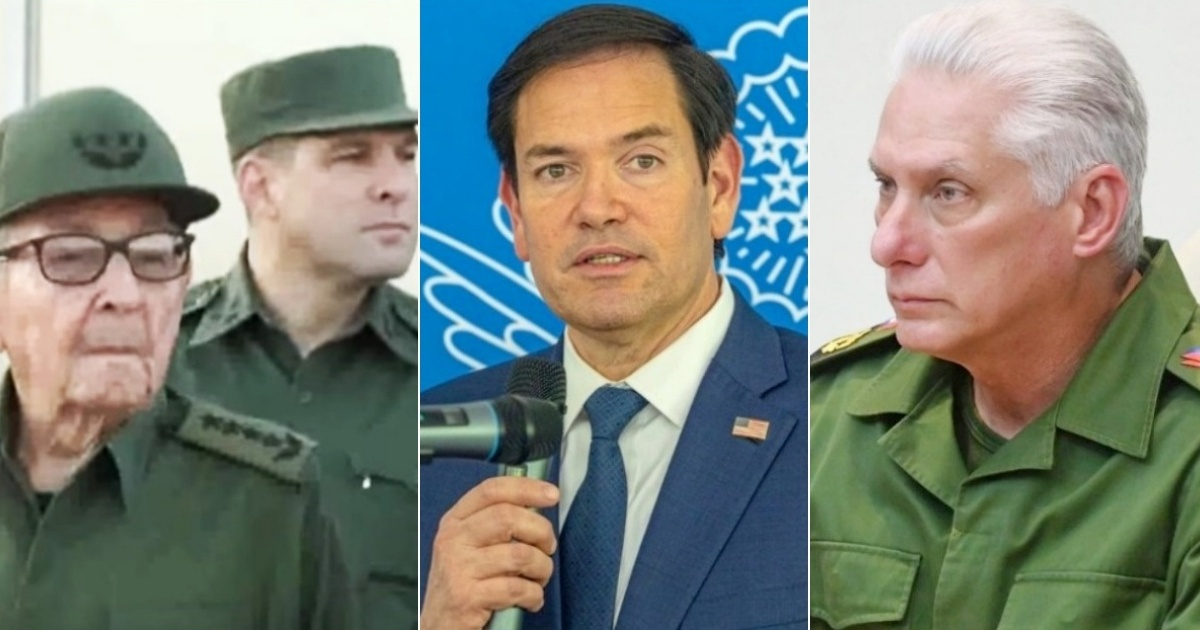
In a revealing report by U.S. news outlet Axios, journalist Marc Caputo uncovers a clandestine series of communications that could indicate cracks in Cuba's leadership and hint at a possible shift in Washington's approach to Havana.
According to three sources cited in the article, U.S. Secretary of State Marco Rubio has been engaged in undisclosed discussions with Raúl Guillermo Rodríguez Castro, the grandson of former Cuban leader Raúl Castro.
Significantly, these interactions bypass the official Cuban government channels and sideline the appointed president, Miguel Díaz-Canel, suggesting that real power might still reside with the 94-year-old former general.
A senior White House official tempered the significance of these encounters, stating, "I wouldn't call them 'negotiations' but rather 'discussions' about the future." The official further clarified, "Our stance – the U.S. government's position – is that the regime must go. But the exact method of doing so is a decision for President Trump, and he hasn't yet made up his mind. Rubio remains in talks with his grandson."
The Generational Link
Raúl Guillermo Rodríguez Castro, aged 41, often referred to as "Raulito" and dubbed "El Cangrejo" within political circles, is characterized by sources as a pivotal figure in the familial circle of the former leader.
Once his grandfather's bodyguard, he is considered the "apple of Raúl's eye" and maintains connections with those heading the military-business conglomerate GAESA, a crucial economic pillar of the system.
Rubio and his team view him as part of a younger Cuban generation with a business-oriented mindset, for whom "revolutionary communism has failed" and who might be open to improved relations with the United States.
One source described the talks as "surprisingly" cordial: "There are no political tirades about the past. It's about the future." The cultural affinity between the interlocutors was also noted: "Raulito could have easily come from Hialeah. This could be a conversation between everyday people on the streets of Miami."
Regime Change or Negotiated Transition?
The situation draws parallels with Venezuela, heightening intrigue. Analysts suggest that Trump might avoid a complete "regime change," recalling the political and strategic costs of a similar effort in Iraq in 2003.
In this scenario, some members of the Castro family—including Raúl himself—might remain in Cuba as part of a potential agreement, a prospect likely to provoke strong opposition among Cuban exiles in Miami.
Just last week, Cuban-American Republican lawmakers urged Trump to prosecute Raúl Castro for the 1996 downing of Brothers to the Rescue planes. The White House has yet to respond.
Meanwhile, Rubio has not reached out to Díaz-Canel or other senior Communist Party officials, whom Washington views as "apparatchiks" without real capacity for significant change, according to another source.
As Rubio reminded during a Senate hearing last month, U.S. law mandates a push for regime change if Cuba does not release political prisoners, allow a free press, and hold elections.
Cuba's Official Response
In response to Axios's inquiries, the Cuban government provided a statement previously sent to a Mexican journalist, denying formal talks with Washington.
"There is no high-level dialogue between the U.S. and Cuban governments. There isn't even mid-level dialogue. There have been exchanges of messages," the statement asserts.
It adds, "Until a year ago, we maintained regular high-level dialogues with the State Department. Today, that no longer exists."
The State Department did not deny Rubio's communications with Raúl Guillermo Rodríguez Castro, but a spokesperson refrained from commenting.
Internal Power Struggles?
Beyond diplomatic speculation, the central issue is political: if Washington is engaging with Raúl Castro's close circle rather than the official government led by Díaz-Canel, it suggests that real authority and potential system fractures lie not within the halls of the Palace of the Revolution, but among the family and military circles controlling economic power.
The looming question is whether these contacts reveal a genuine internal fracture within the Castro regime or merely a pragmatic move to ensure survival amid economic collapse.
What is clear is that, for the first time in decades, dialogue appears to be occurring not between governments, but between actors acknowledging that the current model is at its most vulnerable.
Cuba on the Brink
The report contextualizes these negotiations against a backdrop of rapidly deteriorating conditions in Cuba: a failing power grid, hospitals limiting surgeries, shortages of food and fuel, declining tourism, and mounting garbage in the streets.
The situation reportedly worsened following Trump's January 3 operation to capture and extradite Nicolás Maduro, Havana's main oil supplier.
According to U.S. officials cited by Axios, the military success of that operation—which resulted in the deaths of at least 32 Cuban military and intelligence personnel deployed in Venezuela—shook Cuban leadership.
Simultaneously, Washington's decision to maintain figures from the Chavez regime, especially Delcy Rodríguez as interim president, sent another signal: Trump and Rubio might be willing to negotiate with system insiders, not necessarily dismantle it entirely.
"They're looking for the next Delcy in Cuba," a source familiar with the discussions is quoted as saying.
A Failed State, According to Trump
President Trump himself offered a public hint about the state of these dealings. "Cuba is currently a failed nation and they don't even have fuel for planes to take off," he told reporters aboard Air Force One.
"We're talking with Cuba right now... and they should definitely reach an agreement."
Nonetheless, sources cited by Axios indicate that Cuba is not at the forefront of Trump's immediate priorities, as he focuses more on conflicts like those in Iran and Ukraine. As part of his strategy, the president assigns trusted advisors—like Rubio—to present him with different options before making a decision.
Insights into U.S.-Cuba Relations
What are the implications of Marco Rubio's secret talks with Raúl Guillermo Rodríguez Castro?
These discussions suggest potential internal divisions within Cuba's regime and may indicate a shift in U.S. strategy towards engaging with influential family and military circles instead of the formal government.
How might these talks affect U.S.-Cuba relations?
The talks could lead to a reevaluation of U.S. engagement with Cuba, potentially fostering dialogue with key figures outside the official government structure. However, the outcome depends on the broader strategic decisions of the U.S. administration.
What challenges does Cuba currently face internally?
Cuba is grappling with a severe economic crisis, characterized by power grid failures, medical supply shortages, food and fuel scarcity, and a decline in tourism, all exacerbated by strained diplomatic relations and external pressures.