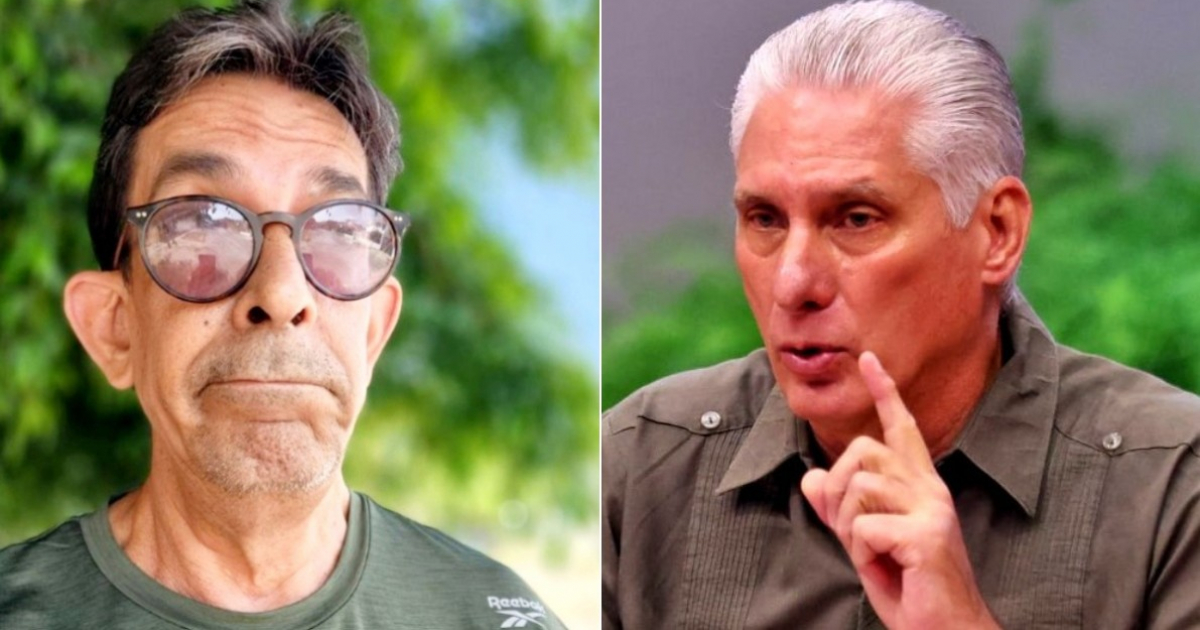
The dire economic and energy crisis in Cuba has found one of its boldest critics in comedian Ulises Toirac, who has taken a stand against what he calls the government's "nothingness"—a deliberate inaction in the face of the country's collapse.
In a Facebook post, Toirac painted a picture of an island brought to a standstill by the severe fuel shortage and exorbitant gasoline prices.
"Rarely do I hear a car pass by. Occasionally. A liter of gas costs around three thousand pesos, and drivers, whose livelihood depends on it, charge a fortune to take you across neighborhoods. And understandably so," he noted.
This vivid depiction is not an exaggeration. Cuba is wrestling with a fuel crisis that has crippled mobility, strained public and private transport, halted services, and worsened power outages.
The Real Cause of the Crisis
Toirac attributes the problem not to external factors, but to the inherent flaws of the Cuban system itself.
While acknowledging that U.S. sanctions exacerbate the situation, he challenges the official narrative that blames all hardships solely on Washington.
"It's not a temporary issue or one suddenly arising because the American government imposes stricter measures. Sure, they tighten the screws, choking off what was already… a trickle of supply we managed to get at a low cost," he elaborated, emphasizing that the root issue is structural.
The comedian highlights the internal productive weakness and the government's failure to implement meaningful solutions as the core of the disaster.
"Decision-making is limited to weathering the storm. It's about surviving day to day. There are no emerging strategies for the medium or long term. It's like watching someone bleed out and doing nothing to stop it," he criticized.
Political Stagnation as a Choice
Toirac argues that this passivity is not accidental but a political choice. "Believe it or not, not taking action is a decision. If you act, it's a deliberate move. If you do nothing, it's not the absence of a decision; it's the decision to do nothing."
He also points out the deteriorating value of the peso, which leads to greater poverty and "more people finding themselves in the desperate situation of not being able to make it through the day."
"Slogans won't solve the problems. People's lives are at stake, and there's a risk of not being able to finish uttering them," he concluded.
Fuel Prices Beyond Reach
In a subsequent message, Toirac delved into the true cost of fuel on the black market. He clarified that he doesn't own a vehicle, citing numbers he heard, but confirmed that prices are even higher than he initially stated.
"Earlier, I mentioned a liter of gasoline being 3,000 pesos. That's what I've heard. Someone even told me that barrier is old news, and it's more expensive now. We're talking about black market prices, of course," he specified.
He added that a 40-liter tank costs about 300 dollars. "That's right, a tank for 300 dollars. Fuel is through the roof."
His explanation highlights the complete distortion of the Cuban economy: "In Cuba, nothing makes sense. Prices reflect the difficulty of obtaining things rather than any stable economic logic… When you buy something, the price includes 'the lost time.'
A Nation at a Standstill
Toirac's portrayal aligns with the reality experienced by millions of Cubans: empty streets, piles of uncollected trash, sporadic transportation, and a pervasive sense of neglect.
"There’s a pervasive absence. The streets are deserted, adorned with mountains of garbage. Nothing seems to work, day or night," he wrote.
The lack of fuel affects electricity generation, food distribution, and workers' ability to commute. Without sufficient oil, the already fragile economy spirals further into decline.
Production is nearly non-existent, power outages are increasing, and inflation is rising. In this context, the official response has been administrative and reactive, lacking the structural changes needed to reduce external dependency and internal inefficiency.
Toirac encapsulates the widespread feeling of exhaustion: "It's incredibly hard to make jokes."
For years, humor served as an escape valve, but now, Toirac suggests, reality threatens something far more profound.
His concept of "nothingness" morphs into a direct critique of the government's paralysis in the face of a crisis that is not just about energy, but deeply structural.
Understanding the Cuban Economic Crisis
What is the main cause of Cuba's current economic crisis?
The primary cause of Cuba's economic crisis is attributed to the internal weaknesses of its system, particularly the lack of productive capacity and failure to implement effective measures, rather than external factors alone.
How does the fuel shortage affect everyday life in Cuba?
The fuel shortage has severely limited mobility, disrupted public and private transport, halted services, and worsened power outages, impacting daily life and economic activity across the island.
Why are fuel prices so high in Cuba?
Fuel prices are exorbitant due to scarcity and the distortions in the black market, where prices reflect the difficulty of obtaining fuel rather than any stable economic principles.